
While the fanatical belief that God will always heal us if we have enough faith is a ditch on one side of the straight and narrow path, an extension of this “ditch” is the fanaticism of presumption which is based on the erroneous idea that God will only work through natural means and miracles but not through the care of the physician. Consider the extreme beliefs of Breatharianism. These individuals believe that one of God’s eight doctors, sunshine, can provide them all that is necessary for life.
Read More

The most offended person in the room
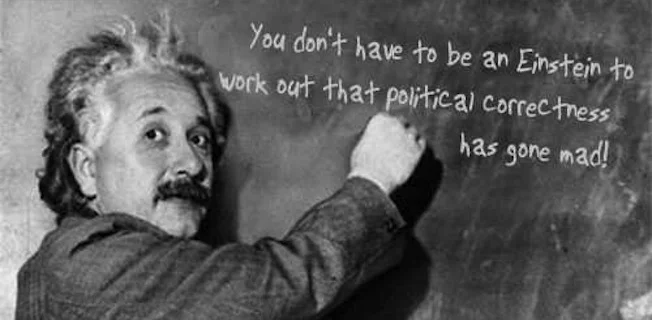
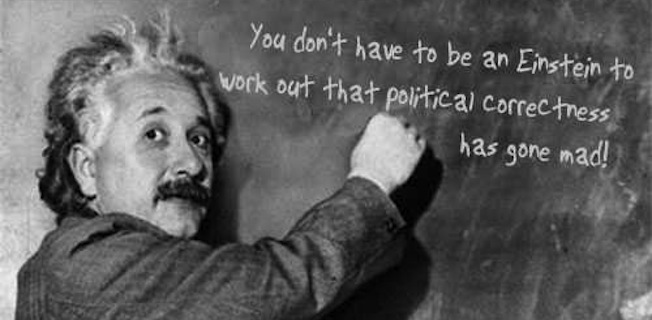 Ok.I detest political correctness.
I love straight talk.
Partly because the Good book says “Let your yea be yea.” Check.
I also like straight talk because I don’t like the bewildered way I feel after listening to political-correct stuff. Double-check.
Ok.I detest political correctness.
I love straight talk.
Partly because the Good book says “Let your yea be yea.” Check.
I also like straight talk because I don’t like the bewildered way I feel after listening to political-correct stuff. Double-check.
Political correctness usually causes one of two responses—I walk away mumbling as I scratch my significantly graying head, or I break into hearty laughter. But lately I‘ve been doing a lot of both, and it’s not easy to walk, mumble, and laugh at the same time.
Let’s face it. We live in a world where spin doctors abound. In this strange world of political correctness, yea doesn't mean yea, no doesn't mean no, and words are twisted into an alphabetic teething ring to pacify the most offended person in the room. Kind of a pedantic pacifier. Here are a couple examples. Cue Paul in Romans 1, “Thinking themselves to be wise they became fool...."
Portland Oregon, September 2012. In her zeal to conquer racism, Verenice Gutierrez (principal of Harvey Scott School in Portland) declared war on a vile offender of racial harmony. Sounds good, I guess. In fact, Verenice was determined to ferret out racism even if it is “sandwiched” between students’ kitchens and the school cafeteria. Her target? Peanut butter and jelly. “Huh!??!!” “HOW CAN PEANUT BUTTER AND JELLY BE Raci……!??!!” Because she says it is…
According to Verenice, PB&J “is a subtle form of racism.” She added that Somali and Hispanic students might not eat such sandwiches so she initiated training exercises among staff members to fight against this “white privilege.” Sorry Skippy, your racially charged sandwich spread is expelled from school until further notice! Had Verenice done some actual research, she might have discovered that peanut butter was partially invented by George Washington Carver. Diagnosis? Absurd political correctness. Conclusion: People like Verenice are not very nice.
Dayton, Ohio, November 23, 2012. JCrane Inc. was lifting new HVAC units onto the roof of Sinclair Community College. Since the college remained open during the project, JCrane took great care to install fencing, barricades, and warning signs to ensure that the public would not be endangered by the heavy-equipment work going on above their heads. All went well until the second morning of the project, when a Sinclair employee called the foreman of the crane company. The foreman was told that they needed to stop all work immediately until the “sexist” sign they had set up on the sidewalk was replaced. The offensive sign in question? “Men working” (I’m not making this up). Initially the foreman thought it was a prank and the workers (seven guys) kept working, chuckling at the sublime joke. They stopped laughing when a college construction department guy showed up in person and demanded that they stop all work immediately! His said his “boss” was having a fit. His boss was Elizabeth Verzi (who works at the college) and she was the most offended person in the room! Maybe in the whole city…
The crane company foreman and the union pipefitter foreman met with the disgruntled feminist (Verzi) to resolve the issue. The meeting didn’t go well, unless you enjoy being yelled at, told you are a sexist, and berated for having a “Men Working” warning sign out by the sidewalk to alert pedestrians. After the “meeting” the two foremen walked away thoughtfully. One said, “I’ve never seen a woman talk like that. She just seemed evil.” The other one said, “We are working with the devil him(her)self here.”
Faced with the prospect of working with this woman for another few months, the pipefitter foreman drove back to his office, turned in his keys and truck and quit. On the spot. A man in his late fifties with over twenty years in the Pipefitters Union, this woman was the end of his career.
Diagnosis Political correctness is a doctrine, fostered by a delusional, illogical minority, and rabidly promoted by an unscrupulous mainstream media and academia, which stubbornly clings to the belief that it is possible to pick up fresh excrement by the clean end.
On the surface, political correctness sounds ludicrous. And it is. In this strange muddled world the homeless are called under-housed and pirates are called seafaring entrepreneurs, the bald are folically–challenged and the fat are horizontally gifted. But at a deeper level, it is an ideology at war with the Biblical principle of honesty. For many, it becomes their religion and "evangelism" is accomplished by force and control (see Great Controversy chapter 35, a wonderfully straightforward book).
We see shameful situations created in our schools and universities in America that have fallen prey to Political Correctness. Some professors, students and publications are being attacked for expressing a point of view that differs from that imposed by a fanatical far left, under the guise of Political Correctness. Furthermore, in schools and workplaces we see that "diversity" has degenerated into reverse discrimination, where often the less qualified are admitted and the incompetent or unethical cannot be fired (see La Sierra for details).
Lamentation I've heard via teachers that some schools are doing away with GT (gifted/talented) classes. This would, of course be so kids in the regular classes don't start crying every day. At that age, most students are either too cool or too lazy to want to be in the egghead classes. And the nerd kids that actually want to learn should be given every opportunity to excel, even if that means segregating them from the students who would rather start fights or put pencils in their noses.
Sports are the same way. When I was a kid, you actually had to try out for sports teams (though you didn't necessarily have to be good, since I made the little league baseball team). Apparently nowadays, to avoid hurting kids' feelings, some sports leagues make the teams take anybody. While this may lead to some awesome videos on the FAIL blog, I don't think it's the best thing for the kids. That goofy kid may actually be good at something, but if we keep telling him he's good at everything when he's not, he'll never figure out what his talents are until it's too late. Then we'll just have one more hobo (er, I mean "Under-housed person") out there walking around with his knapsack full of cornbread. And food-stamps.
Conclusion Political Correctness (PC) originally flowered in academia and spread like a virus through the government and corporate worlds. It has devolved into a tyranny of the most offended person in the room. It now stands at the door of the church and knocks, and will be invited in by a liberal academia who often say “We want a place at the world’s table.” If we go down that road, we will lose the core of our message and mission—a message that is based on hard but essential truth.
As illustrated above, PC complaints now range from the sublime to the ridiculous, and they are stifling the honest assessment and debate of issues in our world. I’ve tried to play nice, but I genuinely don’t care if you’re offended by this article, my men working signs, the Great Controversy, or my Bible. And, please don’t worry about offending me in the comments section.
The falling mantle: from Anabaptist to Advent believer


My mantle was a black, broad-brimmed hat and pants that buttoned
And then a new mantle fell. It was called
"the Advent Movement."
American religious history is filled with churches you’ll never find on 5th Avenue or, for that matter, on main street in Paducah, Kentucky. Hundreds are listed in any comprehensive handbook of denominations. Just for a sampling, you’ll encounter such oddities as the Dunkards and Shakers, the Two-Seed-in-the-Spirit Predestinarian Baptists, Hephzibah Faith Missionary Association, Fire Baptized Holiness Church of God of the Americas, and, if that isn’t enough, the Old German Baptist Brethren.
That was my church, as it had been for seven generations of my family.
It’s not anymore, and that’s the reason for this story.
Most of you’ve probably never heard of an Old German Baptist congregation and surely have not attended one--though recently Perspective Digest printed an Adventist pastor’s report of visiting one in Washington State. Old German Baptists originated in Schwarzenau, Germany, in 1708. A blend of Mennonite, Anabaptist, and Pietism, they moved to American in 1729, where they found freedom to worship God in peace. Today they number only about 5,200, and are generally viewed as either Amish or Mennonites. Think of them as Amish in Chrysler Minivans.
Certainly nothing in my childhood motivated me to leave my church. Boyhood memories overflow with scenes of sincere worship and fellowship. That 80 percent of German Baptist youth remain in the church is testimony to the attraction of the German Brethren way of life. My people have ever valued hard work; thus the skill to start one’s own business is treasured more than an academic degree. So it was with me. I had 25 years of construction experience under my belt when I turned 40 last year. I also had a solid, TV-free education in the ABCs and enough of the rest of the alphabet to know the difference between good and evil.
Elijah’s Mantle
As you might expect of a church with direct ties to the Anabaptist Reformers, membership doesn’t come like royal birth; you make the choice for believer’s baptism when you’re ready, not before. For me, this choice came in 1984, two years after marriage. I was baptized in the chilly spring that flowed through my Uncle Carl’s farm in Covington, Ohio. I witnessed no heavenly phenomenon as I brushed the water from my eyes--just the quiet realization that I was carrying the torch for another generation. My fellow members expected this of me, and I determined to fulfill my twentieth-century Anabaptist role as best I could.
An ancient story stoked my determination. In my mind’s eye I saw Elijah and Elisha cross the Jordan. They stood for a moment, the hand of the elder resting gently on the shoulder of the younger. A request is made, a conditional promise given, and they move on. Then, a celestial chariot swoops down, and Elijah steps on board. Behind he leaves only the emblem of a fulfilled promise. Nothing on earth is so precious to Elijah as that old piece of cloth. . . that old piece of Elijah’s mantle. Twelve years ago the Lord led me back to this story and left me with the conviction that I too had been given a mantle. My mantle was a black broad-brimmed hat and pants that buttoned. (No genuine mantle would have a zipper.) And it came with a question every believer must answer: Did your mantle fall from heaven or from men? Little did I know at that moment the answer I must give....
My Better Half
My wife’s name is Nancy [Nancy Riley]. (She has no middle name, Roland. There were 12-children and they evidently ran out..). She grew up in Scottville, Michigan, with her eleven siblings in a barn converted into a house. Like me, she completed a total of eleven grades of education. Unfortunately she received her diploma through a GED program 2-years ago. Now she’s a lot smarter than me, a little fact that comes up occasionally.
 How did we meet? At church of course. Nancy and I saw each other across crowded rooms from 1977-1980. Instantly we knew. That it was too crowded-I mean. We finally met after church one night in Maple Grove, Ohio (October 25, 1981). I was 21 years old, and Nancy was 18. My older sister was so excited that we were finally meeting, that she stood faithfully by my side and answered every question that Nancy asked me. My sister meant well. As Nancy and I stood outside under the shadow of those beautiful fall-colored maple trees for which the place was named, the trees were almost ugly by comparison.
As a baptized member of the church, Nancy wore a dress made according to pattern. Her modest dresses differed only in pattern and color from that of other German Baptist women. She also wore a lace "prayer covering" --symbolic of the head covering (veil) Paul advocates in his letter to Corinth. She was now living in Ohio with close friends of her family. Unable to erase the memory of her from my mind, I phoned her two nights later. She said yes.
Our first date consisted of attending a baptizing together. I picked her up and we went to church that night, joining 150 other German Baptists to witness the immersion of four young people into the church. I had attended a hundred of these events throughout my childhood, but this was a magic evening. Not yet a member of the church, I was already feeling the clarion call to commit my life to the way of my fathers. I knew that I would walk down into that water someday soon. What was I waiting on? I was waiting until I was completely ready, because I wanted to give the Lord my all. However, I must confess that the young woman at my side consumed most of my attention that evening.
Our second date (courtship) consisted in going to church together again at a communion time for the Stillwater congregation of German Baptists (near Dayton Ohio). People had journeyed a few hundred miles to convene in this annual communion service. Nancy and I were excited to be together again. After seven months of dating (on Mother’s day 1982), I asked Nancy another question. She said yes, and we were married in the fall of 1982-almost a year after we began being sweethearts.
We were united on October 2, 1982 in Brookville, Ohio. It is not the custom of my people to conduct weddings inside their church buildings--thus we were married in a community center owned by my Uncle Glen Miller. Another uncle of mine performed the ceremony--the same one in whose creek I was baptized (Carl Bowman). He did a good job--like always.
 Probably 200 guests were present. Decorations were very modest (maybe a few flowers and some candles). Nancy wore a white dress made in the uniform pattern of the church and I (because I wasn’t yet a member of the church) wore a rented tuxedo. Pretty snazzy stuff.
Normally, a member of the church is not encouraged to marry a non-member, but in this case, people knew that it was just a matter of time before I made my commitment to God. The Lord soon gave us two sons, Dylan and Nathan. They are 16 and 13 as I write this.
By late 1986, I had been a baptized member of the Old German Baptist Brethren church for almost three years. It was a good life; I felt comfortable in the approval of my peers.
In October of 1986 Nan served me our usual breakfast of bacon and eggs. I drank my usual cup of orange juice, carried my breakfast dishes as usual, kissed Nancy on the cheek as usual, and headed out to my business workshop--again, as usual. Little did I know that the Lord was planning something most unusual for me. He was about to deliver a mantle, a mantle that constituted a potentially life-changing question--Had it come from God or from man?
Nights of the Burning Heart
Next month (November), Nancy and I shared a Saturday evening meal in the home of a business partner (Eric and Shirley Rich, the couple who Nancy had lived with here in Ohio). As we ate, Eric showed me a colorful brochure that had been put into his mailbox advertising something called a Daniel and Revelation seminar. Eric and I discussed it at length, and we finally decided to attend the opening meeting that very night. Knowing the suspicion with which our church colleagues regarded anything our church had not originated, we didn’t advertise our decision and determined that if it wasn’t "good," we wouldn’t go back. Though I can’t speak for the rest of the audience that night, I can tell you that two German Baptist listeners were bit between the ears with something powerful, something not of this earth! There was indeed a revelation of Jesus Christ, and I found myself irresistibly drawn to him.
On the following Monday night Eric and I gathered up our families and returned. Early! Got a good seat. Night after night the Holy Spirit opened my mind to hitherto unseen Bible truths. Like the disciples of old on the Emmaus Road, we said to each other, "Did not our hearts burn within us as he opened the Scriptures to us?" I attended all twenty-one of the remaining meetings, even after circumstances prevented Eric from returning. By the close of the seminar I had learned three compelling truths:
The Bible is held together by extraordinary power. That power is a Person. That person is Jesus, the Christ!
A Complete Nitwit
The evangelist preacher was Dr. Pieter Barkhuizen. A powerful preacher from South Africa, he was the Ohio Conference Evangelist for a while. About 45 years old, he and his wife Yvonne made a good team for truth. To these great foundational truths, Pieter had added others: the conditional immortality of the soul, the impending judgment all must face, the everlasting gospel, the Sabbath rest, and the panoramic view of redemptive history (Great Controversy). These wonderful revelations were like water from a deep well, all pointing to Jesus and his unbelievable love. Now I had a problem! Where had these truths been for seven generations? "Where were you, Jesus? Why have these plain truths been hidden from me?" I was shaken to the core. Revelation seminar indeed!
I did the only thing I could think of. I got out my Bible and began to study it carefully. Maybe I’d missed something. Seven generations can’t be wrong! So I resolved to disprove this new message. During the next two years of intensive study, I learned that if a pillar of faith topples, it is a false pillar, without biblical foundation.
At the end of two years of research, I had earned the suspicion of my wife, who silently observed her well-respected husband confirm a message he had sought to refute. Her fears were realized: I was about to go from well-respected husband and church member to complete nitwit in the eyes of my family and erstwhile friends. Had I mistaken the strictures of conviction that bound me for a mantle? I was sorely torn between the pull of my heritage and the power of the Advent message. One night in the spring of 1988, I fell to my knees and prayed with the intensity of one faced with loss of home and heritage. "Father, please help me! You alone know and understand the struggle within me. Take it out of my hands. May your will be done."
That did it. When morning broke, a startling series of events revealed the guidance of a heavenly hand. God had heard. Now he was guiding. I had passed through my Gethsemane. My feet were directed step by step in the path of the Advent movement. And, believe me, not one step went unreported! Rumors spread from Ohio to California and back again, embellished several times over. In two weeks I became a social and spiritual pariah. Through it all I clung to the revelation of Jesus Christ that had challenged and then transformed my heart. I recall thinking that it should really bother me to walk away from the heritage of my forefathers, but it hadn’t. Nothing mattered to me but doing the will of my heavenly Father. Nothing. The Advent mantle had fallen in my path. I picked it up and made it mine. Jesus is coming soon, and I wanted to be ready!
Walking Together
Walking away from seven centuries of tradition--particularly in such a close-knit distinctive body as that of the Old German Baptist Brethren--is never easy nor casually done. But for me it was the only road to peace. I surrendered to God in late 1988, and the peace he brought still warms my heart. On January 7th of 1989, I was baptized into the Advent Movement without Nancy’s support. Only a husband or wife can know the trauma and tension when only one is baptized into a new faith, particularly when one continues to live with neighbors of the old tradition. You can imagine my joy when, on August 19, 1989, Nancy ended her own spiritual struggle and joined me in the fellowship of the Seventh-day Adventist Church. Once again, no divine presence appeared over the Wagoner household to signal God’s approval to the community. Nor did a heavenly being make itself visible in our kitchen or workshop. However, the Scriptures I had loved as a boy blossomed into living truths, foremost that one who said, "I am the way and the truth and the life" (John 14:6 NW). And that presence is indeed a heavenly phenomenon.
Reflections
Now, as a defender of the Advent heritage, I find myself asking whether Adventists can learn anything from the descendants of the Anabaptists. You bet! Let’s start with............
Simplicity
Funny how modesty and simplicity often keep company. Take clothing, for example. My wife and I occasionally find ourselves missing the simplicity of our Anabaptist days. We share a longing sharpened by the world’s fascination with seduction. We see attire (or the lack of it) in Adventist pews--seductive attire-that would not have made it up the aisle of our former church. There. Got that off my chest! Simplicity has other dimensions, like never feeling any pressure to keep up with the proverbial Joneses. We can cultivate a virtue treasured by my family from my boyhood--the virtue of gratefulness stripped of material competition. (However, I do suspect that some of my grandfather’s friends may have occasionally coveted their neighbor’s new buggy or horse-drawn plow. On this point, the Lord may have some sanctification to develop in both pastures.)
Manual skills
Good craftsmanship is a receding shoreline in America. I know this as a contractor. People are slowly losing the desire and ability to work skillfully with their hands. The Anabaptists have moved into this vacuum, surprised at first to learn that the skills they take for granted are highly prized. My Amish cousin Abe once hung his head when he showed me a beautiful handmade bureau chest he had made for a daughter. "I’m not really a craftsman like the man down the road," he apologized. I almost laughed out loud. In New York City they would fight each other for a chance to own one of his oak and walnut bureaus. No cheap plastic in this masterpiece.
Sure, it could be argued that Amish technology is sub par; after all, they use air saws and hand tools to get the job done. But in this setting, skill is an easy master over the electrical cord. Hands can be trained, as were the Lord’s in his youth. Most Anabaptist daughters are taught at minimum the invaluable skills of cooking and sewing, well fitting them to be homemakers.
Historically, Adventists have placed a premium upon academics linked to vocational skills. I’ve learned that until a few decades ago, one could not graduate from an Adventist college without having acquired aptitude in some vocation. Perhaps it was inevitable that in an increasingly urban-oriented age exploding with new discoveries, that church members would gravitate to population centers. I’m happy, of course, for the Adventist church’s medical ministry, though teaching how to live and alter lifestyles, emphasized in the early sanitariums, seems to have been substantially diminished in America. As for education, I’m all for it, when it’s the right kind. Some types close more doors than they open. Somehow, I think I’d be even happier if Adventist youth were being taught quality manual skills. This was good enough for the Lord, it should be good enough for his church. May he grant each of us a degree in wisdom.
Family Togetherness.
I read much today about parents spending quality time with their children. The term seems to excuse a minimum of time with them if one shouts love instead of whispering it. Quality time doesn’t come during a 70-mile-per-hour day; it comes in quiet times when time itself slows down and love blossoms. It begins when we learn it’s okay to say no for the sake of the family. We need to ask whether it’s really necessary for both father and mother to work. Or is it made necessary only by our desire for the things of a world that is passing away? Most Anabaptists have avoided this pitfall. They also take the marriage vow seriously and look for ways to strengthen the union rather than for loopholes to put asunder what the Lord has joined. I’m grateful for their example.
I must also reflect for a moment on the harmonious alliance between the genders of my former people. Men and women gratefully accept their own roles and live in peace. The lines are clear and without friction between them. I am grateful for this example too.
Entertainment
Most Anabaptists grow up without a television set, as Nancy and I did. After we became Adventists, we tried havine a TV for two months, the time it took for us to see what television is made of and that it "ain’t gittin any better" (as Grandma would say). So we threw the set out, along with its sinister influence. When people ask why we don’t have one, we just say, "We can’t afford it." And that surely is true.
Another reason: We are having too much fun without one. We have a woodworking shop out behind the house, where the whole family can get excited about a project. We have a designated welding area also. We also have a dirt bike track back in the woods, where you could often find Dylan-16, Nathan-13, and me. We have a softball field in our four-acre yard. We’re just too busy for Hollywood. Yes, we’ve got enough money for a TV. But, as I said, we just can’t afford it. I hope you can’t either.
Wearing the Mantle
Isn’t there something the Anabaptists can learn from us? Yes. Much! So much. Just look at the precious truths that the Lord has given us, truths that were lost sight of throughout the Middle Ages. Truths that were trampled during the long age of apostasy and persecution. The Anabaptists, their tree planted firmly on the Reformation waterside, often paid the supreme price as they sought to pass on the doctrine of Believer’s baptism. But like the other Reformers, they laid down their spiritual weapons too early, and spent their remaining energy holding onto the truths they had rather than continuing their search. Thus it remained for the Lord to raise up a small band in the 1800s who were willing to challenge the world with the news that Jesus is coming again.
Today my Anabaptist friends desperately need many of the Scriptural insights that we Adventists have. Too few have a desire to look deeper into Bible teachings. Too often they simply set their feet in the path to truths grandpa walked. “If it was good enough for Grandpa ........". Knowing the power of the truth that laid hold of me, I am persuaded that many of my former brethren will stand with me when they discover what I discovered in the Scriptures--not simply academic truths intellectually presented and absorbed. Rather, the truth as it is in Jesus. Powerful! Living! Convicting!
Look! There’s a mantle on the ground in front of you. Old. Worn. Threadbare. Lacking the luster of discovery. A mantle that symbolizes how some who have been long in the way--years, decades, centuries--regard truth. Yes, them, descendants of the Anabaptists. But also us, descendants of the Adventist pioneers.
No parent can put that mantle on our shoulders. No grandparent. It doesn’t work that way. It works the way it did with me. A Bible in hand. Knees bent in prayer. Conviction pressed home on the heart by the Holy Spirit.
There’s a mantle in front of you! Pick it up, my friend. Look at it. Ask yourself: Did your mantle fall from heaven or from men?
A musician’s perspective on contemporary christian music

It is not my purpose in this article to cast moral judgment on contemporary Christian music. What I hope to show, rather, is a musician’s perspective on how a trend toward contemporary Christian music affects a church and its worship service. The last two times I’ve been to Loma Linda University Church, the worship service has been led by younger people, and all of the songs that they chose would fit into the contemporary Christian genus. Up until very recently, LLUC sung primarily hymns during church. (They might go back to hymns next week—two Sabbaths is not a statistically significant sample.) I believe that the atmosphere of the worship service and the reaction of the church to the songs and the song leaders are instructive, particularly because the congregation was not used to such worship services. (Only the style was unfamiliar. The songs chosen were known by all, young and old, and the words were on the screen.) Just to clarify, the music was not loud, nor was it accompanied by drums.
The most obvious change from previous Sabbaths was that the congregation barely sang. There were people quietly mumbling along, but very few people engaged in any of the songs, and many of the people politely did nothing. There are various reasons for this, having to do with both the song leaders and the music.
First, the musicians almost always treat this type of song service as a performance. The people that wrote many of these songs wrote them for the purpose of performing them at their Christian Rock concerts, and the song leaders have carried on the tradition of performing on stage. The problem with this is that performance is diametrically opposed to congregational worship. When one has the attitude of a performer, he or she seeks to become the center of the audience’s attention, rather than leading the congregation to focus its attention on God. The difference can be quite subtle. It is possible to be a humble and soft-spoken performer, and still fail to focus the audience’s attention on God.
The music itself has characteristics that inhibit people from engaging in worship as well. The first has to do with the intellectual level of the music. When I teach a child to play the piano, the first thing they learn is to play a single melody line. A short while later, they learn to add simple chords to the melody line. In a few more days or weeks (if they practice), they are playing songs that contain simultaneous melodic lines in both hands (think of simple works by J. S. Bach). Eventually, the students move on to three- and four-part works of ever increasing complexity (think of “O Sacred Head” or “Break Forth O Beauteous Heavenly Light”). These songs actually have four simultaneous lines of music. Each line has a melodic beauty of its own, and together they form a work of sublime harmonic beauty and interest. When a person has grown up singing hymns, they have been educated in an art form that calls forth the higher levels of intellectual appreciation and aesthetic response. The bulk of contemporary Christian music is stuck at the second stage of music education that I listed above—simple melodies accompanied by simple chords. I think that one of the main reasons hymn-singing congregations feel uncomfortable with contemporary Christian music is that it pulls them back to their second month of childhood music lessons. As an analogy, think how a congregation would feel if a visiting pastor got up to preach a sermon, and started acting out the cradle roll lesson with a perfectly straight face.
A related problem is that the song leaders often pick keys that are too high or too low for some of the people in the congregation. This can be a problem with hymns, too, but when a church sings hymns out of the hymnal, there is a ready solution: sopranos, altos, tenors, and basses each have their own part written out for them. One might think I’m asking too much of congregations here, but I know from much experience that there are very few people in the world who cannot learn to sing well, and most people who do not think they have much musical talent can actually learn to sing in parts with a few years of practice. (It really can take a few years.)
This brings me to an educational consideration. At the academy I attended, we sang hymns and choral songs for several hours a week. Choir was mandatory, and we performed regularly. After a year or two (or occasionally three or four) at the school, most of the students had the capacity to sing well as part of a group and had learned to enjoy singing. Every time we sang, the church rang with rich four-part harmony. When it came to learning new songs, there were enough good readers in the church to carry most any hymn on the first or second run through. All of this was accomplished mostly by mere exposure to the music, rather than dedicated attempts by the faculty to educate us in music.
On the contrary, I’ve noticed that the trappings of contemporary Christian music generally correlate with an overall decline in the musical ability of congregations. The first problematic characteristic of the contemporary style of worship is the movement away from hymnals and written music, which is related to the educational problems mentioned above. This virtually guarantees complete musical illiteracy in all the members of the congregation that do not actively seek out a musical education elsewhere. The second such characteristic is the move away from traditional instruments like the piano and the organ, which are more conducive to a higher level of musical education than guitars or drums, and are much better for leading congregations in four-part harmony. These factors combine to make learning new music cumbersome and limit the complexity of the new songs that are introduced.
Finally, I have noticed that there is an inverse relationship between the volume coming from the stage and the volume of the audience’s singing. The obvious reason is that most full-fledged contemporary Christian praise services are so loud that they do not allow anyone to really hear his or her own voice. In this setting, people feel that they are not contributing to the worship service by singing. The result is that very few people even try to compete with the sound system. On many occasions, I’ve witnessed the congregation spontaneously start singing when the band cut out for a few bars, only to stop and settle back into audience mode when the band came back in.
Supporters of contemporary worship often object that young people will not come to church or get involved with the worship service if we do not play contemporary Christian music. Music appreciation, however, is primarily an issue of education. I have, at various times in my life, appreciated nearly every musical style invented since the dawn of Western musical notation back in the Dark Ages, including modern classical music that very few people can tolerate for more than a few seconds. (In fact, I wrote a thesis on such music.) As I mentioned above, contemporary Christian music is more accessible to those with a very limited musical education, but the fact that it does not seek to improve the musical education of the congregation is a fatal flaw. Singing beautifully as a congregation requires some education and effort. We should, as congregations, strive to make beautiful singing a reality, and in so doing, we will bring up our children to appreciate music of the highest quality.
Islam in Bible prophecy Part II

 In part one, we saw that the rise of Islam is prophesied in Revelation Nine, and we discussed the Fifth Trumpet and First Woe. In this article, we will continue to explore Revelation Nine, examining the Sixth Trumpet and Second Woe, after which we will discuss the time prophecies.
The sixth angel sounded his trumpet, and I heard a voice coming from the horns of the golden altar that is before God. Rev. 9:13
The Hebrew sanctuary was a model of the original in heaven (Ex. 25:40; Heb. 8:5; Rev. 11:19; 15:5). There were two altars with horns on their four corners---the altar of burnt offering in the courtyard and the altar of incense in the first apartment---but the altar of incense was made of acacia wood overlaid with gold (Ex. 30:1-10), whereas the altar of burnt offering was overlaid with brass (Ex. 27:1-8). Hence, the heavenly original here referred to is the golden altar of incense.
The altar of incense is in the first apartment of the sanctuary, indicating that this prophecy concerns a time before the second apartment was opened, as it later would be (Rev. 11:19). This means that the anti-typical day of atonement, the investigative judgment, has not yet begun. Thus, we should expect that this prophecy will have been fulfilled prior to 1844.
Incense was burned on the golden altar every morning and evening, a perpetual sweet savor before God (Ex. 30:7-9). The incense symbolizes the prayers of God's people (Psalm 141:2; Rev. 5:8; 8:3-4). Just prior to the sounding of the seven trumpets, an angel took a censer, filled it with fire from the altar, and hurled it to the earth (Rev. 8:5). This seems to indicate disapproval and disgust and likely portends that the prayers of Christendom would not be efficacious to spare them from the coming catastrophes symbolized by the seven trumpets.
In Bible prophecy, horns symbolize kings or nations (Dan. 8:15-27; Rev. 17:12). In this instance, the horns of the golden altar symbolize the kingly power of God, His power to establish kingdoms and pull them down (Dan. 4:17; Jer. 1:10; Luke 1:52). That the voice came from the horns of the golden altar symbolizes that the coming catastrophe would be a judgment from God, and an exercise of His ability to set up and pull down kingdoms.
It said to the sixth angel who had the trumpet, “Release the four angels who are bound at the great river Euphrates.” And the four angels who had been kept ready for this very hour and day and month and year were released to kill a third of mankind. The number of the mounted troops was two hundred million. I heard their number. The horses and riders I saw in my vision looked like this: Their breastplates were fiery red, dark blue, and yellow as sulfur. The heads of the horses resembled the heads of lions, and out of their mouths came fire, smoke and sulfur. A third of mankind was killed by the three plagues of fire, smoke and sulfur that came out of their mouths. The power of the horses was in their mouths and in their tails; for their tails were like snakes, having heads with which they inflict injury. Rev. 9:14-19
Previously in John's visions, we see four angels holding back the four winds of strife (Rev. 7:1-4). Now, God commands them to loose destructive forces that had previously been held back. The River Euphrates symbolizes a barrier to invasion from the east. The Turks originated in south-central Asia, on the east side of the Euphrates River, and from there migrated across that river and into Palestine and Asia Minor.
The number two hundred million has no known significance. The number is variously translated as twice ten thousand times ten thousand, two myriads of myriads, and two hundred thousand thousand. Obviously, no mounted army of 200 million has ever been fielded, so the number is likely not intended literally. It seems intended to convey a numberless host, a huge force impossible to defeat.
The figure killed by this immense force is given as one third of mankind. Here we must understand that Scripture is not intended as a general history of the world. Rather, it is the story of redemption which focuses on the righteous line, the history of believers, from Adam to Noah to Abraham to Moses, to the Hebrews, and finally to the Christians. Since this prophecy points to events in the Christian era, it is concerned with the plight of Christians, not with all of mankind. Given that Christianity had primarily taken root in the post-Roman Mediterranean world, it is a fair estimate that, between the Arab and Turkish Muslim conquests, a third of Christendom was lost. In saying that a third of mankind was killed, the prophecy is predicting that a third part of the Christian world would be swept away; this prophecy was fulfilled by the loss of Christian North Africa, Egypt, Palestine, Syria, and Asia Minor/modern Turkey.
This point is worth dwelling on, because the religious facts of the pre-Muslim Mediterranean world are today long lost in the mists of time. The most important bishoprics of the 4th through the 7th Centuries were Constantinople, Alexandria and Rome, and their relative importance was often ranked in that order. The Bishop of Rome was a titular first among equals, but the other two often had more real power because of the economic and political prominence of their cities. Of course, Alexandria was overrun by the Arab conquest and Constantinople by the Turkish phase of Islamic conquest.
Moreover, many of the most famous and influential “church fathers” were from places now well within the dar al-Islam (the “house of Islam”): Augustine (354-430 AD) was Bishop of Hippo, now Annaba, Algeria; Tertullian (160-225 AD) was Bishop of Carthage, now in Tunisia; Origen (185-254 AD) was from Alexandria, Egypt; Ignatius (35-110 AD) was Bishop of Antioch, now in Syria; and Polycarp (69-155 AD) was Bishop of Smyrna, now Izmir, Turkey. The most noteworthy of the Greek-speaking fathers were from places that are now Islamic: Clement, Athanasius, and Cyril were all of Alexandria; John Chrysostom and Gregory Nazianzus were Archbishops of Constantinople, Basil was of Ceasaria, Gregory of Nyssa hailed from what is now southern Turkey, and John of Damascus was obviously from Syria. Additionally, the “Seven Churches” of Revelation—Ephesus, Smyrna, Pergamum, Thyatira, Sardis, Philadelphia and Laodicea—were all in Asia Minor, which today is thoroughly Muslim western Turkey. All of these places were predominantly Christian before the Arab and Turkish conquests made them predominantly Muslim.
The Muslim conquest of so much of the Christian world would rightly have been seen as an epochal catastrophe for Christendom and the Christian religion. Christianity's birthplace along with several of its leading bishoprics and teaching centers were lost to Muslim domination. The notion that there would not be a Bible prophecy addressed to such earth-shaking events is symptomatic of a peculiar ignorance of history. We would expect to find a scriptural warning of this catastrophe, and indeed we do.
The colors that John saw on the breastplates are traditional Turkish colors, particularly red and yellow, which have figured prominently in Ottoman flags down through history. The Turks had a remarkable red dye known as “Turkey red” (originally developed in India) made from madder root by a very tedious and complex process, but the result is as striking and almost as lasting as the red in a garnet gemstone. (The British military later dyed their famous red coats with a madder root dye.) The Turks also came up with a bold yellow dye made from Persian berries. Blue has also figured prominently in Turkish cloth, though not as much as red and yellow. These colors identify the mounted host as Turkish.
The fire, smoke and sulfur that came out of the horses' mouths doubtless refers to the Turks' use of gunpowder. Gunpowder was invented by the Chinese in the 9th Century, and came to the west over the trade route known as the silk road, which meant that it reached Muslim domains before reaching the Christian West. Muslim armies began using gunpowder as early as the middle 13th Century, about a hundred years before it came into use in the West. At the first Ottoman siege of Constantinople, in 1422, the Muslim forces deployed cannons. For the final conquest of Constantinople, in 1453, a Hungarian armorer cast a 27-foot long cannon that was used to lob massive stones at the ancient walls of the city This enormous and loud weapon doubtless left a deep impression on all who saw and heard it; it heralded a new kind of warfare, with exotic new weapons that belched fire and smoke.
We have seen that, in the first woe, “it was given to them that they may not kill them, but that they may be tormented . . .” But in the second woe the third of mankind is spoken of as being “killed.” Why is the Arab conquest called torture, whereas the Turkish conquest is compared to death? Perhaps because even though the Arab conquest stripped the Eastern Roman/Byzantine Empire of most of its territory, that empire still existed. The ancient seat of Constantine—that great center of Greek-speaking Christianity and scholarship—still stood and would continue to stand for seven more centuries after the Arab conquests. But that ended with the fall of Constantinople. After 1453, the Byzantine Empire was well and truly dead, never to return; its former territory was encompassed within the Ottoman Empire, and its proud capital was now the seat of that Muslim empire. Christendom was permanently dead and buried in that third of the old Roman Empire.
Christianity would continue to exist in pockets of the Muslim territories, and still does today. But those overrun by the Turks, and thereby exposed to their “tails that bite like snakes” (Rev. 9:19), would learn the same hard lessons that those conquered by the Arabs had previously learned—along with some new ones. To the usual terms of the dhimmi or “treaty” that we discussed in Part I, the Turks added a new form of oppression, unknown to the Arabs and not sanctioned by Islamic law: the devşirme, or “blood tax,” pursuant to which the Christians of Greece and southeastern Europe were required to give some of their children to the Turkish Sultan as slaves, to be raised as Muslims. These children were destined for the Janissaries (the Turkish professional military), the harem, or, in the case of select few of the best and the brightest, the administration of the Sultan's government. It has become fashionable in scholarly circles to argue that the poor Christian peasants were happy to have their children follow this path of advancement into an elite class of civil and military servants, but ask yourself whether you would like to have your children forcibly taken from you and raised as Muslims.
The rest of mankind that were not killed by these plagues still did not repent of the work of their hands; they did not stop worshiping demons, and idols of gold, silver, bronze, stone and wood—idols that cannot see or hear or walk. Nor did they repent of their murders, their magic arts, their sexual immorality or their thefts Rev. 9:20-21.
This passage makes all the more obvious that the Islamic conquests were divine judgment upon the apostate Christianity of the middle ages. Eastern Christianity had fallen into a species of idolatry involving the veneration of murals, or wall paintings, known as icons. This degrading practice continued even after the chastening of Muslim domination (the Muslims being exemplary in their rejection of all types of image-making); indeed, the Eastern Orthodox still venerate icons today. Western Christianity had a similar problem with idolatry involving statuary. Statues of pagan deities, such as Jupiter, were brought into churches, given biblical names, and venerated; this encouraged pagans to join the Catholic Church, but unconverted idolaters corrupted the church from within. And, as Rev. 9:21 indicates, when the Second Commandment is violated, every type of degrading immorality follows in the train of the idolatry (Ex. 32:5-6; Rom. 1:21-27).
Sadly, the two thirds of Christendom still alive and intact after the Arab and Turkish Muslim conquests did not repent of the gross apostasy. If anything, the fallen church of the West was hardened in its rebellion against revealed truth and the God of heaven. The fall of Constantinople meant that a rival variant of Christianity was swept aside, leaving the Bishop of Rome to claim universal headship of the Christian Church. The Roman Church not only continued its apostasy and blasphemous pretensions, it grew ever worse.
A Note on the Time Prophecies
There are two time prophecies in these passages. Rev. 9:5 states, “They were not allowed to kill them but only to torture them for five months,” and Rev. 9:15 states, “These four angels had been kept ready for an hour, a day, a month and year, to kill a third of mankind.” Josiah Litch (1809-1886) was a prominent Methodist preacher in the Millerite movement in the years leading up to 1844. Litch agreed with William Miller on the day-year principle of prophetic interpretation, pursuant to which a day of prophetic time equaled one year of real or literal time; this was a commonly accepted principle of prophetic interpretation, including among Methodist commentators such as the noted Adam Clarke. Litch applied the Fifth and Sixth Trumpets to Islam, as did most in the historical school of prophetic interpretation, and hence sought an application of the time prophecies to the Ottoman Empire, which was very much a going concern in the late 1830s.
The five prophetic months of Rev. 9:5 equals 150 actual years. Litch anchored the beginning of this period to the Battle of Bapheus, which Edward Gibbon, in his monumental work “Decline and Fall of the Roman Empire,” dates to July 27, 1299. Bapheus was the battle in which Osman/Othman, after whom the “Ottoman” Turks would be named (to distinguish them from the pre-existing Seljuk [or Seljuq] Turks), rose to prominence by inflicting a defeat on the Byzantine forces. Going forward 150 years from July 27, 1299 takes us to July, 27, 1449. Although Constantinople did not fall until May, 1453, Litch argued that the fact that the Byzantines were forced to seek the Turkish Sultan's intervention in a dispute regarding succession after the death of John VIII Palaiologos (1392-1448) –and hence Sultan Murad II crowned Constantine XI Palaiologos as the next (and, as it happened, the last) Byzantine Emperor—meant that Byzantium had effectively fallen under Turkish domination, and the capture of Constantinople four years later merely dramatically illustrated that reality. With the fall of the Byzantine Empire, the torture ended and the death began.
The next prophetic time period, “an hour, a day, a month, and a year,” equals 391 literal years, plus—if the “hour” is given a prophetic time value—two weeks. Writing in 1838, Josiah Litch predicted that the Turkish power would be overthrown sometime in August, 1840 (the prophetic period expiring on August 11, 1840). In 1840, a 16 year-old Sultan, Abdülmecid I, was at war with Muhammad Ali, an Ottoman officer of Albanian extraction. Ali had been sent as Ottoman viceroy to Egypt shortly after the end of Napoleon's brief invasion, but was a far more able administrator than the sultans he served, and he effectively established his own personal kingdom; by 1838 Ali was ready to declare independence from the Ottoman Empire. Ali had defeated the sultan's forces at the Battle of Nezib, and the commander of the modest Turkish fleet had just handed it over to Ali. At this point, the European powers--including Great Britain, Austria, Prussia and Russia--intervened on behalf of the young sultan, signing in London, on July 15, 1840, a pact ordering Ali to withdraw from Syria and Lebanon, in return for which he and his descendants would be given hereditary rule of Egypt (which his descendants did rule until 1952).
This ultimatum, which the powers enforced by blockading the Nile and shelling Ali's positions in Lebanon and Syria, reached Ali in Egypt on August 11, 1840, the exact date Litch pointed to as the end of the prophetic time period of Revelation 9:15. There was a remarkable parallel to the beginning and end of the prophetic period: both were demarcated not by an absolute fall, but by a weakening to the point where old enemies were dictating terms. In 1449, the Byzantines were so weak that the Turks had dictated the Byzantine succession, and in 1840, the Ottoman Porte was so frail that the Christian powers dictated a modus vivendi to the sultan and his rogue viceroy, and enforced it on both. Ellen White writes of the encouragement that Litch's astonishingly successful prophetic interpretation brought to the Millerite movement, particularly in its vindication of the day-year principle:
When it became known, multitudes were convinced of the correctness of the principles of prophetic interpretation adopted by Miller and his associates, and a wonderful impetus was given to the advent movement. Men of learning and position united with Miller, both in preaching and in publishing his views, and from 1840 to 1844 the work rapidly extended (GC 335).
Although the Ottoman Empire did not fall until the First World War, its power to persecute Christians was interfered with. It was called “the sick man of Europe;” Britain and France propped it up mainly as a buffer against Russian imperial expansion; the frustration of Russia's attempts to expand its empire southward became such a fixture of Victorian-era British foreign policy that it became known as “the great game,” and assistance to the Turks (such as in the Crimean War) was part of this game. But Western help came with a price: the Turks were forced to abolish the jizyah (the poll tax on non-Muslims) and numerous other features of the ancient treaty or “dhimmi,” as the European powers competed with each other to be seen as the protectors of the Christian peoples of the Ottoman Empire.
Obey God and government—in that order

 On a Sabbath preceding the U.S. presidential election, Ray Navarro, pastor of the Tempe Seventh-day Adventist Church in Tempe, Arizona, gave a thought-provoking sermon entitled “Should Christians Vote?” He shared Biblical insight into how a Christian is to relate to secular governments and politics as well as the historical views of the Adventist church regarding this issue. Throughout the message, he shared a principle that he wanted the congregation to remember: “Obey God and government.” With great emphasis, he added, “In that order.”
This is a relatively simple principle, one with which many of us are undoubtedly already familiar. Some reading this article may find what I am about to share basic—perhaps too basic. If that is the case, then feel free to move on to a more thought-provoking article. However, from my conversations with Adventists and non-Adventists, especially in the political climate of today, I have come to realize the importance of reminding ourselves where our obligation to respect and obey civic governments belongs in our Christian priorities. I would also like to pose the question: How effectively do we implement this principle in our daily lives?
On a Sabbath preceding the U.S. presidential election, Ray Navarro, pastor of the Tempe Seventh-day Adventist Church in Tempe, Arizona, gave a thought-provoking sermon entitled “Should Christians Vote?” He shared Biblical insight into how a Christian is to relate to secular governments and politics as well as the historical views of the Adventist church regarding this issue. Throughout the message, he shared a principle that he wanted the congregation to remember: “Obey God and government.” With great emphasis, he added, “In that order.”
This is a relatively simple principle, one with which many of us are undoubtedly already familiar. Some reading this article may find what I am about to share basic—perhaps too basic. If that is the case, then feel free to move on to a more thought-provoking article. However, from my conversations with Adventists and non-Adventists, especially in the political climate of today, I have come to realize the importance of reminding ourselves where our obligation to respect and obey civic governments belongs in our Christian priorities. I would also like to pose the question: How effectively do we implement this principle in our daily lives?
Romans 13:1-7 is referred to by some as The Charter of Christian Civic Responsibility, for in it the apostle Paul lays out to the Christian citizens of the city of Rome how they were to relate to the Roman government. By extension, the teachings found within this passage of Scripture also provide a blueprint for how Christians should relate to the governments of today. We are told:
Let every soul be subject to the governing authorities. For there is no authority except from God, and the authorities that exist are appointed by God. Therefore whoever resists the authority resists the ordinance of God, and those who resist will bring judgment on themselves. For rulers are not a terror to good works, but to evil. Do you want to be unafraid of the authority? Do what is good, and you will have praise from the same. For he is God's minister to you for good. But if you do evil, be afraid; for he does not bear the sword in vain; for he is God's minister, an avenger to execute wrath on him who practices evil. Therefore you must be subject, not only because of wrath but also for conscience' sake. For because of this you also pay taxes, for they are God's ministers attending continually to this very thing. Render therefore to all their due: taxes to whom taxes are due, customs to whom customs, fear to whom fear, honor to whom honor.
The Scripture is clear: it is the duty of a follower of Christ to obey government. Paul even goes so far as to state that those who do good have no reason to fear governing authorities. We are to obey the laws of the land, pay our taxes, and respect those in authority. This principle is re-enforced by the words of Christ. When the Pharisees attempted to ensnare Him with the question: “Is it lawful to pay taxes to Caesar?”
He responded: “Render therefore to Caesar the things that are Caesar’s, and to God the things that are God’s” (Matthew 22:15-22).
To put it in simplistic terms: God expects His children to be model citizens. Every passing year sees a perceived worsening of society, a further collapse of the family unit, and more erosion of morality. We often bemoan the state of our countries, and we have a tendency to romanticize ages passed, ignoring the troubles of those times and focusing only on what we believe were the best qualities. Yet if our societies are so bad, what are we as individuals doing about it? Christ calls His people “the salt of the earth” and “the light of the world”, but have we become salt without flavor or lights hidden under baskets? (See Matthew 5:13-15.) The Lord wants us to be model citizens for His glory so that, by obeying the laws of the land, we present ourselves as good examples to our neighbors.
In 2007, an out-spoken Christian creationist, Dr. Kent Hovind, was sentenced to ten years in prison for tax fraud. Founder of an adventure land focused on Christian science and dinosaurs in Pensacola, Florida, Hovind was found guilty of not paying hundreds of thousands of dollars in taxes. He claimed he did not have to pay taxes because everything he owned belonged to God. Many people might look at this situation, shake their heads, and perhaps say to themselves: “He must not have read what Jesus said in Matthew 22:15-22.” Hovind’s lack of obedience to civic laws brought ridicule towards creationists, Christians, and even mockery of God in the months following his conviction and sentencing.
While that is a rather extreme example, what about the little things we might do every day that break the laws of the land? Things that may have become second nature to us and we no longer view them as serious offenses? There are some among us who speed. Not only do we speed, we joke it off, brag about it, or perhaps use it for anecdotes in sermons without realizing that the very act of speeding breaks a traffic law and is blatant disobedience to the government that established that law. Traffic laws are not arbitrary; they exist for a reason, and the most important reason is to protect lives. By habitually driving over the speed limit, an individual demonstrates a severe lack of respect for the lives of others sharing the road with them, for the lives of passengers in their own vehicle, and for their own life. How many of us have been driving down a city road or interstate, and without warning a car speeds by us or cuts us off. A dangerous situation is barely avoided, or sadly, in some cases is the cause of accidents. Yet there on the bumper of the offending vehicle is a sticker that proclaims to all the world that they are Christians. How is such behavior glorifying to the Lord?
The principle of 1 Corinthians 10:31 applies to much more than just what we eat and drink. Everything we do should be done to the glory of the Lord. The Lord expects us to be His examples to our communities, and part of that responsibility includes obeying the secular government. How can we, as Adventist Christians, proclaim the importance of keeping, for example, the seventh-day Sabbath according to the law of God if we have no respect for and openly break the laws of the country in which we live?
But what about the places in the world where the governments are corrupt? Or where some of their laws make it difficult or impossible for citizens to follow the laws of God and their consciences? Are Christians required to obey the laws of men even when these laws go against God and conscience? Let us go back to the very beginning: “Obey God and government… in that order.”
We are to obey civil authorities as long as such authorities are inline with the teachings and principles of the Lord and His Word. As Seventh-day Adventists, we hold a unique perspective of end-time events, a part of which is the belief that there will come a time when the enemy, to enforce false worship of the beast and its image, will manipulate civil governments. Even today in some countries and regions, there are governments that execute authority over the people that are not in harmony with the will of the Lord. There are severe punishments for opposing corrupt officials, religious freedom is non-existent, and even basic human rights are stripped away from the people. In these situations, the follower of Christ must clearly understand that his/her priority is to obey God first.
The three Hebrews Hananiah (Shadrach), Mishael (Meshach), and Azariah (Abed-Nego) were faced with such a situation when King Nebuchadnezzar set up a golden statue and ordered all to bow down and worship it. Though up until that moment, these three men were ideal citizens of Babylon, obedient to the king and his laws, this particular order would have them go against the law of God.
Shadrach, Meshach, and Abed-Nego answered and said to the king, “O Nebuchadnezzar, we have no need to answer you in this matter. If that is the case, our God whom we serve is able to deliver us from the burning fiery furnace, and He will deliver us from your hand, O king. But if not, let it be known to you, O king, that we do not serve your gods, nor will we worship the gold image which you have set up” (Daniel 3:16-18).
Even in the face of certain death, these men stood true to their conscience and their choice to obey the Lord. Daniel, during the reign of Darius, made a similar decision when the king issued an order that for thirty days, all the people in the land were to pray to and worship the king only (Daniel 6). The choice was clear: disobey God but obey the civil government or obey God and disobey the government. Daniel refused to disobey the Lord and willingly went to the lion’s den. When the apostles were brought before the Sanhedrin and ordered to stop teaching Christ, they responded: “We ought to obey God rather than men” (Acts 5:27-29).
The Scriptures are clear: whenever the laws of the land are in harmony with the laws of God, we are to obey these laws. Whether it is something large like paying taxes or small like following the traffic laws, if we do that which is good, we have nothing to fear from just governments. Also, our exemplary behavior brings glory to the Lord and aids in our witness for Him to our communities. However, when the laws of men and the laws of God come into conflict, our obedience is always to be to the Lord first. Obey God and government, in that order.
ELDER = PASTOR = BISHOP? (Part II)
The subject of ecclesiology in the New Testament is a broad, interconnected and complex one. Therefore, as we consider this one aspect, there will inevitably be other areas left unresolved. Further studies dealing with deacons, ordination, apostles, E.G. White's understanding, etc. are needed, and will be proposed (Lord willing). The hermeneutical intent of these articles is to follow where the biblical evidence leads, and make conclusions based upon reasonable and consistent lexical, contextual and comparative evidence. In the investigation of these articles, two interesting points regarding leadership structure in the church have emerged: 1) There is a distinction between the offices of presbuteros, episkopos and poimen, and 2) while some offices are spiritual gifts (conferred by the Spirit and recognized by the Church), others are positions established through external, objective and verifiable criteria through prayerful evaluation by the church. This is not the final word on this subject, more research should be done. Part two has been added to help clarify some of the initial conclusions. I also wish to apologize for the technical nature of this article, but feel that some of these issues must be tackled. A word needs to be made in regards to lexical studies and hermeneutics in general. Ferdinand de Saussure has stated that in language “tout se tient” (all things hold together). What he means is that language must be viewed as an interconnected system in which the context provides the clues as to the meaning of the individual words used. Theologian Henry Scott Baldwin makes the following salient points:
- Lexical studies are nothing more than the summaries of contemporaneous uses of the word under consideration. Lexis is a description of what people who use the word normally mean to indicate.
- We have a pre-understanding of the word based on its use in other contexts. This is the dictionary meaning (denotation) we have in our lexicons. We then attempt to apply the meaning to the present context, and then check to see if the resulting sentence makes sense using this meaning.
- This methodology seeks to separate verb and noun. There are numerous examples in Greek where the verbal form does not correspond to all the meanings of the noun. We cannot uncritically assume that a noun we are studying is exactly equivalent to the verb forms in every one of its uses.
As shown in the first article, there are impressive lexical (dictionary) differences between the office of presbuteros and episkopos. An inaccurate understanding of what a word means at the time it was written, will negate all the good contextual, syntactical exegesis we may attempt. There is no doubt that context plays a critical role in an accurate understanding of the text. However, the meaning of the written words are the very foundation of an accurate biblical study. The context will determine which meaning should be used, but the objective starting point is to understand how a word was understood when the author wrote it. The lexical definition, therefore, should not be underestimated, when considering the meaning of a passage.
When dealing with the issue of hermeneutics--the self-authenticating, Protestant principle that Scripture interprets Scripture--should be maintained. We cannot assume that a specific passage or biblical writer will make sharp differences and distinctions between closely related subjects within a chapter, epistle or even all their writings. Examples of this include most of the fundamental beliefs (i.e. justification/sanctification, the differences within the trinity, etc.). It would be far more difficult to understand what Paul means when he penned “absent from the body and present with the Lord” if we didn’t have non-Pauline passages to help us know when we will be present with the Lord. Therefore, when approaching the subject of ecclesiology, we shouldn’t assume one writer will present the corpus of material, nor should we expect to necessarily find the answers to differences within a single passage or context.
1. Are elders (presbuteros) and bishops (episkopos) different and distinct offices?
A. Lexical and comparative evidence shows a distinction as seen in part one, the lexical meanings for presbuteros include primarily administrative, executive and judicial functions:
These definitions matched the biblical evidence when applied to this office. We also noticed that the primary definitions for episkopos focus on guarding, investigative and supervising roles. These definitions harmonize with the comparative biblical evidence as well. We should not underestimate the importance of lexical (dictionary) meanings.
While it is tempting to “run to the text” first and attempt exegesis, we will come up short unless an accurate understanding of the primary and extended meanings are discovered. Only after we know what a word meant when it was originally used, can we apply it to a biblical passage and context and hope to understand it.
B. The offices of episkopos and presbuteros seem to be indicated:
While this should not be the only argument in favor of an office for the episkopos and prebuteros, it is a supportive one. The Greek word episkope has several different meanings (Please see footnotes for a lexical breakdown). There are essentially three definitions for the Greek word episkope:
- Visitation, inspection, examination (usually by God, in mercy or judgment, He looks into, searches)
- Office of episkopos- specifically, ecclesiastical overseer.
- Office (generally), leaders of Christian communities, position, assignment (The N.T. uses episkope in the sense of ‘office’ as well as ‘visitation’)
There are four references for episkope:
- Lu. 19:44 “. . . knewest not the time of your visitation.”
- Acts 1:20 “ . . . his bishoprick let another take.” (KJV)
- 1 Ti. 3:1 “if a man desire the office of a bishop . . .”
- 1 Pet. 2:12 “. . . glorify God in the day of visitation.”
Both Luke 19:44 and 1 Peter 2:12 harmonize nicely with definition one when episkope is placed into their contexts. Acts 1:20 is contextually referring to apostles, so the meaning of an “office in general” would best align with this passage. Gerhard Kittel supports this understanding: “the apostolic office is described as episkope. . . The term is used for the apostolic office in Acts 1:16 only because the selection of a replacement was seen to be a fulfillment of the prophecy in Ps. 108:8.” The context of 1 Tim. 3:1 refers to the episkopos (1 Tim. 3:2). Therefore, it is reasonable to conclude that the “office of episkopos” (and not an “office in general”) is what Paul is referring to in 1 Tim. 3:1. Kittel agrees with this conclusion: “The term episkope in 1 Tim. 3:1 does not derive from Acts 1:20 or its O.T. original. It is newly coined on the basis of the title episkopos, which had meantime established itself in the early Church. This is the more easily possible, of course, because episkope is already used for ‘office’ in the language of the LXX.”
An argument in favor of an office for the presbuteros can be made from the word presbuterion. Lexically, there is support for a distinct office or body (Please see footnotes for references) which represents these officers. With presbuterion, there are essentially two meanings:
- Office, body, college, assembly, council of elders, “body of eldership.”
- Council or Senate of Jews (Sanhedrin), Christian Church, or any body.
There are two references of presbuterion in the N.T.:
- 1 Timothy 4:14- “. . . hands of the presbytery (presbuterion).”
- Acts 22:5- “. . . and all the estate of the elders (presbuterion).”
In Acts 22:5, the context is referring to the Jewish Sanhedrin, so definition two would apply. In 1 Timothy 4:14, the context is the Christian Church, not the Jewish body, so it is likely that it refers to the body of elders (definition one).
C. The names of the words themselves indicate they are offices, not functions:
For this study, we have been looking at presbuteros and episkopos as nouns. If these words indicated a “function” rather than an office, they would be represented by a verb or an adjective. For example, episkopeo is the verb “to look diligently.” While there are adjectival and verbal forms of these words, we have only been focusing on those represented by a noun.
D. Presbuteros and episkopos are referenced in different situations and with other offices:
Presbuteros
Episkopos
Acts 14:23 “ordained elders in every church”
Phil. 1:1 “with the bishops and the deacons”
Acts 15:2,4,6 “the apostles and elders”
1 Tim. 3:2 “a bishop must be blameless”
Acts 20:17 “called the elders of the church”
Acts 25:15 “chief priests and elders”
Titus 1:5 “ordain elders in every city”
2. Is “pastor” a spiritual gift that is it given to all leadership?
In an effort to justify a calling or leading to pastoral ministry (the modern name for “Pastor“ does not seem to be in harmony with the biblical roles of episkopos and prebuteros), some are using the “Gifts of the Spirit” argument to support their belief. It is true the poimen (pastor) is a spiritual gift; it is listed in Eph. 4:11. But as we saw in Part One, the definitions for this word are specific, and do not include the meanings denotated for the presbuteros and episkopos. Furthermore, the biblical references for pastor (poimen) parallel the lexical meanings. In my opinion, this is significant, since it undermines the major propositions in favor of a subjective calling of God into the office of presbuteros or episkopos.
Finally, some see this gift as a function or activity that all or most leadership positions receive. The following include several reasons why this is untenable:
- Ephesians 4:11 -- “He gave some pastors....” It doesn’t say “He gave many” or “He gave all.” 1 Cor. 12:8-10 -- "The Holy Spirit gives . . . To one, to another . . . ., to another . . ., etc." signifying a selective distribution not a comprehensive one. Romans 12:4,5 -- Paul states that “all members have NOT THE SAME OFFICE . . . Having gifts differing....” Therefore, the gifts of the Spirit (including poimen) are selectively given by the Spirit to certain individuals. There is no textual evidence that poimen, or any other gifts, are given to a majority of the church;
- The noun poimen refers to a position. The verb poimaino refers to an action. The position of nurturing and caring is a spiritual gift, but this was not given to the presbuteros and episkopos. While the presbuteros were admonished to “feed (verb poimaino) the church of God” (Acts 20:28) and to “feed (verb poimaino) the flock of God” (1 Pet. 5:2), they were never asked to be the poimen (noun) in the Church of God. The action of feeding, caring and nurturing are simply duties Christ enjoined upon the leadership of His church (“feed My sheep" (Jn 21:16), not gifts.
- Can elder (presbuteros) perform the duties of bishop (episkopos) and vice-versa? There is persuasive evidence that an elder (presbuteros) can and should perform the duties of a bishop (episkopos). As noted in Part One, the presbuteros has the extended function of overseeing, and therefore can also be considered as an episkopos. This is seen in the following passages: Acts 20:17, 28 Paul “called for the elders [presbuteros] of the church. . . take heed to yourselves and to all the flock, among which the Holy Spirit has made you overseers [episkopos] . . .”; Titus 1:5,7 “... and ordain elders [presbuteros] in every city ... a bishop [episkopos] must be blameless.”
Biblical evidence shows that the presbuteros fulfilled both its own roles and that of the episkopos:
Administrative/Executive
- Acts 15:2,6 “the apostles and elders [presbuteros] to consider this question . . . Consider this matter.” (See also Acts. 16:4; Acts 4:5,8,23)
Judicial
- Matt. 27:12 “He was accused of the chief priests and elders [presbuteros] . . .” (See Mk 15:1; Lk 9:22)
Investigative/Guardian
- Acts 20:31 “. . . therefore watch . . .”
- 1 Pet. 5:2 “. . . taking oversight . . . Of a ready mind”
The function(s) of the episkopos are outlined in 1 Timothy 3:2-7 and Titus 1:6-9. In these passages, the episkopos’ duties do not include those of the presbuteros. Rather, they are in harmony with the lexical understanding of this office.
- Instructing -- 1 Tim. 3:2 “...able to teach" (didaktikos)
- Guarding -- 1 Tim. 3:5 “...take care (epimeleomai: to take care, Careful attention- of the church of God.”)
- Inspecting/Supervising/Review -- Titus 1:9 “Exhort (parakaleo). . Gainsayers"; Titus 1:9,13 “Convince (elegcho) . . . Gainsayers . . . Rebuke (elegcho) them sharply . . ”
An overview of the New Testament evidence does not show the episkopos functioning as an executive, administrative or judicial authority as do the presbuteros. Therefore, from the weight of evidence, the office of presbuteros can function as an episkopos, the episkopos obviously functions as itself, but the episkopos does not fulfill the role of the presbuteros.
4. Who is called to pray over the sick?
Interestingly, James 5:14 calls for the elders (presbuterous) to “pray for the sick of the church.” We have traditionally referred to this verse as referring to the local elders. At this point there is no attempt to take a dogmatic position on specifically who the presbuteros are, but it is certainly within the lexical understanding of presbuteros, to be involved in the caring and nurturing functions of the church, including prayer for the sick. Furthermore, unless we are compelled otherwise by Scripture, the episkopos and poimen are not included in this injunction.
5. Is the office of apostles (apostolos) linked with that of the bishop (episkopos)?
At first glance, Acts 1:20 seems to say that the office of the apostles is the same as the office of the episkopos, "his bishoprick (episkope- KJV) let another take." We have already seen that the office of the episkopos was referred to by episkope, but should the “office of the apostles” be understood in the same way? As already seen, the word episkope has three meanings: 1) Watching over, visitation, inspecting; 2) The office for an episkopos; 3) An office or “charge“ in generally.
From the context we know that Peter was speaking of an “office” and not an “action”- so meaning #1 is not possible. Also, we know from the context, the object of Peter’s presentation were not “Episkopos”- but rather “Apostolos.” Therefore, it is not referring to the office of the Episkopos, but to an “office” in general. This is why several translations have rendered it:
- “Let another man take his office” (NASB)
- “his office let another take” (ASV, RSV)
- “Let another take his office” (ESV)
Therefore, the office of apostles is not connected with the office of the episkopos. Rather, we must use the extended meaning for the word episkope and its meaning should be office or position.
6. Is the position of pastor distinct from its function?
The pastor (noun poimen) as discussed in part one, had the basic role of: guardian, nurturer, guide and teacher. As we discussed in question two above, there are times when the elders (presbuteros) were instructed to feed (verb poimano) the church of God. However, since feeding, nurturing and caring were actions, and not spiritual gifts, we must make a distinction between a function and a spiritual gift. Here are a few examples of presbuteros acting out the poimano:
- 1 Peter 5:1-4 "The elders [presbuteros] who are among you I exhort . . . To feed [verb form- Poimano] the flock of God which is among you..."
- Acts 20:17,28 "[Paul] sent to Ephesus and called for the elders [presbuteros] of the church. . . take heed . . . to shepherd [verb poimano] the church of God..."
This point is important, since some want to interchange the verbal forms of a word with the noun forms. In doing so, they neglect the contextual and the lexical meanings for the word. No where in Scripture do we see the presbuteros given the spiritual gift of being a pastor (poimen) whether explicit or implicit. While they lexically fulfill the functions of the poimen (nurturing, caring), they were not referred to by the poimen (noun).
In conclusion, after re-evaluating the N.T. testimony regarding the presbuteros, episkopos and poimen, the weight of evidence leans strongly in favor of three distinct and separate offices. As stated in the disclaimer, a thorough treatment of this subject should include the confirming influence of E.G. White’s statements. However, at this point, only a biblical study is possible due to time constraints. The role of pastor (poimen) is a spiritual gift, while elder and bishop are not (presbuteros, episkopos). What difference does all this make, especially in light of the current discussion regarding ordination? When church members assert their right to become a pastor by reason of an inner calling from God, we must ask them to which position are they called? If they feel called to the nurturing, caring and teaching position of the pastor (poimen), they have a legitimate argument to fulfill this role. If, however, they feel that it is the administrative, executive, judicial role of the presbuteros or the inspecting, watching role of the episkopos to which they are called, then the church must evaluate that subjective calling with the objective criterion that are listed in 1 Timothy 3:2-7 and Titus 1:6-8. Scripture must be the final arbiter of all callings, leadings, or gifts or we are left with wild subjectivism with no check or restraint. Finally, although a discussion for another day, bear in mind that the list for episkopos and presbuteros mentioned in Timothy and Titus, not only includes gender specificity, but also marital status and child-rearing responsibilities. We need to be consistent in our exegesis of these passages, by focusing so hard on one area, we may fail to account for other important criteria.
Footnotes will be added soon.
A vision for Adventist science education

I’ve noticed two troubling ways in which many conservative Adventist educators approach science education: the first tendency is to conform to mainstream science in every way possible, except where it directly contradicts the Biblical narrative, and the second is to use atheistic theories as a foundation for scientific thinking, even while believing in the literal truth of the Biblical narrative.
Read MoreHomosexual students: what to do?

 One of our readers alerted us to a recent posting on The Student Movement website, the official newspaper for Andrews University. The words "sexual orientation" were added to a list of personal characteristics protected from harassment and discrimination; however, the change has confused some gay students because they felt the school was acknowledging their presence, but limiting their freedom to express their relationships as heterosexual couples.
The handbook states on page 176, “We expect students to refrain from all premarital and extramarital sexual relationships and inappropriate displays of affection, including displays of romantic affection between individuals of the same sex.”
One of our readers alerted us to a recent posting on The Student Movement website, the official newspaper for Andrews University. The words "sexual orientation" were added to a list of personal characteristics protected from harassment and discrimination; however, the change has confused some gay students because they felt the school was acknowledging their presence, but limiting their freedom to express their relationships as heterosexual couples.
The handbook states on page 176, “We expect students to refrain from all premarital and extramarital sexual relationships and inappropriate displays of affection, including displays of romantic affection between individuals of the same sex.”
One gay student said, "As a gay student on campus, there is no support for students or faculty that identify as LGBT." The article doesn't specify what kind of support they're looking for. Are these students who acknowledge that the homosexual lifestyle is sinful and they want freedom from their sins? Or are they wanting a club that makes them feel good about their lifestyle?
There's a lot of talk in the church about how we should treat homosexuals in the church. One issue that complicates this discussion is that the church is dealing with what appears to be an increasing number of homosexuals and supporters that no longer think the homosexual lifestyle is sinful. Are churches following the biblical steps outlined in the Church Manual for members who engage in sin and refuse to repent and turn from their sin?
No church officer should advise, no committee should recommend, nor should any church vote, that the name of a wrongdoer shall be removed from the church books, until the instruction given by Christ has been faith- fully followed. When this instruction has been followed, the church has cleared herself before God. The evil must then be made to appear as it is, and must be removed, that it may not become more and more widespread. The health and purity of the church must be preserved, that she may stand before God unsullied, clad in the robes of Christ’s righteousness....
“‘Verily I say unto you,’ Christ continued, ‘whatsoever ye shall bind on earth shall be bound in heaven: and whatsoever ye shall loose on earth shall be loosed in heaven.’ Page 57
Our universities and colleges should do absolutely nothing that encourages students to continue in their sins, but be ever diligent in loving and encouraging them to over come their sins. Creating clubs that promote sin is not the answer.
I applaud Andrews University for recognizing the need to protect gay students from harassment, but also drawing the line.
This year, Andrews University edited policies in the Student Handbook on pages 174, 176, and 184, of the 2012-2013 Student Handbook, adding the words “sexual orientation,” to the list of personal characteristics protected from acts of harassment and discrimination. This has rekindled an ongoing debate regarding lesbian, gay, bisexual, and transgender (LGBT) students on campus.
Steve Yeagley, Associate Dean for Student Life, said, “We wanted to clarify the position of the church.“
According to Yeagley, a task force, comprised of AU’s faculty, staff, and legal team, came together to adjust the harassment and discrimination clauses in the Student Handbook. Yeagley believes the reason for the change was not the result of previous harassment or discrimination cases. He says that regarding sexual orientation, he is “not aware of any cases that have been formally brought to the [Student Life] office.” He explains, “Students were saying to us they wanted to know how they are protected, [and] what their rights were, especially when it came to how the university would protect them.”
The changes in the handbook occur in a few places. The harassment section simply adds the words “sexual orientation” to a list of traits including race, color, disability, religion and age. The discrimination section on the other hand, is more detailed. An entire paragraph was added regarding sexual orientation. The paragraph specifies that while sexual orientation is not legally protected in the state of Michigan, it is still protected under Andrews policy, “except as necessary to upholding the University’s commitment to the moral propriety as understood by the Seventh-day Adventist Church (pg. 174).” The paragraph then goes on to warn, “However, promoting or engaging in certain behaviors is prohibited (pg.174).”
LGBT students are confused by the handbook changes. An anonymous gay student said, “It’s like [AU] is acknowledging that we are here, and we are gay, but we still can’t act like it or show it. We can’t have a relationship like any of these other couples walking around campus. ”
The student also believes that, while all couples on campus are held to the standards of the church, homosexual students would receive harsher punishment. This assertion stems from the Student Handbook changes on page 176, under Rights to Relationships. The handbook states, “We expect students to refrain from all premarital and extramarital sexual relationships and inappropriate displays of affection, including displays of romantic affection between individuals of the same sex.” This is also stated again on page 184, under Code of Student Conduct. To the LGBT students, there is a clear distinction between the “inappropriate” romantic behavior for heterosexual students, and “displays of romantic affection” regarding homosexual students.
Victor D. Perez Andino, a junior architecture student who is gay, comments, “It is a good thing for the church to have put this in the handbook, but it doesn’t change the fact that I can’t hold hands with someone if I wanted to.”
Yeagley addresses the issue saying, “We claim the 1st amendment right to discriminate based on our faith-based belief.” As this is an issue that many religious institutions face, Yeagley clarifies, “We need to be aware of the comfort levels of everyone involved.” He explains, “Homosexuality is one of those conversations that the church is just now bringing into the open. […]”
This recent development occurred on October 17, when the Seventh-day Adventist Church reaffirmed its stance opposing homosexual behavior and same-sex marriage, but emphasized compassion and love towards all people. Yeagley reiterates this decision, saying “We have theological positions that we take, but there are pastoral issues that need to be looked at.” Yeagley supports the church’s stance when stating that being part of the LGBT community is not a sin, rather the practice of romantic behavior between same-sex attracted individuals is. Yeagley says, “The problem is the distinction that we make inside the church between orientation and behavior.”
Yeagley underlines his main point saying, “The question, I think, is how we can be as supportive as we can of the church’s position, but also be supportive of students on our campus. […] What we are facing right now is society around us changing.”
This seems to be the core issue for LGBT students as well. A gay student, who is waiting to officially come out, declares that, “As a gay student on campus, there is no support for students or faculty that identify as LGBT.” Since acting on any feelings or attractions would be considered a sin, LGBT members must commit themselves to a life of celibacy in order to be in alignment with the Adventist Church’s views. The student goes on to state, “If the Church and the University are going to take such a stance, they should realize that support groups must be maintained for gay students and faculty. […] We should have a Gay-Straight Alliance that is an approved club on campus.” The student describes the lifelong dilemma of the LGBT community within the church saying, “Imagine that you will never be able to experience the joy of children, or waking up with the person you love. That’s a very difficult thing to deal with.”
Jearmaine Semeleer, a junior marketing major, feels like he understands both perspectives. “I think ‘Why not’? If [LGBT] students are willing to notice that they need help, the church should do everything in their might to help them.” But he continues saying, “The way they word [the handbook] could be offensive, but God is the center of this school.”
Dr. Nancy Carbonell, a psychology and counseling professor at AU’s Graduate School of Education, was a part of the task force that revised the 2012 Student Handbook. She agrees that there needs to be support for LGBT students on campus, and she is proud of AU for revising the handbook. “It’s a step in the right direction,” she remarks, “It might not cover all the issues, but it lets students know they can report their concerns.”
Let your voice be heard. Read the official same-sex union statement (issued by the church), and share your opinions about the subject on our website ausmnews.com.
Adventist Review appears to lean toward women's ordination

 The following story was published by the Adventist Review recently in anticipation of a diversity celebration summit October 31 through November 2, 2012, hosted by the North American Division:
In anticipation of this event the Adventist Review asked five authors to write about aspects of this topic they hope to see addressed in this year’s event. We welcome your feedback concerning these and other issues reflecting the diversity of the members of the Seventh-day Adventist Church.—Editors.
The first author was a female pastor who told her story of an agnostic coworker who allegedly had a dream in which God told the agnostic to tell her to "prepare yourself to be a pastor." There is much biblical evidence that God speaks through a variety of mediums to communicate to his people, and there is also biblical evidence that supports women being given the gift of speaking.
However, there is no biblical evidence that supports our experiences superseding God's word. Experience is not our guide. The word of God is our ultimate measure of truth. When experience contradicts the word of God, we must submit to God's word. So obviously the Adventist Review is saying women's ordination is biblical; otherwise, they would be putting experience over God's word.
It appears the Adventist Review may be jumping the gun by publishing this pro-women's ordination story before any thoughtful article discussing the biblical validity of ordination is published. Publishing touchy/feely stories in support of female ordination is not helpful to the discussion.
Here is the story they published:
I had a strange dream last night,” my coworker said to me. “In that dream your God gave me a message to give to you.” I froze in disbelief. She was agnostic and thought Christianity was a ridiculous religion. But God has spoken in dramatically “divers manners” before (Heb. 1:1, KJV)!
“Tell me more about your dream,” I said.
She continued, “Your God instructed me to tell you that you are to go prepare yourself to be a pastor.” She then proceeded to describe, in precise detail, the campus of Andrews University, where the Seventh-day Adventist Theological Seminary is located. She had never heard of Andrews University. She concluded by saying, “That is where you are to go. I’ve done what I was told. Now it’s your turn to do what you’ve been told.”
For many years I had stubbornly avoided God’s call to pastoral ministry. So, perhaps in a bit of divine exasperation, God chose a most unlikely person to get my attention and to convict me to obey. In some strange way I also felt that God used her to convey the affirmation of His call for me. That was 10 years ago. Every day since, God has affirmed that call in unlikely ways.
God’s call is affirmed through Paul, whom I baptized, with some hesitation, when he was 7. Paul, in turn, gathered eight of his friends and gave them Bible studies. Two years later I baptized four of them, with Paul standing in the baptismal tank with me.
God’s call is affirmed through Carolyn, who after hearing me preach about courage informed her family that she was going to be a pastor. Her tenacious conviction to follow God’s will, against her family’s wishes, inspired her brother to give up drugs and turn his life around. They are now both studying to be pastors.
God’s call is affirmed as I answer a midnight phone call from a teenage girl, feeling uncomfortable that her boyfriend was pressuring her into an intimate encounter. She resisted his advances and broke off the relationship. She is now a young adult speaking to teenage girls about God’s plans for their lives.
God’s call is affirmed through Kent and Marissa, who have grown to understand that their priority is to teach their children to love God and follow Jesus. They make choices that are often ridiculed to be spiritual mentors for their children.
God has done some amazing things through my ministry. He has given me strength, courage, and wisdom to overcome many of the challenges I face as a woman in pastoral ministry. Every day I see signs of His affirmation. Ultimately, though, God’s affirmation is measured not in what I do, but rather in what He does in the lives of the people I minister to. I continue watching and listening as God acts in ways I never would have dreamed.
Shacking up

 In 2009, I bought a Volkswagen Jetta diesel through a Craigslist ad. The flight out to Kansas City was pleasant and so were the sellers of the car who picked me up at the airport. We drove to a bank parking lot, where I paid them the agreed-on purchase price and I then hit the road for Ohio. For the first time in my life, I had bought a car without test driving it first! Though I don’t normally recommend that, I’ll explain why later.
The biblical institute of marriage is under attack on several fronts today. One of these attacks is what Grandpa and Grandma called “shacking up” and it is affecting almost every family in one way or another.
In 2009, I bought a Volkswagen Jetta diesel through a Craigslist ad. The flight out to Kansas City was pleasant and so were the sellers of the car who picked me up at the airport. We drove to a bank parking lot, where I paid them the agreed-on purchase price and I then hit the road for Ohio. For the first time in my life, I had bought a car without test driving it first! Though I don’t normally recommend that, I’ll explain why later.
The biblical institute of marriage is under attack on several fronts today. One of these attacks is what Grandpa and Grandma called “shacking up” and it is affecting almost every family in one way or another.
This may surprise you, but prior to 1970, it was illegal for a man & woman to live together if they were not married. Several decades have passed since then, and let's look at what the facts reveal about cohabiting outside of marriage.
In 1970 there were 523,000 people “living together” (or cohabiting) outside of marriage. That is 11 percent.
- 1980 1,589,000
- 1990 2,856,000
- 2000 5,500,000 (50 percentage)
Today, the number of couples who cohabit prior to, or instead of marriage is 60 percent! This is a serious trend that is altering society in several ways, and the worst of it has to do with children. That number is growing too. In 1980, cohabiting couples with children were 27 percent. Today, that number has risen to over 40.1 percent.
Between 1990 and 2007, the number of cohabiting unmarried partners increased by 88% (2). In 2010 alone, the number of new couples living together rose a record-breaking 13 percent in one year (3). But the real question remains. Is cohabitating a good idea, or not? As a counselor, I have spoken to many young people over the years, and this is what I have learned about cohabitating.
There are five reasons that people commonly give for cohabiting:
- “We want to find out if we are compatible with each other” (human wisdom).
- “We do it because it makes good sense financially.”
- “We don’t like to live alone (companionship).”
- “Everyone else is doing it (rationalization).”
- “We’re going to get married eventually. We’re in love.”
Welcome to the real world 1. Far greater chance for divorce. About two-thirds of couples cohabiting said they believed that moving in together before marriage was a good way to avoid divorce. Forty percent of all couples that marry end up getting divorced. Over 75 percent of couples that shackup prior to marriage end up getting divorced (Alan Booth and David Johnson, Premarital Cohabitation and Marital Success, pp.261-270).
2. Greater odds for conflict. Living together outside of marriage increases the risk of emotional and physical abuse (Pennsylvania State University study). According to the U.S. Justice Department, women are nine times more likely to be assaulted if living with a man unmarried than if they were married. The Family Violence Research Program at the University of New Hampshire found the overall rate for “severe” violence is nearly six times as high for cohabitating couples then it is for married couples (Journal of Family violence vol. 41). The National Crime Victimization Survey revealed that between 1979 and 1987, 65 percent of violent crimes against women were committed by boyfriends (or ex-husbands), while only 9 percent were committed by a husband (April 4, 2003). This is astounding.
3. Less chance for happiness. It is hard for a person to be happy if his or her relationship is built on the need to prove himself or herself. In a shack-up arrangement, commitment is day-to-day and month-to-month--“If you make me happy... If we are sexually compatible.” People who marry “til death do us part” have quite a different level of commitment, and therefore quite a different level of security, thus quite a different level of freedom, and as a result a quite different level of happiness. A recent study of 6,023 couples reported significantly higher levels of happiness in married partners than did cohabitating partners (4). The married couples report less depression, less anxiety, and lower levels of psychological distress and, according to the National Institute for Mental Health, women who cohabit with men have rates of depression three times higher than married women (a similar study in the U.K. revealed depression rates of 330% higher).
4. Greater risk of adultery. Sexual faithfulness is one of the many areas that are negatively impacted for couples who cohabit. This pattern continues into their marriage if they wed. A Michigan study shows that couples who waited to cohabit until after they were married (the correct way) were much more likely to rate those relationships stronger than those who lived together before marriage. If a woman lives with a man prior to marriage she is more likely to cheat on him once they are married. Three-point-three times more likely. Contrary to popular belief, the best sex is experienced by married people (The National Sex Survey of 3,500 people, and then 1,000 people).
5. Less likelihood of saying “I do.” A common reason couples give for cohabiting up is that they are going to get married anyway. According to Brown & Booth, only about 40% of couples who cohabit eventually marry. Other studies have shown similar or worse findings. Living together before marriage actually decreases the chances that a couple will marry. The odds are greater that they will not. Cohabiting up is a high-risk--low reward option.
Summary If you and your boyfriend/girlfriend “cohabit,” your chances for long term marital success drops to 21.2 percent. Aggression (domestic violence) is 50 percent greater, and 60 percent greater if you don't marry at all. Your chance of experiencing depression is three times greater than couples who marry.
Would you parachute out of an airplane if you knew that four of every five parachutes would fail? Probably not. Adding these unnecessary failure rates would probably make the bravest of us say, “No thanks.” The wise choice is to marry first and then live together.
Here is a testimony hot off the griddle:
I am in a cohabitation relationship going on a year now and I love the person dearly but living together is just not enough for me anymore. I want marriage, but in a way, I think that he is just comfortable the way things are now and I feel as if he could make me wait forever. I will never do this again should my boyfriend and I break up. I just feel like I am doing all that a wife does and more and I don't get anything out of it. The stats scare me considering that we are currently engaged and I am just frightened. I don't even want to marry him now. I just want to move out and start over…" (spoken with tears).
So today, when young people offer the objection, “You wouldn’t buy a car without test driving it would you??!!” I can honestly say “Yes, I have.” And that gives me an opportunity to tell them about God’s will for marriage, about the biblical instruction regarding it. There are four things that amaze me:
- I am amazed how God can change a life.
- I am amazed how sin binds and destroys a person.
- I am amazed how repentance and cleansing frees a person.
- I am amazed how accurate the Bible is to provide answers for the things that we struggle with.
Go and do as He commands (Hebrews 5:9).
_____ 1. Nearly 40% of unmarried American households include children. - U.S. Census Bureau. “America’s Families and Living Arrangements: 2007.” 2. U.S. Census Bureau. “America’s Families and Living Arrangements: 2007.” 3. Cohabitation Numbers Jump 13%, Linked to Job Losses, By Sharon Jayson, USA TODAY 1/27/2011 4. Steven L. Nock, “A Comparison of Marriages and Cohabitating Relationships.” 1995
Women’s ordination: official GC voted statements
A Need for Accurate Information on Women’s Ordination Though I had attended both the 1990 and 1995 General Conference [GC] Sessions, somehow, over time my memory of the actual votes taken regarding women’s ordination had become fuzzy and confused. It was only since mid-2012, and in the midst of the expanding debates on this matter that I went to the recorded minutes of those pivotal GC sessions to consider what was voted, and on what stated basis the decisions were made.
Read MoreIslam in Bible prophecy Part I

 Islam, a totalitarian religio-political ideology that combines religious beliefs with a body of law and a belligerent nationalistic outlook, is re-asserting itself after centuries of quiescence. The military power of Islam, ferocious and rightly feared for centuries, was broken around the turn of the 19th century. Soon thereafter, most Muslim territories became colonies, client states, or protectorates of Christian nations. The European powers all eventually relinquished their Muslim colonies, but the native regimes that followed were usually secular and modeled after the Western governments that had recently controlled them; these benign governments typically were overthrown by dictators, but the dictators were almost always secularists and, in many cases, socialists. For the most part, they wanted nothing to do with Islam as a governing ideology.
There were very few Islamic governments in the Muslim world for several decades. The Kingdom of Saudi Arabia, founded after the fall of the Ottoman Empire and never a Western colony, long had the most Islamic government in the world. (Close ties between the U.S. and Saudi Arabia prevented it from becoming jihadist in character, but the Saudis used their enormous oil wealth to peacefully promote Salafist Islam around the world.) Then came the Iranian Revolution of 1979, in which a pro-American secularist dictator, the Shah, was replaced by an explicitly Islamic government, a government run by Muslim clerics who sought to implement sharia law as interpreted in the Shia tradition. Although Kemal Ataturk, the leader of Turkey after the fall of the Ottoman Empire, took elaborate precautions to guard against a resurgence of political Islam in that nation, the past decade has seen the slow death of Kemalism (Turkish secularism) under the Islamist government of Recep Tayyip Erdogan. Last year's “Arab Spring,” saw the removal of several secularist Arab dictators, most notably Egypt's Hosni Mubarak, a long-time friend and ally of the United States, who was replaced by an Islamic government led by the Muslim Brotherhood (and another Salafist party even more militant than the Brotherhood).
Islam, a totalitarian religio-political ideology that combines religious beliefs with a body of law and a belligerent nationalistic outlook, is re-asserting itself after centuries of quiescence. The military power of Islam, ferocious and rightly feared for centuries, was broken around the turn of the 19th century. Soon thereafter, most Muslim territories became colonies, client states, or protectorates of Christian nations. The European powers all eventually relinquished their Muslim colonies, but the native regimes that followed were usually secular and modeled after the Western governments that had recently controlled them; these benign governments typically were overthrown by dictators, but the dictators were almost always secularists and, in many cases, socialists. For the most part, they wanted nothing to do with Islam as a governing ideology.
There were very few Islamic governments in the Muslim world for several decades. The Kingdom of Saudi Arabia, founded after the fall of the Ottoman Empire and never a Western colony, long had the most Islamic government in the world. (Close ties between the U.S. and Saudi Arabia prevented it from becoming jihadist in character, but the Saudis used their enormous oil wealth to peacefully promote Salafist Islam around the world.) Then came the Iranian Revolution of 1979, in which a pro-American secularist dictator, the Shah, was replaced by an explicitly Islamic government, a government run by Muslim clerics who sought to implement sharia law as interpreted in the Shia tradition. Although Kemal Ataturk, the leader of Turkey after the fall of the Ottoman Empire, took elaborate precautions to guard against a resurgence of political Islam in that nation, the past decade has seen the slow death of Kemalism (Turkish secularism) under the Islamist government of Recep Tayyip Erdogan. Last year's “Arab Spring,” saw the removal of several secularist Arab dictators, most notably Egypt's Hosni Mubarak, a long-time friend and ally of the United States, who was replaced by an Islamic government led by the Muslim Brotherhood (and another Salafist party even more militant than the Brotherhood).
In summary, what is happening in the Muslim world is an Islamic revival. Secular governments that had looked to the West for governing laws, principles, and structures are being rejected by their Muslim constituents. They are being replaced, often violently, by governments that look to Islamic law (sharia law) for guidance. Sharia law is a system of law, developed mostly in the 7th through the 10th centuries, derived from the Quran, the hadith (collections of oral traditions about the life and teachings of Muhammad), and the various schools of Islamic jurisprudence.
The current Islamic revival has many Christians wondering about Islam's place in Bible prophecy. Any discussion of prophecy must begin with a basic methodology of prophetic interpretation. One school, preterism, contends that the prophecies were all fulfilled by events that took place close to the time they were written. Another school, futurism, contends that everything remains to be fulfilled; it is all still in the future, and will take place shortly before the Second Coming of Christ. A third school of prophecy, historicism, contends that many of the prophecies were fulfilled during the 20 centuries between John the Revelator's time and our time. Although preterism and especially futurism are now more popular in evangelical circles, Seventh-day Adventists have always taken the historical approach.
Historicists have generally seen Islam as prefigured in the fifth and sixth trumpets, or first and second woes, of Revelation Chapter Nine. The fifth trumpet, or messenger, which is the first woe (Rev. 9:1-12), is seen as the Saracen or Arab wave of Islamic expansion. The Arab wave destroyed the Persian Empire, stripped the Byzantine/Eastern Roman Empire of most of its territory, swept away Christian Egypt and North Africa, destroyed a Christian Visigothic kingdom in Spain, and crested in northern France in 732 A.D. at the battle of Tours/Poitiers, at which Frankish forces led by Charles Martel (“the hammer”) defeated a large Muslim raiding force.
The sixth trumpet/messenger, which is the second woe (Rev. 9:13-20), is interpreted as the Ottoman Turkish wave of Islamic expansion. This Turkish wave destroyed the old Byzantine/Eastern Roman Empire (when Constantinople, now Istanbul, finally fell to the Turks in 1453), eventually conquered most of Greece and Southeastern Europe, and reached its high water mark at the gates of Vienna in 1529, and again in 1683 when King Jan III Sobieski of Poland defeated the Ottoman forces.
The historical school of prophetic interpretation views Islam as divinely-allowed retribution against the apostate Christianity of the middle ages, that period of 42 prophetic months or 1,260 literal years lasting from 538 to 1798 AD, which was a time when pure, Bible believing Christians were furiously persecuted and the biblical witness was muted, forced to testify “clothed in sackcloth” (Rev. 11:2-3; 13:5). As Uriah Smith wrote, “The Saracens [Arabs] and the Turks were the instruments by which a false religion became the scourge of an apostate church . . . .” and later, “The hordes of the Saracens and Turks were let loose as a scourge and punishment upon apostate Christendom. Men suffered the punishment, but learned no lesson from it.” It was not long after the beginning of the period of Papal supremacy in 538 AD that Muhammad was born (570 AD), and Islam's assault on Christendom began in earnest soon after his death in 632 AD.
Let us now see what John wrote regarding the visions shown him on the Isle of Patmos, and discuss how it was fulfilled by Islam:
And the fifth messenger did sound, and I saw a star out of the heaven having fallen to the earth, and there was given to it the key of the pit of the abyss, and he did open the pit of the abyss, and there came up a smoke out of the pit as smoke of a great furnace, and darkened was the sun and the air, from the smoke of the pit. Rev. 9:1-2
The star that fell from heaven to earth was Lucifer, now Satan (Isaiah 14:12; Ezekiel 28:14-187; Luke 10:18; Rev. 12:7-9, 13, 17). Muhammad believed his prophecies were inspired by the angel Gabriel (Quran 2:97); in reality, his inspiration came from a different angel, a fallen angel. Satan was given the key to open the abyss, meaning that he was allowed to inspire Muhammad to form a false religion. Like every Satanically-inspired false religion, Islam is a mixture of truth and error. Included among its positives are its acknowledgment of the inspiration of the Hebrew and Christian Scriptures, it promotion of monotheism, and its strong condemnation of idolatry and any sort of veneration of icons or statuary. But Islam denies the divinity of Christ and denies that Christ died on the cross to save the human race from its sins. These denials are the dark smoke that obscures the saving light of the gospel of Jesus Christ.
In the New Testament, the “abyss” is a dark abode where demons are held (Luke 8:30-31; 1 Pet. 3;19; Jude 6), and a place from which demonic things emerge (Rev. 17:8). After the Second Coming, the lifeless, empty, desolate earth forms an “abyss” in which Satan is locked (Rev. 20:1-3, 7-10). So the abyss is both a dark abode for demons and a desolate place. The term “abyss” in Revelation nine can symbolize both 1) that Islam would emerge from the abyss from which demonically inspired doctrines come, and 2) that Islam would emerge from the desolate desert wastes of Arabia.
And out of the smoke came forth locusts to the earth, and there was given to them authority, as scorpions of the earth have authority, and it was said to them that they may not injure the grass of the earth, nor any green thing, nor any tree, but--the men only who have not the seal of upon their foreheads. Rev. 9:3-4
The false religion of Islam was soon to invade Christendom like a plague of locusts—although obviously not a literal swarm of locusts, because such swarms always destroy every green and growing thing. These “locusts” do not injure the grass or the trees. Gibbon notes that Abu Bakr, the first successor (caliph) to Muhammad, ordered his warriors not to destroy palm trees, fruit trees or grain fields, thus fulfilling this part of the prophecy.
Those who lack the seal of God will be sorely afflicted by these locusts. The seal of God is the Sabbath; the Fourth Commandment describes God's creation of the heavens and the earth, and thus establishes God's sovereignty over that creation, and His right to make laws to govern it. (Gen. 2:2-3; Ex. 20:8-11; 31:13, 17; Ezek. 20:12, 20. See, also, PP 307). Most Christians of the seventh century embraced the name of Christ while neglecting His laws and precepts, beginning with the Sabbath commandment. They had for centuries been neglecting Christ's commandments while persecuting and killing each other in pointless, inane controversies over the exact mixture of human and divine in the person of Christ.
And the likenesses of the locusts are like to horses made ready for battle, and upon their heads as crowns like gold, and their faces as faces of men, and they had hair as hair of women, and their teeth were as those of lions, and they had breastplates as breastplates of iron, and the noise of their wings is as the noise of chariots of many horses racing to battle; and they have tails like scorpions, and stings were in their tails; and their authority to injure men five months; and they have over them a king--the messenger of the abyss–his name in Hebrew is Abaddon, and in the Greek his name is Apollyon. Rev. 9:7-11
The prophecy obviously does not speak of actual grasshoppers, or any other insects. We are here being shown a ferocious warrior nation that specialized in fast-moving cavalry attacks. This mode of warfare was the signature of the Arab Muslim armies, composed of magnificent Arabian horses ridden by skilled horsemen. These fearsome mounted armies rapidly conquered much of the world; within a century after the death of Muhammad (570-632 AD), Muslims had conquered all of Arabia, Mesopotamia, Persia, Palestine, Egypt, North Africa, and Spain, and had raided deep into France. Abaddon and Apollyon both mean “destruction” or “destroyer,” and that perfectly describes Satan, his prophet Muhammad—the prophet or messenger of the abyss—and what Islam did to the Persian Empire, the Eastern Roman (Byzantine) Empire, and the Visigothic kingdom of Spain:
[A]nd it was given to them that they may not kill them, but that they may be tormented five months, and their torment is as the torment of a scorpion, when it may strike a man; and in those days shall men seek death, and they shall not find it, and they shall desire to die, and death shall flee from them. Rev. 9:5-6
Islam is a militant creed that prescribes constant warfare against the infidel until sharia law is established throughout the world. However, Islam protects the lives of non-Muslim “people of the book”--Christians and Jews—on condition that they accept the treaty (“dhimmi,” in Arabic) pursuant to which they agree to live in submission to Muslim overlords. (In this respect, Islam compares favorably with the medieval Papacy, which tended to purposefully exterminate heretics and non-conformists in inquisitions or pogroms; the crusade against the Albigenses/Cathars was one such campaign of extermination.) Christians and Jews who live under the protection of the treaty are called dhimmis.
The plight of the dhimmi is not a pleasant one. The details of dhimmitude varied from place to place, but the main features were the same. Since Islamic persecution of the Copts has recently resumed in earnest, we will discuss the conditions of dhimmitude in Egypt that, over the course of about a thousand years, reduced the Egyptian Christians from the overwhelming majority of the population to a small minority of about ten percent. (Interestingly, when the Arabs first conquered Egypt in 641 AD, the Copts found them preferable to their erstwhile Byzantine rulers, largely because most of the Copts were monophysites who were persecuted by the Chalcedonian Byzantine government [monophysitism and Chalcedonianism being competing schools of thought regarding Christ's exact human/divine nature] and the Muslims put a stop to this internecine persecution. Some years later, after the Muslims had consolidated their grip on power, the Copts were introduced to the true nature of Islamic tolerance.)
First, dhimmis are required to pay a special poll tax called the jizyah that Muslims are not required to pay, and typically paid other commercial taxes at a higher rate than Muslims. The jizyah is paid in a humiliating public ceremony at which the dhimmi is slapped in the face or hit on the back of the neck. He was then issued a receipt that allowed him to travel, but if he lost the receipt he was subject to execution. Dhimmis were not allowed to travel without a passport, and any boat transporting a dhimmi lacking a passport was burned.
Second, title to land was forfeit to the Muslims; dhimmis had to pay a land tax called the kharaj to continue to cultivate their own land. The kharaj instantly reduced many of the Copts to destitution. Thousands left the land or converted to Islam. But the Muslim rulers could not afford to lose their peasant class, so they rounded up Coptic villagers and branded them with identifying brands, so that they could not escape their serfdom. For many years, Copts were forbidden to sell their land to Muslims, because that would exempt the land from the kharaj, which the Muslim rulers needed. To discourage mass conversion, the jizyah was extended to new converts to Islam.
In theory, dhimmis are allowed freedom of religion, but they are not allowed to build new churches or repair existing churches. They must worship in quietness and are not allowed to ring church bells, or have singing at church or lamentations at funerals. They were forbidden to proselytize. Disparaging or criticizing Muhammad or Islam is considered a serious breach of the treaty, punishable by death. (When today we see Muslims demand that Westerners not disparage the prophet, they are treating Westerners as already conquered dhimmis; many Western leaders, much to their disgrace, try to accommodate these sharia demands, not realizing that submitting to one sharia demand will only lead to more and still more such demands until submission is complete. Islam means submission.)
A dhimmi man is not allowed to marry or have relations with a Muslim woman; this also is breach of the treaty serious enough to warrant death. By contrast, Muslim men are allowed to marry Christian women. A dhimmi is not allowed to own or carry a weapon. Dhimmis are not allowed to have any authority over a Muslim, nor testify against a Muslim in court. Dhimmis were required to wear special clothing, usually ugly, ill-fitting and ridiculous, to distinguish them from Muslims; they could not wear clothes that Muslims wore, nor certain colors, such as green. The purpose of these clothing regulations was to both humiliate and to easily distinguish dhimmis. Dhimmis were not allowed to ride noble mounts such as horses or camels, but were relegated to donkeys and mules. Dhimmis were not allowed to build houses as high as the houses of Muslims, and often were consigned to ghettos away from the Muslim neighborhoods. Dhimmis were required to stand and remain standing in the presence of Muslims.
The enforcement of the treaty fell to the Muslim ruler of the land, and these varied greatly in the extent to which they enforced it. On many of those occasions when enforcement was lax and dhimmis got too far above their station, however, the Muslim “street” would take matters into its own hands; rioting Muslims would often destroy dhimmi property and kill dozens to hundreds of dhimmis. They reasoned that by ignoring the restrictions of the treaty, the dhimmis had forfeited its protection of their lives.
The bleak life of dhimmitude was indeed “as the torment of the scorpion.” It is little wonder that most of the Copts eventually chose conversion to Islam, and even this route out of their serfdom was not always open to them. But the plight of the dhimmi was better than the fate of non-Muslims captured in raids and in piracy; these were not entitled to the protection of the treaty. Piracy has always been acceptable in Islam, following the example of Muhammad, who practiced brigandage against desert caravans. For hundreds of years, Muslims raided the coasts of Greece, Sicily, Italy, France, and even Ireland. Mediterranean shipping was not safe from Muslim piracy until after the Napoleonic Wars. Captives taken in these raids were booty, the spoils of war. They could be killed or forced to convert to Islam. Typically their fate was slavery, which usually meant concubinage for the women, and often meant castration for the men. Muhammad's example in owning slaves and concubines legitimized slavery, both sexual and non-sexual, for his followers down through history. (One of Muhammad's concubines was “Mary the Copt,” who was gifted to him by the Byzantine governor of Egypt in 628 AD.) Although we think of Islam as the realm of the veil, niqab, chador and burka, slave girls could be exhibited in the marketplace naked from the waist up.
Clearly, during the First Woe, many Christians would “desire to die, but death would flee from them.”
Humble ourselves for time is short

 Droughts, wildfires, dust storms, hurricanes, floods, derechos, earthquakes, tsunamis; frightening outbreaks of West Nile virus and Hantavirus put large sections of the country on edge; the economic and political arenas are filled with uncertainty and conflicting messages. Today’s world would be alien to those who lived even a few decades ago and completely unimaginable to those who lived a century ago. Even those with little or no knowledge or interest in religion and eschatology have noticed that something odd is happening to the world. For the believers who are paying attention, we see in these natural and man-made events signs of the soon return of our Lord Jesus Christ. Like children anxiously anticipating the long-awaited arrival of the final destination, we look around at the world and ask: “Are we there yet? How much longer?”
My question, to all those who profess Christ as our Lord and Savior, is: “Are we ready?”
Droughts, wildfires, dust storms, hurricanes, floods, derechos, earthquakes, tsunamis; frightening outbreaks of West Nile virus and Hantavirus put large sections of the country on edge; the economic and political arenas are filled with uncertainty and conflicting messages. Today’s world would be alien to those who lived even a few decades ago and completely unimaginable to those who lived a century ago. Even those with little or no knowledge or interest in religion and eschatology have noticed that something odd is happening to the world. For the believers who are paying attention, we see in these natural and man-made events signs of the soon return of our Lord Jesus Christ. Like children anxiously anticipating the long-awaited arrival of the final destination, we look around at the world and ask: “Are we there yet? How much longer?”
My question, to all those who profess Christ as our Lord and Savior, is: “Are we ready?”
All around us are the signs of the nearness of the Lord’s return. We are living in the prophetic time of the third angel’s message (Revelation 14:9-12). The beast’s deadly wound has been healed (Revelation 13:3), and there is an ever present danger of being deceived by the great miracles performed through Satanic power (Revelation 13:3, 13). The solemn warning of the third angel could not be more applicable yet many who profess to be followers of Christ have grown complacent in their faith and indifferent to the warning signs. We do not know the exact day or hour of Christ’s coming (Matthew 25:13). While we wait, the Lord has entrusted His people with the privilege of sharing His message of love and salvation to the world. Are we seriously fulfilling our duties as followers of Christ? Are we prepared to meet our Lord? Are we preparing others?
My friends, right now hundreds—no, thousands and possibly millions—of precious souls are perishing for the lack of the truth while those of us with the truth are standing by idly. The people of God need to forsake worldly things, shake off their indifference, and focus on the task that the Lord has entrusted to them. They desperately need to straighten out their priorities, making the conscious decision to study God’s Word, spend time in communion with the Lord through earnest prayer, and boldly share the good news of Christ’s sacrifice in their place and gift of eternal life to those the Holy Spirit guides them to. This is the privilege and responsibility of a child of God.
However, a word of caution: one of the most grievous and deadly afflictions to fall upon the people of the Lord at this time in the prophetic landscape is pride. The word pride can be defined as “having an excessively high opinion of oneself or one's importance.” Pride is selfishness: focusing inwardly on oneself rather than outwardly on the Lord and others. Psalm 10:4 gives a solemn warning: “The wicked, through the pride of his countenance, will not seek after God: God is not in all his thoughts.” Pride ruins our relationships with others and causes us to think, behave, and say things that are not in harmony with the Holy Spirit. At the same time, we are self-deceived into thinking we are accomplishing the Lord’s work.
Pride gets in the way of our relationship with the Lord, turns our priorities upside down, and severely hinders the work of the Lord. Think about it: the Lord cannot work with or through a proud heart. There is simply no room for Him, and the proud are not willing to follow the leading of the Holy Spirit. “Yea, all of you be subject one to another, and be clothed with humility: for God resisteth the proud, and giveth grace to the humble. Humble yourselves therefore under the mighty hand of God, that he may exalt you in due time” (1 Peter 5:5b-6).
Through humbling ourselves before the Lord, we allow Him to work through us to feed the spiritually hungry and provide living water to the spiritually thirsty. In Testimonies of the Church, Volume 9, Ellen White counsels: “If we would humble ourselves before God, and be kind and courteous and tenderhearted and pitiful, there would be one hundred conversions to the truth where now there is only one” (9T 189.4).
The followers of Christ—true believers—will forsake pride and, through the transforming power of the Lord, display the fruit of the Spirit in every aspect of their lives. In a parable, Christ declared: “A good tree cannot bear bad fruit, nor can a bad tree bear good fruit. Every tree that does not bear good fruit is cut down and thrown into the fire. Therefore by their fruits you will know them (Matthew 7:18-20). We know from Galatians 5:21-23 that “…the fruit of the Spirit is love, joy, peace, longsuffering, gentleness, goodness, faith, meekness, temperance: against such there is no law.”
As we travel down the road of history and see the signs all around us foretelling the soon coming of our Lord, we should not be asking: “Are we there yet?” but “Am I doing everything I can, through the power of Christ, so that no one will perish because I failed to do the simple task the Lord has entrusted to me?” 1 Corinthians 6:20 brings everything into perspective: “For ye are bought with a price: therefore glorify God in your body, and in your spirit, which are God's.” You and I, we belong to God, and if we truly love the Lord with all of our heart, soul, strength, and mind, then how can we not be compelled to share His love and mercy with others? Do we not want every loved one, every friend and acquaintance, every neighbor and co-worker, and every man, woman, and child on this planet to know the joy of salvation in Christ and be with us in New Jerusalem? Brothers and sisters, we owe it to Christ, the one who risked everything to save us from our sins. If we do not have any compassion for those who do not yet know our Lord, then the spirit that is within us is not the Holy Spirit and our own salvation is called into question.
In Testimonies for the Church, Volume 1, we are given a saddening and solemn picture: “In concluding this narrative, I would say that we are living in a most solemn time. In the last vision given me, I was shown the startling fact that but a small portion of those who now profess the truth will be sanctified by it and be saved. Many will get above the simplicity of the work. They will conform to the world, cherish idols, and become spiritually dead. The humble, self-sacrificing followers of Jesus will pass on to perfection, leaving behind the indifferent and lovers of the world” (1T 608.3). Beloved, we desperately need to humble ourselves for time is short, and we are not ready for our Lord’s return.
A response to Richard Davidson

 As the debate over ordination and female headship has progressed, several otherwise conservative Adventists have stated that they see no problem with female headship in the church. In several instances, they have said this not because they have studied this biblical issue for themselves but because they trust a conservative theologian who has studied it and sees no problem with female headship in the church.
Preliminarily, the idea that we can outsource our Bible study to some theologian or panel of theologians is not an Adventist, nor an historic Protestant position, as Ellen White makes very clear:
As the debate over ordination and female headship has progressed, several otherwise conservative Adventists have stated that they see no problem with female headship in the church. In several instances, they have said this not because they have studied this biblical issue for themselves but because they trust a conservative theologian who has studied it and sees no problem with female headship in the church.
Preliminarily, the idea that we can outsource our Bible study to some theologian or panel of theologians is not an Adventist, nor an historic Protestant position, as Ellen White makes very clear:
But God will have a people upon the earth to maintain the Bible, and the Bible only, as the standard of all doctrines and the basis of all reforms. The opinions of learned men, . . . the creeds or decisions of ecclesiastical councils, . . . the voice of the majority—not one nor all of these should be regarded as evidence for or against any point of religious faith. . . . Satan is constantly endeavoring to attract attention to man in the place of God. He leads the people to look to bishops, to pastors, to professors of theology, as their guides, instead of searching the Scriptures to learn their duty for themselves. Then, by controlling the minds of these leaders, he can influence the multitudes according to his will. Great Controversy 595
Although this debate was not sought by traditional Adventist believers but, rather, was thrust upon us by our more liberal brethren, the current posture of church politics demands that every Seventh-day Adventist personally study this issue. We must not look to “the opinions of learned men” nor to “bishops, pastors or professors of theology” to decide for us what is Bible truth.
The theologian most frequently cited as a conservative who favors female headship is Richard Davidson, a professor of Old Testament at the Adventist Seminary. He wrote a chapter (Ch. 13) in the book, Women in Ministry, entitled, “Headship, Submission, and Equality in Scripture.” Turning first to the issue of whether there were created, pre-Fall sex role distinctions that might have a bearing on sex roles in the Christian Church, Davidson notes that most commentators have seen in Genesis 2 clear indications of role distinctions. The most frequently cited indicators are:
- man was created first and woman later (2:7, 22);
- woman was created for man to be his “helpmate,” to solve Adam's loneliness after naming the animals and seeing that they had mates but he did not (18-20);
- woman comes out of man, created from Adam's rib (21-22); and
- the man names the woman (v. 23 [also 3:20]).
Davidson argues that these Bible facts do not indicate created role distinctions, or male headship, in the pre-Fall world.
But in arguing that these facts have no bearing on sex roles in the church, Davidson contradicts other passages of Scripture. Paul uses three of these facts to argue for male authority and female submission in the church, including 1) man was created first, 2) woman was created from man, and 3) woman was created for man. See 1 Tim. 2:11-14, "I do not permit a woman to teach or to have authority over a man; she must be silent. [1] For Adam was formed first, then Eve”); 1 Cor. 11:3, 8-10 (“But I want you to realize that the head of every man is Christ, and the head of the woman is man, and the head of Christ is God. . . . For [2] man did not come from woman, but woman from man; [3] neither was man created for woman, but woman for man. It is for this reason that a woman ought to have a sign of authority over her own head”). Instead of allowing Scripture to interpret Scripture, Davidson argues against Paul's inspired interpretation of the Genesis narrative.
Scripture must be allowed to interpret Scripture. This method of Bible study defines us as Protestants and as Seventh-day Adventists. The Protestant reformers understood that to concede that a panel of scholars—a magisterium—was required to rightly interpret Scripture was to concede that Rome had been right all along, and that the Reformation had been a mistake. Scripture must be interpreted not by a council of learned doctors of the church but by reference to other Scriptures. As the Westminster Confession (1646), a typical Reformed statement of faith, puts it:
The infallible rule of interpretation of Scripture is the Scripture itself: and therefore, when there is a question about the true and full sense of any Scripture (which is not manifold, but one [one Spirit inspired it]), it must be searched and known by other places that speak more clearly.
Ellen White concurs with this historic Protestant principle and methodology:
The Bible is its own expositor. One passage will prove to be a key that will unlock other passages, and in this way light will be shed upon the hidden meaning of the word. By comparing different texts treating on the same subject, viewing their bearing on every side, the true meaning of the Scriptures will be made evident. Fundamentals of Christian Education 187
Applying the principle that Scripture is its own expositor, we must submit to the Bible's own interpretation of the Bible facts regarding the created sexual order. Richard Davidson's interpretation must not be allowed to trump Paul's inspired interpretation, and the Pauline Epistles clearly indicate that the history of creation prior to the Fall has implications for the sexual ordering of the Christian Church.
Discussing Gen. 3:16 (“Your desire will be for your husband, and he will rule over you”), Davidson concludes, correctly I think, that this should be viewed not merely as a description of the way things would henceforth be, but rather “a normative divine sentence” subjecting a wife to her husband. But although Davidson concedes that Genesis 3 is a sentence of female submission in the family, he denies that there is anything in the history of the Fall that points to male headship in the Christian Church. Here again he contradicts Paul, who finds in the history of the Fall a rationale for male headship in the church: “I do not permit a woman to teach or to have authority over a man; she must be silent. For Adam was formed first, then Eve. And Adam was not the one deceived; it was the woman who was deceived and became a sinner” (1 Tim. 2:11-14).
Davidson's response to 1 Tim. 2 is to argue that this passage, which is commonly translated, “I do not permit a woman to teach or have authority over a man,” should really be translated, “I do not permit a wife to teach or have authority over her husband.” He argues that the passage is yet another variation, or reiteration, of the household codes that command a wife to obey her husband. (See, e.g., Eph. 5:22-33; Col. 3:18-19; 1 Peter 3:1) The Greek is ambiguous, so one has to look at the context to see whether it should be translated woman/man or wife/husband. The context is public worship, i.e., what goes on in church, and assuming that the husband and wife attend the same church, putting the wife in a headship role in that church would effectively put her in authority over her own husband. Hence, Davidson's interpretation contravenes what he himself believes is the purpose of the passage, unless untenable provisos are added, such as that only single women may exercise authority in church, or only married women whose husbands attend different churches. The overwhelming majority of translations translate this passage as woman/man rather than wife/husband.
Davidson takes this same approach to 1 Corinthians 14:33-35, arguing that the Greek term should be translated “wives” rather than “women,” as in, “wives should remain silent in the churches. They are not allowed to speak, but must be in submission . . . it is disgraceful for a wife to speak in the church.” Here again, however, if Davidson's advocacy of female headship prevails, wives will not be in submissive roles in church, even vis-a-vis their own husbands. The self-defeating nature of this interpretation is likely why, just as is also true of 1 Timothy 2, the overwhelming majority of translations render the Greek term “women” instead of “wives.”
Davidson argues that this passage addresses a specific problem in the Corinthian Church, perhaps wives disrupting the service by loudly asking questions of their husbands (if the Corinthian Christians were following the Jewish synagogue model, men and women would have been seated in different areas, thus physically separating husbands and wives). But the term “ecclesias” is plural—“the churches”--indicating that the advice applies to more than one church. Moreover, there is a legitimate question as to whether the clause “as in all the churches of the saints” in verse 33 modifies the previous clause, “For God is not a God of disorder but of peace,” or the next clause, “Women should remain silent in the churches.” That God is a God of order and peace seems to be a general attribute of the Divinity, not an attribute that applies alone with regard to the churches. Hence, “For God is not a God of disorder but of peace—as in all the churches of the saints,” does not really make sense. Accordingly, several modern translations put the latter two clauses together, rather than the former two: “As in all the churches of the saints, women should remain silent in the churches.” If these clauses are joined, then Paul clearly was not addressing a specific problem in Corinth, but was giving general guidance about deportment in Christian Churches.
Davidson's strategy—pursued by sacrificing a rational translation of texts such as 1 Timothy 2:11 and 9 Corinthians 14:33-35—is to limit male headship to the marriage relationship and the family, denying that it applies to the organization of the church. But he does not seem to realize that in placing even more scriptural weight behind the “household codes” he is pari passu strengthening the argument for male headship in the church based upon 1 Timothy 3:
Whoever aspires to be an overseer [episkopes, bishop] desires a noble task. . . . He must manage his own family well and see that his children obey him with proper respect. (If anyone does not know how to manage his own family, how can he take care of God’s church?)
Davidson would weaken the case for male headship in the church based upon passages such as 1 Timothy 2, but in so doing he inadvertently underscores the fact that, biblically, only men are heads of households, and hence only men are qualified to be overseers and fill headship roles in God's church.
Ultimately, the problem with the supposedly conservative Davidson is that his approach to this scriptural issue is not the historic Protestant and Seventh-day Adventist approach. He does not allow Scripture to be the rule of interpretation of Scripture. He analyzes passages in isolation from other passages that bear on their meaning. Few Adventist doctrines could survive this hermeneutic, if subjected to it by hostile theologians. One suspects that Davidson is trying to save Scripture from the ignominy of being out of step with the dominant culture. But, as I explored more fully in the article, “The Adventist Arab Spring,” the dominant culture (which is nowhere more dominant than in academia) is increasingly hostile to biblical values with regard to sexuality and sex roles. As we approach the end of time, it will become more and more difficult to remain faithful to Scripture while remaining, in any degree, sympathetic to the prevailing culture.
A prophet or a loss: dealing with issues

 She gave up Adventism because of one word, the preposition: “with.” Let me explain. Many years ago she had graduated from an Adventist university as a medical professional. Then one day a close relative asked her a simple question: “Where was Adam when Eve got tempted by the Serpent in Eden?” Her immediate response? Eve had wandered away from Adam’s side when she encountered the devil at the tree of the knowledge of good and evil. Then, that medical professional was asked to read Genesis 3:6. “And when the woman saw that the tree was good for food, and that it was pleasant to the eyes, and a tree to be desired to make one wise, she took of the fruit thereof, and did eat, and gave also unto her husband with her; and he did eat.”
If the Bible says that Eve “gave also unto her husband with her,” what does one do with the following statement from Ellen White? “The angels had cautioned Eve to beware of separating herself from her husband while occupied in their daily labor in the garden; with him she would be in less danger from temptation than if she were alone. But absorbed in her pleasing task, she unconsciously wandered from his side. . . . Unmindful of the angels’ caution, she soon found herself gazing with mingled curiosity and admiration upon the forbidden tree” (Patriarchs and Prophets, 53-54). After Eve had eaten from the tree, Ellen White notes that, “with her hands filled with the forbidden fruit, she sought his [i.e., Adam’s] presence, and related all that had occurred” (Patriarchs and Prophets, 56).
She gave up Adventism because of one word, the preposition: “with.” Let me explain. Many years ago she had graduated from an Adventist university as a medical professional. Then one day a close relative asked her a simple question: “Where was Adam when Eve got tempted by the Serpent in Eden?” Her immediate response? Eve had wandered away from Adam’s side when she encountered the devil at the tree of the knowledge of good and evil. Then, that medical professional was asked to read Genesis 3:6. “And when the woman saw that the tree was good for food, and that it was pleasant to the eyes, and a tree to be desired to make one wise, she took of the fruit thereof, and did eat, and gave also unto her husband with her; and he did eat.”
If the Bible says that Eve “gave also unto her husband with her,” what does one do with the following statement from Ellen White? “The angels had cautioned Eve to beware of separating herself from her husband while occupied in their daily labor in the garden; with him she would be in less danger from temptation than if she were alone. But absorbed in her pleasing task, she unconsciously wandered from his side. . . . Unmindful of the angels’ caution, she soon found herself gazing with mingled curiosity and admiration upon the forbidden tree” (Patriarchs and Prophets, 53-54). After Eve had eaten from the tree, Ellen White notes that, “with her hands filled with the forbidden fruit, she sought his [i.e., Adam’s] presence, and related all that had occurred” (Patriarchs and Prophets, 56).
Ellen White’s clear statement that Eve was not with Adam when tempted seems to directly contradict the Bible’s account that her husband was “with her.” How should Adventists respond when confronted with such challenges? Just the way we have consistently done in the past – by means of “careful research and prayerful reflection” (see Steps to Christ, 91). For example, when challenged with the words of Jesus to the dying thief (“Verily I say unto thee, To day shalt thou be with me in paradise”), we have correctly pointed out that the original Greek language had no punctuation. Hence, based upon the rest of the Bible’s teaching that humankind is mortal, we conclude that Luke 23:43 should read: “Verily I say unto thee today, shalt thou be with me in paradise.”
So then, how does “careful research and prayerful reflection” resolve the apparent contradiction of the Adam and Eve accounts of Ellen White and the Bible? Interestingly, it all centers on that English preposition “with.” The Hebrew language has two completely different terms for “with:” ’eth and ‘im, each with its own distinct primary meaning. The standard Hebrew dictionary points out that ’eth is a preposition “denoting proximity;” then, it adds “together with.” For example, speaking about the wicked, God says to Noah: “I will destroy them with the earth“ (Genesis 6:13b). The word “with” in this text is a translation of the Hebrew ’eth, which means “together with,” because it denotes “proximity.”
However, consider for a moment Genesis 3:12, where Adam is vainly seeking to excuse his sin: “And the man said, The woman whom thou gavest to be with me, she gave me of the tree, and I did eat.” Immediately, one will recognize that vital preposition “with.” However, instead of the Hebrew term ’eth, the completely different word ‘im, is used. Why? Because, this latter term is one which refers to “fellowship and companionship.” Hence, the New English Bible, accurately capturing the specific meaning of this different Hebrew term for “with,” renders Genesis 3:12 as follows: “The man said, ‘The woman you gave me for a companion, she gave me fruit from the tree and I ate it.’” Obviously, God did not give Eve to Adam to be physically “together with” him wherever he went. But, He did give Eve to Adam “for a companion,” which is an accurate translation conveying what the Hebrew term ‘im means.
So, guess which Hebrew term for “with” is used in our “problem text” of Genesis 3:6? Right, it’s the word ‘im, the term that means “companionship.” In brief, using “careful research” we can correctly conclude as follows: By inspiration, Moses stated that, after she had taken and eaten of the forbidden tree, Eve gave some fruit “unto her husband, [literally] companion of her.” Actually, nothing in the text (or especially the context) suggests that Adam was “together with” Eve. On the contrary, the use of the specific term denoting “companionship” reveals that there is no contradiction between the Bible and Ellen White!
If only that medical professional had engaged in “careful research and prayerful reflection” – she may not have abandoned Adventism, when her surface reading of Scripture led her to the inaccurate impression that Ellen White is a false prophet. Our faith need not falter when faced with any challenge, if we are willing to do “careful research and prayerful reflection.”
But, what are we to do when Ellen White’s declarations seem to be directly contrary to published historical “facts”? Recently, the fifth and sixth trumpets of Revelation 9 have become a topic of intensive investigation. In the Great Controversy (pp. 334-335) Ellen White states: “In the year 1840 another remarkable fulfillment of prophecy excited widespread interest. Two years before, Josiah Litch, one of the leading ministers preaching the second advent, published an exposition of Revelation 9, predicting the fall of the Ottoman Empire. According to his calculations, this power was to be overthrown ‘in A.D. 1840, sometime in the month of August;’ and only a few days previous to its accomplishment he wrote. . . . [that since] ‘the 391 years, fifteen days, commenced at the close of the first period, it will end on the 11th of August, 1840, when the Ottoman power in Constantinople may be expected to be broken. . . .’
"At the very time specified, Turkey, through her ambassadors, accepted the protection of the allied powers of Europe, and thus placed herself under the control of Christian nations. The event exactly fulfilled the prediction. (See Appendix.) When it became known, multitudes were convinced of the correctness of the principles of prophetic interpretation adopted by Miller and his associates, and a wonderful impetus was given to the advent movement. Men of learning and position united with Miller, both in preaching and in publishing his views, and from 1840 to 1844 the work rapidly extended.”
The above two paragraphs have recently come under increasing scrutiny, due to the fact that the generally accepted historical records did not appear to support Ellen White’s account. Over the past two years, as a result of several visits to five research centers in four states, original newspapers from 1840 have been located and documented. Several newspapers in the United Kingdom record the fact that the arrival of ambassador Rifat Bey “from Constantinople, on the 11th instant [i.e., of August, 1840], with the ultimatum of the four Powers, produced a great sensation here [in Alexandria]” (London Morning Chronicle, September 5, 1840).
Those living at that time (and those aware of events in Europe) rightly understood the significance of that “ultimatum.” This significant news was reported here in the USA in the New York Spectator, of September 26, 1840. In fact, according to A Short History of Islam (published by Oxford University Press in 1960), once this ultimatum had been signed by these “Christian nations,” “the death-knell had rung for the Ottoman Empire” (p. 581). By the end of November of 1840, the London Morning Herald stated that: “We fear that the Sultan [i.e., the ruler of the Ottoman Empire] has been reduced to the rank of a puppet” (December 1, 1840, p. 4).
Additional evidence is now surfacing, showing once again that Ellen White was right all along. Indeed, no truth will lose anything by means of the closest investigation. We, as Adventists, have not “followed cunningly devised fables” (see 2 Peter 1:16). With even greater gusto, Adventists can now boldly distribute that classic volume, the Great Controversy, knowing that God inspired this important book, for sharing His love, at such a time as this in world history.
Set your house in order

 What happens to a nation or church that squanders its history? God will ultimately leave them.
That insight happened a few years ago when I was reading a book—the book of Ezekiel. It was fascinating to me. It fell upon the shoulders of a young man about thirty years old in exile to tell the people some ominous forewarnings. And those predictions are a warning to us.
What happens to a nation or church that squanders its history? God will ultimately leave them.
That insight happened a few years ago when I was reading a book—the book of Ezekiel. It was fascinating to me. It fell upon the shoulders of a young man about thirty years old in exile to tell the people some ominous forewarnings. And those predictions are a warning to us.
God revealed through Ezekiel that the glory of God was going to depart from His people. God was going to say goodbye to them. Why? I believe that the answer is found in Psalms 138, “Though the LORD is on high, He regards the lowly, but the proud He knows from afar” (v. 6). Pride pushes God away.
Israel was a nation uniquely privileged. They dwelt in a land where the glory of God was accessible. As a reminder of God’s watch-care, the marvelous glory of God was present in the temple. Now in an incredible scene there is a movement of this radiance. The sins of pride, errant leadership, and spiritual confusion led to that fateful day when the radiance of God began moving away. God said “Goodbye.”
The scene moves me. As that glory leaves the inner sanctuary, He moves to the door and pauses for a long moment in a reluctant departure. What was the Lord thinking? Was He remembering all the hopes and promises of His people? Was this a moment of divine regret that so little had come from so much? And finally, the glory moves away from His people. Only in the latter part of the book are we told how God might return.
This story is for us too. What’s the difference between a life that has the glory and a life that doesn’t? When God brought the children of Israel out of Egypt into the Promised Land, there were three great ideas that He gave to them. When God called the Advent Movement out of Babylon He gave us those same three gifts. The first idea was redemption. “I have brought you out of bondage and set you in this land.” The symbolism was clear. They, and us, were now a redeemed people.
But not only were they redeemed, they were now going to be a righteous people. Enter the Moral Law. And finally He gave them the description of true worship and the voice of prophecy. That is always the sequence that God expects of an individual. Redemption, righteousness, and worship. You can never change that sequence. If you are not redeemed you cannot be righteous. And if you are not redeemed and righteous you cannot worship. “For who shall ascend unto the hill of the Lord, but he that hath clean hands and a pure heart?” Redemption is indispensable to righteousness, nothing is good apart from first being redeemed.
He redeemed them from slavery, He gave them the moral law and taught them what worship was all about. Suddenly they began to want to be like other nations. A big red flag. They said, “We want kings to be leading us as other nations do...” So they wanted to be like all the other nations. And God said He was going to depart from them, and that glory was going to leave them 1000 years after the Exodus.
Here is a warning for us to consider. In Ezekiel, when the glory of God departed, His voice left also (Eze. 10:5).
In Ezekiel 10 we hear God’s glory departing. His voice was the sound of a rushing army. In Ezekiel 43, the glory is returning and we are told that his glory was as the sound of a mighty river. And then we see in the Psalms, “The heavens declare the glory of God...Day unto day utters speech.” Here it is, where the glory of God dwells, there the voice of God is heard! When the glory of God departs, the voice of God has left. Why then did that voice leave? There are reasons:
- The Word tells us that the glory of God departed because the spiritual leadership that was to lead the temple had betrayed their trust (Ezekiel 11). And along with that glory went the voice of God. When the glory and the word depart, one must ask what have spiritual leaders done. The problem began in Ezekiel 10. They wanted a king to be like all the other nations, and they were seeking glory in the approval of the other nations! So it is with any church that elevates culture over Scripture.
- Saul had Samuel. David had Nathan. Solomon had no prophet. And Jeroboam began regarding no authority and made priests of anybody who wanted it (1 Kings 13:33). Take a long look. That is what it means to "be like other nations" (1 Samuel 8:5). So we move from the prophetic voices to the absence of a voice, to the manipulations of kings who appointed people who would make them feel comfortable. Unqualified prophets and priests were elected to office. Now, lies are being given to the nation. The glory has departed. I have reflected on the North American continent for the last two decades. What went wrong? While we were building glorious church buildings, while budgets were booming, while voices filled the airwaves with the Advent Message, while our hospitals flourished—like Solomon did we begin to have grand outward expressions, with no voice from God where it really mattered? Like Israel of old, it is so easy to lose control – to compromise without recognizing it.
- Self-aggrandizement is fatal. There is one vice in the world from which no man is free. Everyone in the world loathes it when they see it in someone else. Hardly any people except Christians ever imagine that they would see it in themselves. I have heard people confess that they have bad tempers. I have heard them confess that they can’t keep their heads above immorality or alcohol. Yet drunkenness, immorality and greed are merely flea bites in comparison to pride. Pride will block the resolution of every other problem that people experience. And pride says that there is no need for the voice of God anymore.
Think of the gender conflict. I’ve seen colleges and church publications advertising themselves as “Giving women a sense of empowerment.” As if that’s all we are lacking. I have seen feminism baptized into the church, and witnessed contemporary clamor for “equality.” It is an echo of “Give us a king that we may be like the nations around us.” I see the sociological fabric of sexuality becoming desacralized in our church. When you desacralize that which God has made sacred, which way are you going to go when there is no voice of God anymore? Self-aggrandizement is fatal in my life and yours.
What can we do to get the glory back? Four things come to mind.
- Humble ourselves before God.
- Pray for our spiritual leaders and hold them accountable.
- Honor God by obedience to known truth.
- Take personal responsibility (set our house in order).
People say the vision is failing (Ezekiel 12:22). God says, “No. It is going to come to pass!” (v. 23). They say perhaps a single righteous man can save us (Ezekiel 14). God says, “No. Just set your own house in order.” Here is a simple question. In the tide of history, where we seem to be moving towards so much lawlessness & unrighteousness, what should we do? We should set our house in order.
It was in the breakdown of Rome that Christendom was born. In the breakdown of Christendom, the Remnant was born. If the Remnant breaks down, what is left?
As believers we are citizens of a city that we did not build and man cannot destroy. Consciousness of this promise will cause us to reject human glory and seek His glory. And when our lives glorify God through humility and obedience (1 Peter 2:12) something special will happen. His glory and His voice will return (Psalm 29:9).
From death to life

 Many people have experienced trauma in their lives, and as a result of this trauma, they are trapped in a downward spiral of negative behaviors and thought patterns. When they seek help, they are introduced to the solution that the world offers. This solution is called self-help, and it promotes the idea that you can change yourself if you implement certain actions into your life. The problem with self-help is that it teaches the necessity of changing oneself. God’s Word, however, teaches us that self must die. Gaining victory over the destructive habits that enslave us does not involve making our best effort to gain control over self. In order for victory to be gained, self must cease to exist. “I affirm, by the boasting in you which I have in Christ Jesus our Lord, I die daily.” (1 Corinthians 15:31).* “For you died, and your life is hidden with Christ in God” (Colossians 3:3).
So what does it mean to die to self? The answer to this question is found in the following two verses. “I have been crucified with Christ; it is no longer I who live, but Christ lives in me; and the life which I now live in the flesh I live by faith in the Son of God, who loved me and gave Himself for me.” (Galatians 2:20). “And those who are Christ’s have crucified the flesh with its passions and desires” (Galatians 5:24). The word “crucified,” which is found in both of these verses, is the key to understanding what it means to die to self. Jesus demonstrated the process of dying to self by His death on the cross. There is a specific reason why it was in God’s plan for Jesus to be crucified. Jesus could have died in many ways, and if we were to take our own lives—although I certainly hope not— we could do this in a variety of ways. But it is physically impossible for a person to crucify himself. The process of crucifixion can be accomplished only if a person submits himself to the will of another. The same is true when it comes to our spiritual growth. If we want to die to self, to be crucified with Christ, we must submit our will to the will of God. “Therefore submit to God. Resist the devil and he will flee from you” (James 4:7).
Many people have experienced trauma in their lives, and as a result of this trauma, they are trapped in a downward spiral of negative behaviors and thought patterns. When they seek help, they are introduced to the solution that the world offers. This solution is called self-help, and it promotes the idea that you can change yourself if you implement certain actions into your life. The problem with self-help is that it teaches the necessity of changing oneself. God’s Word, however, teaches us that self must die. Gaining victory over the destructive habits that enslave us does not involve making our best effort to gain control over self. In order for victory to be gained, self must cease to exist. “I affirm, by the boasting in you which I have in Christ Jesus our Lord, I die daily.” (1 Corinthians 15:31).* “For you died, and your life is hidden with Christ in God” (Colossians 3:3).
So what does it mean to die to self? The answer to this question is found in the following two verses. “I have been crucified with Christ; it is no longer I who live, but Christ lives in me; and the life which I now live in the flesh I live by faith in the Son of God, who loved me and gave Himself for me.” (Galatians 2:20). “And those who are Christ’s have crucified the flesh with its passions and desires” (Galatians 5:24). The word “crucified,” which is found in both of these verses, is the key to understanding what it means to die to self. Jesus demonstrated the process of dying to self by His death on the cross. There is a specific reason why it was in God’s plan for Jesus to be crucified. Jesus could have died in many ways, and if we were to take our own lives—although I certainly hope not— we could do this in a variety of ways. But it is physically impossible for a person to crucify himself. The process of crucifixion can be accomplished only if a person submits himself to the will of another. The same is true when it comes to our spiritual growth. If we want to die to self, to be crucified with Christ, we must submit our will to the will of God. “Therefore submit to God. Resist the devil and he will flee from you” (James 4:7).
Dying to self does not involve trying really hard to force ourselves to do something good or trying really hard to resist doing something bad. In the words of Moris Vendon, “Restrained badness is the worst kind of goodness.” Even if we did manage to make ourselves do good things and restrain ourselves from doing evil things, this external behavior would not change our hearts, because changing the heart is something only God can do. This is why Ellen White made the following statement in Christ’s Object Lessons, found on page 159. “No outward observances can take the place of simple faith and entire renunciation of self. But no man can empty himself of self. We can only consent for Christ to accomplish the work.” Notice that James tells us to resist the devil, not to do battle with the devil. If we try to engage the devil in battle, not only will we be utterly defeated, but we will be fighting a pointless battle, because Jesus has already fought the battle with Satan and won. Christ has rendered the devil powerless. Rather than fighting the devil, we are to resist the devil, to defend ourselves against his attacks, but this can be accomplished only by submitting our will to God. If we submit to God, He will empty us of self, impart to us the mind of Christ, and give us victory over sin. “For it is God who works in you both to will and to do for His good pleasure” (Philippians 2:13). “But thanks be to God, who gives us the victory through our Lord Jesus Christ” (1 Corinthians 15:57). When we surrender our hearts to God, the mind of Christ within us will empower us to resist the devil.
It is through the process of submitting to God and receiving the mind of Christ that self is crucified, spiritual life is imparted, and freedom from sin is attained, but in order for this work to be accomplished, death must precede life. In John chapter 12 verse 24 Jesus uses the following analogy to describe what He had to endure in order to redeem humanity and establish His kingdom. “Most assuredly, I say to you, unless a grain of wheat falls into the ground and dies, it remains alone; but if it dies, it produces much grain.” Just as a grain of wheat must die beneath the earth in order to produce more grain, Jesus had to be crucified and buried before He could rise again and expand His kingdom by transforming the lives of all those who would accept His gift of salvation. In the earthly ministry of Christ, death had to precede life, and the same is true with us today. In order to be restored into the likeness of Christ in body, mind, and spirit, we must follow Christ’s example. “Then He said to them all, “If anyone desires to come after Me, let him deny himself, and take up his cross daily, and follow Me. For whoever desires to save his life will lose it, but whoever loses his life for My sake will save it” (Luke 9:23-24). Just as Christ had to die before He could live again, we, too, are to take up our cross and die to self by being crucified with Christ if we want to be resurrected to spiritual life through the power of God’s healing grace. The process of dying to self is a continual process. It involves coming to the foot of the cross on a daily basis, accepting God’s gift of salvation, reckoning ourselves to be dead indeed to sin but alive to God in Christ Jesus our Lord (Romans 6:11), and asking God to give us the mind of Christ through the baptism of the Holy Spirit. Every day we must choose to lose our life in order to save it. Ellen White explains this concept very clearly in a statement she made in Christ’s Object Lessons, found on page 163. “As the sinner, drawn by the power of Christ, approaches the uplifted cross, and prostrates himself before it, there is a new creation. A new heart is given him. He becomes a new creature in Christ Jesus.”
In 1 John 3:14, John describes what happens when we transition from death to life. “We know that we have passed from death to life, because we love the brethren. He who does not love his brother abides in death.” As long as self remains alive, we are spiritually dead. There is no love in our hearts, because we abide in death. When we pass from death to life, self dies, we are given spiritual life, and the new heart God gives us causes us to love God and love others. If we choose to walk the road that Jesus walked by allowing God to take us through the process of transitioning from death to life, we will experience God’s complete healing. “For if we have been united together in the likeness of His death, certainly we also shall be in the likeness of His resurrection, knowing this, that our old man was crucified with Him, that the body of sin might be done away with, that we should no longer be slaves of sin. For he who has died has been freed from sin” (Romans 6:5-7).
This message of hope is the message that we as Christians must take to those whose wounded lives have entangled them in the snare of sin. Jesus not only died for our sins, but He also died for our suffering. The same Jesus who was wounded for our transgressions and bruised for our iniquities also bore our griefs and our sorrows. He took our pain, as well as our sin, to the cross. “When evening had come, they brought to Him many who were demon-possessed. And He cast out the spirits with a word, and healed all who were sick, that it might be fulfilled which was spoken by Isaiah the prophet, saying: “He Himself took our infirmities And bore our sicknesses” (Matthew 8:16-17). If we were to witness to people who have experienced physical, emotional, or sexual abuse, would it minister to them if we told them that Jesus died for their sins, or would it minister to them if we told them that Jesus died for the pain, the anger, the fear, the shame, and the powerlessness they experienced during the trauma they endured? Not only did Jesus bear our pain to the cross, but He also lived a life of hardship and suffering on Earth and can personally identify with us in every trial we face. If we could choose the course of our lives, how many of us would choose to be born in a barn, grow up in a ghetto, and bear the stigma of being considered an illegitimate child? How many of us would choose to go through the heartache of being slandered, falsely accused, misunderstood, unfairly judged, rejected, abandoned, and betrayed? How many of us would choose to endure the shame and humiliation that results from having our physical boundaries violated? How many of us would choose to endure the physical agony of being tortured, as well as the emotional agony of being separated from God? How many of us would choose to die by means of one of the most cruel and barbaric forms of execution ever invented by man? Jesus endured all of these things when HE lived on Earth. Since we are all born into a sinful world, we all endure things over which we have no control, but Jesus did not have to experience any of the things He experienced while living on Earth. Incredibly, He chose to experience these things. He lived as a man, enduring temptations and trials so that He could identify with us in our temptations and trials. He overcame all of this by relying on His Father’s power so that He could pave the way for us to overcome. Then He died and rose again so that He could set us free from our pain and sin. “Inasmuch then as the children have partaken of flesh and blood, He Himself likewise shared in the same, that through death He might destroy him who had the power of death, that is, the devil, and release those who through fear of death were all their lifetime subject to bondage. For indeed He does not give aid to angels, but He does give aid to the seed of Abraham. Therefore, in all things He had to be made like His brethren, that He might be a merciful and faithful High Priest in things pertaining to God, to make propitiation for the sins of the people. For in that He Himself has suffered, being tempted, He is able to aid those who are tempted” (Hebrews 2:14-18). “Seeing then that we have a great High Priest who has passed through the heavens, Jesus the Son of God, let us hold fast our confession. For we do not have a High Priest who cannot sympathize with our weaknesses, but was in all points tempted as we are, yet without sin. Let us therefore come boldly to the throne of grace, that we may obtain mercy and find grace to help in time of need” (Hebrews 4:14-16).
The only thing that self-help has to offer a hurting world is a futile attempt at gaining control over the sinful self, and if the world is not presented with a better alternative, it will plunge deeper and deeper into a hopeless state of decay and ruin. As God watches people desperately trying to gain the mastery over self through their own efforts, He desperately longs to cause them to die to self so that He can give them a new life of joy and freedom. As God’s ambassadors on Earth, we are called to introduce the world to a real and tangible God who not only identifies with them in their pain, but also longs to remove their pain by setting them free. This freedom can be attained only by passing from death to life, and since the process of passing from death to life can be frightening at times, people who are hurting need to be shown that God is someone they can trust because He can relate to the pain they are going through. When they see God for who He really is, when they realize that they are safe with God because HE knows them and identifies with them, they will be ready to move forward by taking up their cross and following after the God they have learned to trust. Rather than trying to maintain control over their lives by attempting to change themselves, they will allow God to take control. The sinful self that they were previously trying to change through their own effort will be crucified with Christ, and they will pass from death to newness of life. This is what freedom is all about, and God is willing to give all of us this miraculous gift of freedom if we let Him.
*All Scriptures are taken from the New King James Version.
Adventist or fragmentist?

 Let’s begin with two basic affirmations: First, as committed Christians we take seriously our Savior’s prayer for unity among His followers: “that they may be one, even as we are one” (John 17:22). Second, we have personally chosen to be members of this divinely-directed movement—the Seventh-day Adventist Church. Since these facts are true, then why do we encounter evermore dissonance and disparity of both belief and practice among us? Allow me to illustrate, from recent personal experience.
In the fall of 2009, while attending a communication workshop in another state, I decided to visit a local “emerging” church which had been positively promoted as a model of “how to do church.” Up on the platform was a contemporary band of about ten performers—and they were just that! Besides the sensually overpowering cacophony (notice, I did not call it “music”), these individuals looked as though they’d been brought in from a rock concert—some men even had caps pulled low down over their eyes, while the woman lead singer had a golf ball-size pendant in front of a low-cut revealing dress. “An Adventist church?” you wonder. Yes, at least that’s what they claim, even though their Sabbath “worship” time was a blatant betrayal of a biblically-based, Christ-centered, sacred service. Seeking to be “relevant,” they’re morphing into becoming just like the world.
Let’s begin with two basic affirmations: First, as committed Christians we take seriously our Savior’s prayer for unity among His followers: “that they may be one, even as we are one” (John 17:22). Second, we have personally chosen to be members of this divinely-directed movement—the Seventh-day Adventist Church. Since these facts are true, then why do we encounter evermore dissonance and disparity of both belief and practice among us? Allow me to illustrate, from recent personal experience.
In the fall of 2009, while attending a communication workshop in another state, I decided to visit a local “emerging” church which had been positively promoted as a model of “how to do church.” Up on the platform was a contemporary band of about ten performers—and they were just that! Besides the sensually overpowering cacophony (notice, I did not call it “music”), these individuals looked as though they’d been brought in from a rock concert—some men even had caps pulled low down over their eyes, while the woman lead singer had a golf ball-size pendant in front of a low-cut revealing dress. “An Adventist church?” you wonder. Yes, at least that’s what they claim, even though their Sabbath “worship” time was a blatant betrayal of a biblically-based, Christ-centered, sacred service. Seeking to be “relevant,” they’re morphing into becoming just like the world.
Contrast that experience with one I had just a few months earlier, in the same state, where I spent a long weekend at an Adventist feast-keeping “camp meeting,” in order to attempt to understand why some are insisting on observing festivals that have already met their fulfillment in Jesus Christ. They held a so-called Passover seder, complete with ancient Jewish traditions and rituals, with a growing focus on referring to God as “Yahweh,” and Jesus as “Yahshua.” Many of the men sported long, full beards; and a couple of them even wore tassels. Interestingly, while they publicly professed allegiance to the Seventh-day Adventist Church, they also underhandedly undermined this Remnant Church and its leaders. Wanting to be more “biblical,” are they retrogressing into becoming Judaizers, as described in Galatians?
I share these experiences merely to illustrate that, as one looks around, it becomes obvious that there are some individuals who, while claiming to be genuine Seventh-day Adventists, are practicing and promoting views and values that are not only “outside the mainstream,” but clearly contrary to the fundamentals of our faith.
After that sermon by Elder Ted Wilson on July 3 at the 59th General Conference Session, in which he made a prophetic call for “revival and reformation” among us so as to share the good news of the imminent return of our Lord and Savior Jesus Christ, I paused to ponder on the challenge the church is confronting from within. Quickly I jotted down more than a dozen different “discussions” that are distracting us from our mission. For example, some impose the historical-critical method upon Scripture, thereby denying its divine inspiration and neutralizing its spiritually-transformative impact. Others engage in highly imaginative allegorizations and subjective symbolic suppositions, thereby distorting and destroying any definitive and defensible biblical basis for our basic beliefs. Some lean toward pushing the apocalyptic prophecies into the past, while others find futuristic fulfillments for that which has already happened in history.
Incidentally, regarding both the above issues, most laity and leadership are well aware that the Seventh-day Adventist Church promotes and practices a careful searching of Scripture, in which the inspired Word of God is its own interpreter (i.e., the historical-grammatical method); also, we believe in the appropriate manner of interpreting apocalyptic prophecies—the method used by Jesus Himself (i.e., the historicist approach, in which the prophecies of the pivotal books of Daniel and the Revelation cover the span of history, culminating in the second advent of Jesus Christ). Sadly, this fragmentation of foundational aspects of our faith has begun to affect not just some of our core beliefs, but it is also starting to impact our interaction with the world around us. This erosion has become increasingly evident in the variety of aberrant lifestyle choices, whether it be in private or in public, in dress or in demeanor, at work or at worship.
Some of those causing fragmentation want the church to become a “larger tent” so as to include “tolerance” of secularism within the family of God, mistakenly thinking that accommodating worldliness will cause church growth. Others reason that we must return to a rigid ritualism, to find and follow “new light” from the Scriptures, so as to bring about the latter rain.
Ellen White, who warns of the “ice of indifference” and the “fire of fanaticism,” gives some timely counsel on this matter: “God is leading a people out from the world upon the exalted platform of eternal truth, the commandments of God and the faith of Jesus…. They will not be at variance, one believing one thing, and another having faith and views entirely opposite, each moving independently of the body. Through the diversity of the gifts and governments that He has placed in the church, they will all come to the unity of the faith. If one man takes his views of Bible truth without regard to the opinions of his brethren, and justifies his course, alleging that he has a right to his own peculiar views, and then presses them upon others, how can he be fulfilling the prayer of Christ? And if another and still another arises, each asserting his right to believe and talk what he pleases without reference to the faith of the body, where will be that harmony which existed between Christ and His Father, and which Christ prayed might exist among His brethren?” (Testimonies, 3:446). True, the preamble to our “Fundamental Beliefs” rightly maintains that “Seventh-day Adventists accept the Bible as their only creed.” The preamble also continues to state that we as a church “hold certain fundamental beliefs to be the teaching of the Holy Scriptures. These beliefs, as set forth here, constitute the church’s understanding and expression of the teaching of Scripture.” In brief, those 28 fundamental beliefs are the warp and woof of who we are—they indicate our interpretation of key theological concepts; they identify how to lovingly live for our Lord; and they inspire us to the undertaking of our worldwide work.
So, in view of the danger of either minimizing so-called “inconvenient” truths that our church stands for, or of adding to our denominational doctrines, each one of us needs to ask ourselves: “Am I an Adventist or a Fragmentist?” Isn’t it time to participate in practicing that prayer of Jesus: “that they also may be one in us: that the world may believe that thou hast sent me” (John 17:21)? I concur with a friend of mine, when he recently wrote: “For Seventh-day Adventists, our facts and our faith are found in the Bible. I invite all in our church family to embrace and support its teachings.” (Adventist Review, 5/27/10, p. 7).
Recognizing our constant need of spiritual revival and reformation, let’s live as Bible-based, Christ-centered, kingdom-directed, lovingly-loyal and active members of the Seventh-day Adventist Church, raised up by God “for such a time as this.” Be, an Adventist!
Originally published in the Michigan Memo September 2010.