

• About
  • Submit Article
  • Style Guide
  • Writing Agreement
  • Podcast
  • Subscribe
  • Donate
  • Archive
  • Comment Policy
  • Contact
Menu

ADvindicate

11256 Benton Street
Loma Linda, CA, 92354
Phone Number
Reasoning from Scripture

Reasoning from Scripture

ADvindicate

  • About
  • Writers
    • Submit Article
    • Style Guide
    • Writing Agreement
  • Podcast
  • Subscribe
  • Donate
  • Archive
  • Comment Policy
  • Contact

PASTOR = BISHOP = ELDER? (Part I)

July 23, 2012 Brent Shakespeare
new-testament-600.jpg

New Testament GreekThere is a growing consensus within the Christian community regarding the role and authority of the “Elder,” “Pastor,” and “Bishop”. Many people see these New Testament positions as simply different names for the same office. Comments such as the following are common:

“There is no distinction between a pastor, a bishop or an elder in the scripture. They all refer to the exact same office. . . To put it simply: A pastor is a bishop is an elder.”

“All three Greek words [presbuteros, poimen, episkopos] refer to the same men, the same work. Pastors, elders, bishops and overseers are the same. The Bible uses all six English words (bishop, overseer, elder, presbyter, shepherd and pastor) interchangeably to refer to the same men, and so should we.”

This study will attempt to show there is a difference between these offices, and that we should not conflate the terms. The proposition is that the Holy Spirit has used different words to describe distinct and separate roles within the church. Certainly there is some overlap between these offices, and we should expect to see some redundancy. However, an examination of the linguistic, lexical and relational usages seems to demonstrate unique differences.

Presbuteros (“Elder”)

Linguistic

The Greek word most often translated “elder” in the New Testament is “presbuteros” (pronounced pres-boo'-ter-os). Presbuteros is formed from the root word presbus. This word has the general meaning of:

  1. Old man, an older person, natural dignity of age, more advance in age, implying dignity and wisdom.
  2. Ambassador
  3. Elder of Jewish/Christian Sanhedrin or Church, assembly of elders.
  4. Senators (Spartan Constitution)
  5. Local Dignitary

The overall meaning for the root word presbus can be summarized as: 1) an older person; 2) an ambassador; 3) administrative member of an assembly of elders; 4) involved with legislative and possibly judicial functions (senatorial position); and 5) a local dignitary.

Grammatical

When used to signify the comparative degree of a presbus (i.e.- “old man,” “an elder”), it is an adjective. When referring to a specific person, role or function (i.e.- a “leader” in the church), it is a noun. We will be looking at the noun for our study.

Definition(s)

(The meaning of the Greek words in this study, is based upon their usage and common understanding from the time period when the New Testament was written. From now on, I will refer to this category by the technical term, “Lexical”).

The Lexical meaning of this word can be summarized as follows:

  1. Administered justice.
  2. Rulers of the people.
  3. Officials in councils - - presiding over assemblies. Management of affairs (members of the Sanhedrin.)
  4. Ranked superior in age- in terms of official responsibility. (“Representatives of the older generation as compared to the younger”)
  5. Representatives of the people
  6. Spiritual care, exercise oversight over, overseers.
  7. Leaders in Congregational settings, “committed the direction and government of individual churches”
  8. Teachers in church.

Several distinct definitions emerge from this list. The presbuteros function in an administrative (officials in assemblies), judicial (administers justice) and executive (congregational assemblies) roles within the church. They also serve as “teachers” and “spiritual care givers”; however, these duties do not uniquely define their position. New Testament scholar Gerhard Kittel makes the following insightful comment: “in the constitution of Sparta presbus occurs as a political title to denote a president of a college . . . Presbuteroi have administrative and judicial functions . . . . And are charged with supervision of the finances and negotiations with the authorities . . . [and] men belonging to the senate.”

Comparative

Presbuteros is used 66 times in the New Testament. Regarding the administrative role, the presbuteros made managerial decisions—“assembled in council,” and “held consultation.” As executive leaders of the “church” they “persuaded the multitude”. Throughout Jesus’ ministry (and the Apostles’), they came with the challenge—“by what authority [power] do you teach in the temple?” Furthermore, they were involved in judicial activities—“they delivered Jesus to Pilate,” Jesus was “rejected of the presbuteros,” and was “accused of the presbuteros”.

In the Post-Resurrection era (i.e. the Christian Church), the functions of the presbuteros remained intact. The administrative capacity was seen when Paul and Barnabas came to Jerusalem and the presbuteros assembled “to consider the matter” of circumcision. Their executive decision was authoritative (in consultation with the Apostles), and their “decrees” were delivered to the churches. Their executive authority is seen at Ephesus, where Paul called the presbuteros together, giving them a mandate to “feed the church.” When relief was sent to the brethren at Antioch, it was sent to the presbuteros.

Their teaching responsibilities were affirmed as they labored in “word and in doctrine.” Their spiritual care can be seen in James’ call for the presbuteros to “pray over the sick. . . anointing them.” Both Paul and Peter addressed the presbuteros as “overseers”, showing that they fulfilled some of the same duties of the episkopos and the poimen (“bishops”, “pastors”).

In Titus 1:5-7 we see that the presbuteros and episkopos have overlapping roles. Paul exhorts the church to “ordain elders (presbuteros) in every city . . . For a bishop (episkopos) must be blameless . . .” Also, when Paul is addressing the “elders” (presbuteros) in Ephesus, he reminds them that “the Holy Ghost has made you overseers (episkopos)”. These passages affirm that a presbuteros CAN (and should) perform the duties of the episkopos but not the other way around. In a sense, the presbuteros must be a “master of all trades”—and the functions of the episkopos are included and incorporated into this office. Titus 1:5-7 confirms that the presbuteros is recognized as such through the ordination process. Furthermore, Paul calls for presbuteros to be ordained in “every city” and in “every church.”

The presbuteros were to be accorded double honor, and be “rewarded monetarily as is appropriate for the laborer is worthy of his wages.” Also, they “should not be accused unfairly or frivolously. An accusation should not even be received unless two or three gather to accuse and the ones who accuse are witnesses of the offense.” Interestingly, both Peter and John refer to themselves as presbuteros while Paul never does.

In conclusion, a linguistic, lexical, comparative overview shows that the primary functions of a presbuteros include administrative, legislative and judicial roles. Within the scope of their duties, are the functions of the episkopos (“overseeing,” etc.) and the “shepherding” roles of the poimen (“feeding,” “caring,” etc.). Dr. Mare summarizes these findings nicely: “Presbuteros is used in Christian contexts for leading officials in local (Acts 11:30; 14:23) and regional (Acts 15:2,4,6) ecclesiae (churches) to lead the church in doctrinal decisions (Acts 15:22f; 16:4), to be responsible for missionary endeavors (Acts 21:18,19), to supervise distribution to the physical needs of the congregations (Acts 11:30), and to guard churches from error (Acts 20:17-31). The position of presbuteros is confirmed through ordination, after a careful review of the qualifications by the church.”

Episcopes (“Bishop”)

Linguistic

The word translated “bishop” in the N.T. is episkopos (pronounced ep-is'-kop-os). Episkopos is made up of the words epi and skopos. The preposition epi has several definitions, but generally means: “towards,” “to,” “against,” “on,” “at,” “upon,” “near,” “for,“ etc. The root word skopos has the following meanings:

  1. Look, Peer into the distance at a goal, end, a mark.
  2. Examine, View attentively; look into one’s affairs- with reference to laws.
  3. Observer, Look out for, watch(er)- a hilltop or lookout-place, watch tower.
  4. Guardian, protector
  5. Spy, Scout, messenger sent to learn tidings.

The root word skopos has the general meaning of: 1) examining, looking attentively at; 2) watching; 3) guarding; and 4) scouting. Therefore, we could say that it refers to “looking towards,” “watching for,” “guarding at/near,” etc.

Grammatical

Episkopos is a masculine noun.

Lexical

The meaning of episkopos is summarized as follows:

  1. Inspecting (an inspector sent to Athens by the states) (In Cynic philosophy- a “Cynic preacher tests men, whether their lives conform to the truth. . . [and] strives for perception of the truth as the basis of moral and rational conduct.”)
  2. Overseeing, a watch- one who watches over- a man charged with seeing that things be done properly. (In the Odyssey, an episkopos is an overseer over goods as the work of a ship’s captain or merchant”)
  3. Scout (In Homer’s writings, an episkopos means a “scout or a spy.”)
  4. Guardian (Office of guardianship within a group), Guarding the apostolic tradition, Protector (Plato asserts that the episkopoi is one who “sees to it that there are no transgressions.“)
  5. Superintendent- supervisor (In Athens, episkopoi were “supervisors sent to the cities. . . . And were in some sense governors.”)
  6. Judicial- There seems to be some judicial element to the function of the Episcopes (it seems a minor role as compared to the presbuteros). State officials seemed “to have discharged, or supervised judicial functions.”

In combination with the root word skopos, we see several unique definitions for the episkopos compared to those for presbuteros. While there are some overlapping qualities (overseeing, teaching), the core responsibilities are primarily supervisory, investigative and guardian. The definitions of episkopos imply the office has a more intimate contact with the laity than with the presbuteros, being less administrative and more personal (“inspecting,” “guarding,” “watching”).

Comparative

Episkopos occurs five times in the New Testament, and confirms the basic Lexical meanings. Regarding the Guarding and Investigative functions—Paul reminds the bishop to be “vigilant.” He exhorts the bishop to “convince gainsayers, vain talkers, deceivers . . . .” He concludes by saying to “rebuke them sharply.” In 1 Peter 2:25, Jesus is referred to as the “guardian” (episkopos) of the soul. When speaking of supervisory function, Paul tells Timothy that the bishop must “rule his own house well. . . having his children in subjection.” He urges Titus that they “hold fast the faithful word . . . exhorting by sound doctrine,” while Peter commands them to “take the oversight . . . [and] feed the flock of God.” By extension, if the presbuteros is to be ordained as an episkopos, then an episkopos is also recognized through the process of ordination.

Other reasons why episkopos should be seen as a distinct role, 1) it is an “office”, “a man desires the office of a bishop”; 2) it is listed as distinct and separate with other offices, “with the bishops (Episkopos) and deacons”; and 3) the Apostles offices are included in being an episkopos, “his (Judas’) bishoprick (episkopee) let another take.”

In conclusion, the episkopos is a church officer whose roles include: “inspecting,” “overseeing,” and “superintending.” This Greek word was used specifically for those sent to conduct affairs of the state as a scout or watch of their jurisdiction. The position of episkopos is established through ordination. It is not a spiritual gift, and therefore there are objective criteria the church must evaluate before instating into position.

Poimen (“Pastor”)

Linguistic/Grammatical

The word translated “pastor” in the New Testament is the root word poimen (pronounced poy-mane'). This masculine noun is akin to poia, which means “to protect.” It is related to the verb poimano, which has the general meaning of to feed or tend a flock, to keep sheep. It is also has a relationship with the noun poimne, which means a flock of sheep.

Lexical

This word also has exclusive and inherent meanings that distinguish it from prebuteros and episkopos:

  1. Shepherd (Shepherd of sheep, oxen, people)
  2. Guardian, protector
  3. Tender care- nourishes, cherishes- not one who merely feeds
  4. Teachers of pupils
  5. Guide, leader of Christian communities

From a lexical standpoint, we can see that the word poimen contains several different meanings from the other two Greek words. This word specifies a position that is more nurturing and guiding. It does not have the administrative, judicial and executive meaning that presbuteros has, or the supervisory, investigative and oversight functions of episkopos. It does, however, include the teaching and protecting roles that are seen in the other two offices.

Comparative

Poimen occurs 18 times in the New Testament, and the comparative survey confirms the preceding definitions. The nurturing function is seen in Matt. 9:36 and Mark 6:34, where Jesus has “compassion on the people.” The guiding role can be seen in passages such as “smite the shepherd and the sheep will be scattered.” Peter elaborates on sheep that have gone astray, whom Jesus, “Shepherd (poimen) of the soul,” rescues. At the birth of Jesus, there were “shepherds in the fields, keeping watch over the flock by night.” John 10 refers to Jesus as the “Chief” poimen, and tells us that the sheep “follow” Him, and “hear His voice.” In Ephesians 4:13, we see that the poimen works with the church to promote the “unity of the faith,” “the work of the ministry,” and prevents “winds of doctrine from tossing” the church “to and fro”.

Interestingly, the role of poimen in the church is a spiritual gift. Unlike the prebuteros and episkopos, it is a position that is not established by a set list of “criteria” or confirmed by ordination. Rather, like other spiritual gifts, it is recognized or discerned by the church as a supernatural gift bestowed by the Holy Spirit. The qualifications for all spiritual gifts are those that involve the heart, and are given to those who are truly consecrated wholly to God.

A common mistake is to conflate the actions (verbs) of the poimen with the positions (nouns) of the presbuteros and episkopos. It is true that the latter two have responsibilities to “feed” the church of God and to “nurture”, but these actions cannot be construed to be the actual position itself.

In conclusion, we have seen lexically and comparatively that the poimen (translated as “shepherd” or “pastor”) fulfills the role of “guarding,” “teacher,” and “nurturer”. This position could include any role that does not involve judicial, administrative, authoritative, investigative, supervisory or managerial roles. The poimen is not a position which is established through ordination, but is a spiritual gift bestowed by the Holy Spirit. It is beyond the scope of this paper to enumerate all the positions or roles this could include.

Summary

The findings of this brief study reveal some interesting conclusions. We have seen that the functions and roles of the presbuteros (“elder”), episkopos (“bishop”), and poimen (“pastor”) are unique to each one. The presbuteros deals with executive, administrative and judicial areas, as well as teaching and supervising. The episkopos deals with supervisory, investigative and protecting areas, as well as teaching. The poimen functions primarily as nurturing, guarding and teaching. The presbuteros and episkopos are both recognized by external, objective criteria that the church evaluates, and then confirms them with ordination. The poimen, on the other hand, is a gift received from the Holy Spirit as a result of internal qualifications that the Spirit recognizes. The following table highlight the major findings:

Functions Presbuteros Episkopos Poimen
Administrative X
Legislative X
Judicial X X
Mature (superior in age) X X
Leaders of Congregations X X
Investigative X
Supervisory X X
Guardian (Overseeing) X X
Teaching X X X
Nurturing X X X
Guiding X X
Ordination X X

So what? Why is this study important—or is it? There are two reasons why these findings are significant:

1) Many people today feel that they are “called to the office of pastor.” A common mantra is “the Holy Spirit has given me the gift of being a pastor—no one has the right to prevent the Spirit‘s calling in my life!” While it IS TRUE that the gift of the Spirit includes the poimen, it DOES NOT include the office of presbuteros and episkopos. As already mentioned, the latter two have specific objective, external check points that the church must evaluate before allowing anyone who feels “called” to fulfill their roles in the church. Scripture simply will not allow for a subjective, internal and gift-oriented rationale for becoming a modern-day presbuteros (“elder”) or episcopes (“bishop“).

2) On the other side of the coin, we shouldn’t be too quick to negate someone’s “calling” for the office of poimen. This spiritual gift is given by God, and it is to be used for His glory.


Read ELDER = PASTOR = BISHOP? (Part II)

Tags brent shakespeare, church, feature, leaders, ordination, part 1, scripture, spotlight

After Lawsuit, Alabama City Agrees To Adventist Literature Evangelists' Return 

July 20, 2012 ADvindicate News
20120630-102600.jpg

Literature evangelists are expected return to the streets of Alabaster, Alabama on July 18, one day after a U.S. District Court Judge in Alabama set March 2013 for a hearing on a Seventh-day Adventist Church challenge to local laws requiring colporteurs to get a permit from the city. Alabaster police issued tickets June 27 to two Oakwood University students who were canvassing there. U.S. District Judge Karon O. Bowdre, during a July 18 hearing at the Hugo L. Black U.S. Courthouse in Birmingham, Alabama, said she was “convinced” the Adventist activity – a longtime staple of church outreach in the United States and other countries – was spiritual and not commercial in nature, according to attorney Todd McFarland, an associate general counsel for the General Conference of Seventh-day Adventists.

In a lawsuit filed with the court, the Adventist Church alleged Alabaster’s “ordinances directly target, and impose a prior restraint upon, speech afforded the highest levels of protection by the First Amendment,” noting, “Courts have routinely rejected governmental efforts to impose this sort of sweeping prior restraint on speech, and particularly so when the speech involved lies at the very core of our constitutional system.”

The Alabaster regulations, which media reports said were enacted in 1994, require filing of an extensive application, without the promise of approval, or even the opportunity to appeal, before activity is slated to begin. The city “may,” according to its regulations, grant such approval, but is not required to do so even if all the conditions are met, the Adventist Church complaint alleges.

McFarland said the student missionaries – often referred to as “Literature Evangelists” – attend church-owned Oakwood University in Huntsville, 122.5 miles north of Alabaster. The school’s summer evangelism teams had planned a door-to-door effort in the Birmingham suburb, and had notified city officials of their plans.

In common with many religious groups, including The Church of Jesus Christ of Latter-day Saints, Jehovah’s Witnesses, The Salvation Army and other Christian and non-Christian movements, Seventh-day Adventists believe it is a basic right to go door-to-door to spread their message. The Supreme Court of the United States has upheld this right in two celebrated cases, 1943’s Murdock vs. Commonwealth of Pennsylvania and 2002’s Watchtower Society vs. Village of Stratton, and Judge Bowdrie cited Murdock in her comments from the bench.

For Adventists, such activity is said to be in fulfillment of what is often called Jesus’ “Great Commission” to His disciples: “go and make disciples of all nations,” as recorded in Matthew 28:19.

According to the legal complaint, “One of the methods by which the Plaintiffs and other members of the Seventh-day Adventist Church communicate their religious views is through door to door solicitation, evangelism and the distribution of free literature about the Seventh-day Adventist faith to interested persons.”

Receiving voluntary donations, the lawsuit says, is often the “first step” in someone’s interactions with, and eventual affiliation with, the Seventh-day Adventist Church.

The lawsuit was filed on behalf of the South Central Conference of Seventh-day Adventists and literature evangelists Nathanael De Canal and Joshua Desire. The tickets against De Canal and Desire, which carried potential fines of up to $500 or a penalty of six month’s imprisonment “at hard labor,” are on hold pending a final resolution of the matter, McFarland said.

By Mark KelLner Adventist Review

In News Tags feature, freedom, lawsuit, literature, religious, spotlight

Empowered witnessing: reaching all people (Part 2)

July 17, 2012 Jacquelyn Fisher
MP900439467.jpg

A group of six adults of various ethniticies.In Part I, we discussed some of the challenges to witnessing to our non-Christian family, friends, and those within our circle of influence. Sometimes we may have only one opportunity—perhaps a casual meeting during our commute to work or a seemingly random question from the clerk at the store—but the Lord also brings people into our lives for longer than a few minutes. In this section, we will look at some practical advice and Biblical examples to give all of us, even the inexperienced layperson, the foundation we will need to witness to all people. Recently during the Third International Bible Conference in Jerusalem, Francisco Gayoba, president of the Adventist University of the Philippines, mentioned the difficulties of witnessing to and evangelizing those of other faiths. Gayoba stressed that “[w]e need to adapt our missionary methods.” (1) As the discussion at the conference demonstrates, there is not a specific one-size-fits-all witnessing strategy. A method that may be effective in reaching one person may not be successful in reaching another. As ambassadors for Christ, we must learn to be flexible in our approach.

In Gospel Workers, Ellen White wrote: “Thus the apostle [Paul] varied his manner of labor, shaping his message to the circumstances under which he was placed.”(2) And she goes on to warn that “[s]ome there are today who will not be convinced by any method of presenting the truth; and the laborer for God is to study carefully the best methods.”(3) Yet sometimes we fail to adapt our methods to meet the individual’s needs, and this results in failure. “By following their natural inclinations, they have closed doors through which they might, by a different method of labor, have found access to hearts, and through them to other hearts.”(4)

Importance of Studying God’s Word and Prayer

The first and most important part of any type of witnessing is strengthening our own relationship with our Lord and Savior Jesus Christ. We have been given a mission—to share the gospel—and this is not something we can accomplish with our own strength, power, or intellect. Just as soldiers would not enter into battle untrained and unarmed, we must not enter into spiritual warfare without adequate training from the Word of God and rightly armed with His truth. Just as the Bereans were commended for studying the Scriptures daily, we also must open the Bible and study (Acts 17:11). When we are in God’s Word regularly, we guard ourselves from pride and arrogance (1 Samuel 2:3); ensure that what we share with others is Biblically sound (2 Timothy 2:15); and ready ourselves so that the Holy Spirit can bring back to our remembrance what we have studied (John 14:26). When we are immersed in the Word of God, we will “…be ready always to give an answer to every man that asketh you a reason of the hope that is in you…” (1 Peter 3:15).

As equally vital to our relationship with the Lord is prayer. Some view prayer as a chore to be avoided as much as possible rather than a privilege to eagerly look forward to. If we desire to be an effective witness for our Lord, prayer needs to become an irreplaceable part of our daily routine. During His earthly ministry, Jesus would make time to pray, because through prayer, He communed with His Father in Heaven and was given the strength to face the ordeals before Him (Matthew 26:36; Mark 6:46; Luke 5:16; John 17). After Christ’s ascension into heaven, His followers continued in the example He had given them. Stephen prayed for the men who were stoning him (Acts 7:55-60); Paul prayed for the believers (Romans 1:9; Ephesians 1:16); and we are admonished to “Pray without ceasing” (1 Thessalonians 5:17).

As witnesses for Christ, we enter into a battle, not against flesh and bone, but against Satan and his fallen angels (Ephesians 6:12). We need to consecrate our own hearts and minds before entering into this battle, and this is done through earnest, humbling prayer in which we confess our shortcomings and give control to the Lord. We should never omit praying for the ones we are called to witness to, that they may be protected from the enemy. 1 Peter 5:6-8 illustrates this well: “Humble yourselves therefore under the mighty hand of God, that He may exalt you in due time: Casting all your care upon Him; for He careth for you. Be sober, be vigilant; because your adversary the devil, as a roaring lion, walketh about, seeking whom he may devour.”

Building Genuine Friendships

As we strengthen and deepen our own relationship with Christ, He will provide opportunities to witness for Him. One of the most effective forms of witnessing, especially to those who are not of a Christian faith, is to build a genuine, personal relationship with the person as an individual. Be a friend! How simple a concept, yet we sometimes gloss over this very important step. Many non-Christians will not take what we say seriously if they feel we are preaching at them or merely adding another notch in our evangelism belts.

To be honest, if there is no real relationship between the witness and the one he or she is witnessing to, many times the recipient of the message feels insulted or even attacked. We need to take the time to create a real, authentic friendship with the person—whether a loved one or an acquaintance—and, even if their worldview and belief system is very different from a Biblical one, show them respect. Remember the Golden Rule: do unto others as you would have them do unto you (Luke 6:31).

Building an authentic friendship requires a large investment of our time. As a 1993 Ministry article on friendship evangelism points out, “It is highly individualized and defies the typical organizational processes of church programs and statistical reporting.”(5) Friendship evangelism is all about becoming a compassionate and caring friend without expecting anything in return. As the friendship grows, the Lord will guide us in discovering openings to share our faith, but these openings are often brief and need to be handled delicately.

Listening to Understand The Needs of Others

That leads us right in to a crucial point that can be missing from some witnessing strategies: listening to the other person. We often think that witnessing is all about talking … preaching the word of God, talking about Jesus, and sharing our testimony. While these are integral to witnessing, sometimes we jump straight to the talking without having first listened to the other person. Yet it is through listening that we discern where that person is spiritually, what their specific needs are, and how the Holy Spirit will guide us in providing for what that person needs at that specific moment in time. Perhaps the Lord brought this person into our lives because we share a similar experience—health, finances, family, sorrow, whatever the experience may be—and the Lord is allowing us the opportunity to help the person (2 Corinthians 1:3-4).

Paul expresses the importance of listening to understand in 1 Corinthians 9:19-24. He says, “Unto the Jews I became as a Jew,” “ to them that are without the law, as without law,” “to the weak I became weak,” and so on. He is not talking about compromise but flexibility in his method of sharing his faith. He witnessed for Christ among Jews and gentiles, believers and non-believers, but he approached people differently depending upon their spiritual needs. We, too, need to listen and be able to adjust our approach to meet the needs of the individual directly before us. An individual who already has some understanding of the Scriptures may be ready to have Bible studies, another person may only be ready to hear that Jesus loves them, and others may need comfort for specific problems or challenges, such as the death of a loved one or the loss of employment.

When we do not take the time to listen first and jump directly into preaching as led by our natural inclinations, we are actually running ahead of the Holy Spirit and may even end up sabotaging the work. We need to have patience and follow His leading. The Holy Spirit guided Philip to the Ethiopian just when the man was reading the Scriptures (the prophet Isaiah) and seeking a deeper understanding. I encourage you to read the entire account in Acts 8:26-40 to see how Philip allowed the Holy Spirit to lead, how he listened to the Ethiopian to understand where he was spiritually and what his needs were, and then how he met those needs while sharing about Jesus. It is a beautiful example of witnessing!

Dealing With Discouragement

In the account of the Ethiopian, he was so moved by the revelation of Christ that Philip baptized him right there in the river. Yet not all witnessing will result in immediate conversions nor baptisms. Sometimes it will take months and even years of friendship, conversations, and one-on-one Bible studies before the other person’s heart opens completely to the Lord. Sometimes we will find no amount of effort on our part seems to make a difference. We might even lose a few friends along the way. We must not be discouraged!

In 1 Corinthians 3:6-7, Paul writes about an important principle of witnessing: “I have planted, Apollos watered; but God gave the increase. So then neither is he that planteth any thing, neither he that watereth; but God that giveth the increase.” We may plant the seed or water a seed planted by someone else, but we must remember that it is always the Lord who is in control of spiritual growth. And we may never know, this side of Christ’s second advent, whether something we said or did within a friendship led someone to ultimately choose Christ.

My younger sister recently experienced such a surprise when, after reuniting with a friend she had not seen nor spoken with for five years, she discovered that the seed she planted in her friend’s mind during their time together in high school was the catalyst that brought her friend into a relationship with Christ and, eventually, to accept the teachings of the Seventh-day Adventist Church. My sister planted the seed, and though she saw no result at the time and thought her witnessing efforts had failed, the Lord used others—including professional evangelists via online video archives—during those five years to water and nurture that seed. Then the Lord brought my sister and her friend together and graciously allowed my sister to give her friend in-depth Bible studies preparing her for baptism.

At the beginning of this witnessing effort, seven years ago, a positive outcome seemed highly improbable: a brief friendship during the tumultuous years of high school resulting in, years later, someone choosing to give their life completely to Christ. Yet this type of story, an example of the long-term effects of friendship evangelism, is playing out all around us. Sometimes the Lord allows us to see the fruit of our labors—such as the reunion of my sister and her friend—and other times we will not know the far-reaching influence of our endeavors until Christ’s second coming. So do not let a perceived failure discourage you and prevent you from continuing to witness for Christ.

In Conclusion

In Testimonies for the Church, Ellen White wrote: “If we would humble ourselves before God, and be kind and courteous and tenderhearted and pitiful, there would be one hundred conversions to the truth where now there is only one.”(6) Each one of us has been given a unique mission field by the Lord and, more often than not, it is right here at home among our families, friends, classmates, co-workers, neighbors, and others within our immediate circle of influence. Some of us may not feel that we are suited to being witnesses for Christ—perhaps we have never had the opportunity to attend a formal training program for personal evangelism—but the Lord has given us the spiritual gifts we need to share Him with those around us. The Lord may be calling us to plant the seed in someone’s mind or to water and nurture a seed planted by another.

Witnessing is not a one-time encounter but living every day of our lives to the glory to the Lord. Below is a quick reference for the basic foundation needed for reaching all people, whether Christian or not, within our individual circles. Remember, there is no "one-size-fits-all" witnessing strategy, but if you put into practice the tips below, you will find that witnessing becomes a part of who you are. If you are struggling, whether witnessing to a specific individual or witnessing as a whole, go to the Lord and ask Him to help you become a more effective witness.

  • Strengthen your own relationship with the Lord through daily Bible study and prayer (2 Timothy 2:15; Philippians 4:6).
  • Build genuine relationships based on authentic and unconditional friendship, respect, and compassion (Luke 6:31; 1 Peter 3:8-12).
  • Wait on the Lord and be ready to answer questions or share your testimony, and He will provide the opportunities when the one you are witnessing to is ready (1 Peter 3:15-16).
  • Listen to the other person, and the Holy Spirit will help you discern what that person’s spiritual needs are. Be flexible and allow the Lord to help you adapt your methods to best meet the needs of the specific individual before you (1 Corinthians 9:19-24).
  • Remember that sometimes the Lord will allow you to go through difficult situations so you will be better equipped to help others experiencing similar challenges (2 Corinthians 1:4).
  • Do not overwhelm or pressure the person you are witnessing to. It is your place to share; it is the Holy Spirit who convicts (Philippians 2:14; John 16:7-10).
  • Not all efforts will see immediate results, but that does not mean the witnessing was in vain. You may be the planter or the one watering, but remember God is the One who causes spiritual growth (1 Corinthians 3:6-7; Hebrews 12:2).


  1. Mark A. Kellner, “Battle Against Spiritualism Far From Over, Adventist Theologian Says”, Adventist Review, June 19, 2012. Accessed June 20, 2012. [link]
  2. Ellen G. White, Gospel Workers, 118.
  3. Ibid.
  4. Ibid.
  5. Monte Sahlin, “Friendship Evangelism”, Ministry, 1993. Accessed June 20, 2012. [link]
  6. Ellen G. White, Testimonies for the Church, vol. 9, 189.

In Opinion Tags christian, feature, part 2, people, spotlight, witnessing

Three little words (verbose venerations)

July 16, 2012 Gerry Wagoner
ID-10075134.jpg

Several studies have concluded that there is a difference in the average number of words that men and women speak daily. Nancy and I have found this to be true in our own lives and in the lives of almost everyone we minister to. Last evening we went to our favorite Chinese restaurant for another round of fried bean curd and vegetables. As I was making the food disappear, my wife wanted to talk. Between my eating and checking the weather updates on my iPhone, I overheard my wife comment quietly, "You're fun tonight.." Uh-oh™. On the surface we were at a typical male-female roadblock. Nancy wanted to connect, and I wanted a bit of space to eat and plan our work for the rest of the week. Part of the fun of marriage (29-years) is that moments like this happen all the time, but we have learned how to navigate around them. She has learned how to listen better, and I have learned how to communicate beyond monosyllabic, caveman grunts.

The consensus between such relationship stalwarts as Dr. James Dobson, Dr. Gary Smalley, and more recently, Mark Gungor is that men speak about half of the words daily that their female counterparts do. “Not wrong, just different" as Emerson Eggrich says.

There are various reasons for this difference. When a woman is upset she generally needs to talk about it. Wise husbands recognizing this will lend a listening ear to their wives during such moments instead of thinking about how cool it would be to parachute off a skyscraper (umm…guilty).

On the flip side, when a man is troubled, we tend to go quiet or go ape, depending on the circumstances.

In 2007 researchers at the University of Pennsylvania conducted functional Magnetic Resonance Imaging scans to try to understand how men and women handle stress. Among the findings? Anxiety activates the "tend and befriend" reaction in women's limbic systems and the "fight or flight" response in men's prefrontal cortexes. Translation: Under pressure, women reach out, while guys go Rambo or clam up (1). I’m not a big fan of the “men are from Mars and women are from Kansas” or whatever that book was called, but I am a fan of the Bible, and the Scriptures tell us that men and women are fundamentally different in our created roles. And it’s a good thing.

"The brains of men and women, while similar in many ways, are more different than most scientists ever realized," says Larry Cahill, Ph.D., an associate at the University of California, where he researches emotion, memory, and the brain (2).

In spite of the evidence, there will always be modern-minded multitudes who don't want to believe that men & women are fundamentally different in our God-created cores (Pennebaker, Mehl, and CBS News itself). But hard truth is truth nonetheless and the hard truth is that we are different in a complimentary way. Guy’s brains have boxes, women have wires.

In 1996, I purchased the book Brain Sex for my library. Despite its provocative title, this informative book by David Jessel and Ann Moir helped me to understand what people like James Dobson and Gary Smalley already knew. Men and women tend to think differently. Not wrong, just different.

One benefit that some women derive from their wiring is the ability to utter those three little words—“I was wrong.” They may not admit it to men but they’ll admit it to others of their persuasion. Men have that ability too. Just not very often. The last man to use the “Sorry, I was wrong” box was Custer at Little Big Horn after he told his men, “Here they come boys. Don’t take any prisoners!” Oops. With God we can do better than that!

If I am focusing on my laptop at breakfast when Nancy wants to talk, she will feel frustrated/ignored. If she wants to tell me about a sister's emotional mood swings when I am reading Russell Sullivan's book on Rocky Marciano, I will feel like turning on the ceiling fan to blow some of the words out the windows. If I am waxing eloquent to my wife about the specific merits of polymeric isocyanates, it may cause her to have an out-of-body experience. What's the solution?

Quality over quantity. The solution is to learn how to communicate heart-to-heart. This takes less words (all the guys say YES!!) and the words have a heavier specific gravity, meaning they are worth more. This builds emotional intimacy (right here all the girls say "Yes!!"). So whether it is 20,000 words a day for women and 10,000 for the guys, or 16,000 words for the women and 8,000 for the guys—there are really only three words necessary for heart-to-heart communication. Are you ready?

“Are you happy?” “I need you” “I am lonely” “Can we pray?” “I love you” “We need Jesus” “There is hope” You are special “Let’s resolve this” “I was wrong” “Can I care?”

As you communicate on this deeper level beware of three bad words:

“Ready, aim, fire!” “I don’t care.” “Just shut up” “I won’t listen” “You are wrong” “I’m usually right” “What an idiot” “All about me…” “Get a life!” “I’m in charge” “Got my rights!”

So instead of counting words, smart couples will count the cost, count their blessings and count on God. That will give our words life, and most importantly quality over quantity.


  1. Corporate Wellness Magazine, “It’s all in your Head” Jason Krausert and Donna Tosky, May 2011
  2. Scientific American, May 2005
In Opinion Tags emotions, feature, marriage, men, spotlight, women

Can liberal Christianity be saved?

July 15, 2012 Shane Hilde
20120716-094429.jpg

In 1998, John Shelby Spong, then the reliably controversial Episcopal bishop of Newark, published a book entitled “Why Christianity Must Change or Die.” Spong was a uniquely radical figure — during his career, he dismissed almost every element of traditional Christian faith as so much superstition — but most recent leaders of the Episcopal Church have shared his premise. Thus their church has spent the last several decades changing and then changing some more, from a sedate pillar of the WASP establishment into one of the most self-consciously progressive Christian bodies in the United States. As a result, today the Episcopal Church looks roughly how Roman Catholicism would look if Pope Benedict XVI suddenly adopted every reform ever urged on the Vatican by liberal pundits and theologians. It still has priests and bishops, altars and stained-glass windows. But it is flexible to the point of indifference on dogma, friendly to sexual liberation in almost every form, willing to blend Christianity with other faiths, and eager to downplay theology entirely in favor of secular political causes.

Yet instead of attracting a younger, more open-minded demographic with these changes, the Episcopal Church’s dying has proceeded apace. Last week, while the church’s House of Bishops was approving a rite to bless same-sex unions, Episcopalian church attendance figures for 2000-10 circulated in the religion blogosphere. They showed something between a decline and a collapse: In the last decade, average Sunday attendance dropped 23 percent, and not a single Episcopal diocese in the country saw churchgoing increase. (Read more)

By Josh Haner The New York Times

In Opinion Tags church, conservative, feature, liberal, opinion

Two unions lobby for female pastoral ordination

July 12, 2012 David Read
July2012VisitorCover_400px.jpg

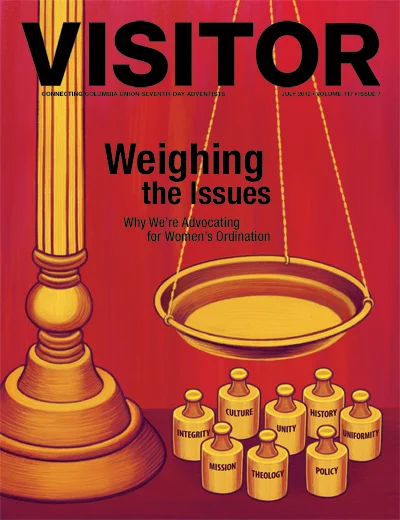
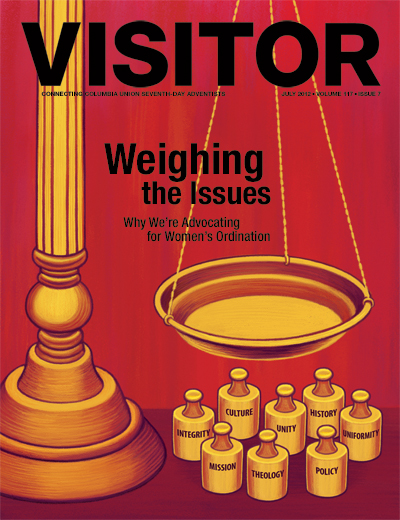
The Columbia Union and the Pacific Union both plan special constituency meetings at which there will be a vote on whether to authorize the ordination of female pastors. The Columbia Union constituency meeting is set for July 29, and the Pacific Union constituency meeting is set for August 19. The presidents of these unions have abandoned any pretense of neutrality, and are strongly urging their constituents to endorse women's ordination. Dave Weigley, President of the Columbia Union Conference, and Ricardo Graham, President of the Pacific Union Conference, have written editorials in favor of female ordination, and beyond that, both have dedicated the July issue of their respective union news outlets to arguing for female ordination.

Part I: The Columbia Union Visitor

In the July issue of the Columbia Union's monthly paper, The Visitor, Elder Dave Weigley sets out his reasons for supporting female ordination:

“Since we announced plans to hold a special constituency meeting July 29, I’ve discovered that many members, pastors and leaders support our request to authorize ordination of women clergy. They realize that although we continue to debate the issue theologically, it’s largely cultural.”

But is it a merely cultural issue? Paul based his teaching of male headship in the church on the history of creation and the Fall. (2 Timothy 2:11-14) Because the doctrine of male headship is rooted in facts of history that do not change and are the same for every culture, this apostolic mandate is eternal and trans-cultural.

Elder Weigley continues:

In his new book titled Where Are We Going? Jan Paulsen, immediate past president of our world church, writes, “The church has never taken the view that biblical teachings exclude the possibility of women being ordained to ministry on an equal footing with men. But global leadership has felt that local readiness and perceptions—heavily influenced by culture—have thus far kept us from moving forward on this as a global community.” (p. 12)

The first sentence quoted from Elder Paulsen is true: the SDA Church has not put this issue on a doctrinal basis. Given the clarity of Scripture, it should have done so long ago, but it has not. It seems very unlikely, however, that all opposition to female ordination is merely cultural and not scripturally based.

Elder Weigley, in what has become typical of liberal argumentation, appeals to the Holy Spirit in justification of what is not in accordance with the Scriptures the Spirit inspired:

1. I can no longer dismiss the evidence of the Spirit’s moving in China and other parts of the world where women are advancing the mission of the church as promised in Joel 2.

China is transitioning from the extreme persecution of Christianity to a more tolerant attitude toward faith. After communists took power in 1949, foreign missionaries were expelled and all ties were cut between Chinese Christianity and Christianity in other countries. Even today, no foreign ties are tolerated, hence the church in China has no connection to the world-wide Seventh-day Adventist Church. The practice of having women in leadership roles developed by necessity during times of persecution, when male pastors were often imprisoned. Frequently, “old uncles” guided the churches from the background. It is wonderful that God has used women to skirt persecution in China. It does not follow from the Chinese situation, however, that Christians who are free to practice their religion according to the dictates of conscience should set aside clear scriptural guidelines.

And of course the reference to Joel 2:28-29 is not persuasive:

“And afterward, I will pour out my Spirit on all people. Your sons and daughters will prophesy, your old men will dream dreams, your young men will see visions. Even on my servants, both men and women, I will pour out my Spirit in those days.”

No one disputes that the gift of prophecy can be given to both men and women. The Bible affords several examples of female prophets (Judges 14:4; 2 Kings 22:14; Luke 2:36; Acts 21:8-9), and, obviously, a female prophet was crucial to the founding of this denomination. But the fact that women can be and have been given the gift of prophecy---a fact of which Paul was fully aware (1 Cor. 11:5)---does not set aside the apostolic mandate of male headship. To the contrary, in the very same passage in which Paul writes of women prophesying, he also notes that “the head of every man is Christ, and the head of the woman is man . . .” (1 Cor. 11:3)

Elder Weigley continues:

2. In the early days, our church saw the value of encouraging both genders to serve according to their calling, and history tells of female pastors, missionaries, evangelists, conference presidents and General Conference treasurers (see pp. 16-17). In New York at the turn of the 19th century, for example, women won 60 percent of our converts.

Several of the examples are husband-wife evangelistic teams, not female senior pastors. Opponents of female ordination or female headship do not dispute that women have a vital and indispensable role to play in evangelism, soul-winning, bible work, social-welfare-charity outreach, etc. The issue is female headship in the church, which is not scripturally a woman's prerogative.

The rest of Elder Weigley's arguments are premised upon the assumption that opposition to female headship in the church is merely cultural, and that the issue is mere “policy,” rather than a scriptural or doctrinal principle:

  1. We already accommodate policy variances in some places for practical purposes, cultural sensitivities or to advance our mission, e.g., polygamy, labor unions, women’s ordination. In our cultural context, this issue has moral and ethical implications.
  2. Only recently has there been an attempt to have us walk lockstep in policy. Our pioneers would have been hampered by such uniformity.
  3. Mission should drive policy, not vice versa. As policies become outdated or problematic for the advancement of the gospel, we revise or abolish them, and/or create new ones.

In addition to Dave Weigley's editorial, several other articles in The Visitor advocate for female headship in the church, including: “Why We're Advocating for Women's Ordination,” “Understanding Ordination,” “11 Pioneering Women Ministers,” and “Time Line: The Road to Ordination.”

In “Why We're Advocating for Women's Ordination,” the authors address the concern that women's ordination will lead to acceptance of homosexuality and same-sex marriage as follows: “That's an unfounded leap because these topics are in no way related. The church's stance on marriage is doctrinal (See, Fundamental Belief # 23) and we, therefore, affirm it.” Later, in responding to the charge that the Columbia Union is rebelling against the world-wide SDA Church, they say, “If this were theological or even doctrinal, we would continue to deny the requests we receive for female ordination from our conferences. But this is an ecclesiastical practice that . . . holds no Biblical mandate.” And again, later in the article, “But this is a matter of practice, not doctrinal belief. We are united with the world church in doctrine, mission and Spirit.”

Clearly, the failure of the Seventh-day Adventist Church to have articulated, long before now, a scriptural doctrine of male headship has made it difficult to maintain discipline among the church's various administrative units on this issue. Had such a doctrine been articulated, the Columbia Union would, by its own admission, be compelled to abide by that doctrine. But because the issue has not been framed as doctrinal, the liberal unions call it a question of mere “policy,” and feel at liberty to ignore the repeated verdict of the world church in General Conference Session. It is crucial that the Church at the General Conference level articulate that male headship in the Christian Church is not mere “policy,” but Bible doctrine.

The Visitor also relies on the fact that the General Conference has already fatally compromised the principle of male headship by allowing the ordination of female elders in those divisions that want to do so:

“We are already united in our practice of ordaining both men and women to ministry at every level except one – pastoral. . . . To be commissioned as a pastor, she must be ordained as an elder first.”

Since the ordination of female elders violates the principle of male headship in the church, the Church, if it ever recognizes such a principle as Bible doctrine, will need to “walk back” the policy of ordaining female elders. Needless to say, such a reversal will be very difficult to accomplish. The advocates of female headship (but sadly not their opponents) were looking to the future when they achieved this compromise.

Part II: The Pacific Union Recorder

The Pacific Union Recorder also has devoted most of its July issue to lobbying for female ordination. The articles are “Our Praise Shall Ascend” (an editorial by Ricardo Graham), “The Campbellite and Mrs. White,” “What Haskell Said,” “A Pastor's Perspective,” and “Following the Heart of Jesus” (a condensed sermon by Ricardo Graham). In addition, a notice of the Special Constituency Session is posted, and the name of every delegate is listed (subjecting them to lobbying and importuning for a period of about six weeks, until August 19). The articles are all translated into Spanish, Elder Graham probably correctly anticipating that opposition to female headship will be stronger in the Spanish-language community than among English-speakers.

In the article “Following the Heart of Jesus,” Elder Graham argues that the trajectory of Jesus' teaching leads to radical equality between men and women:

“What is the bull’s eye? Equality and unity in the church. There can be no unity without equality and inclusion. The church must seek to follow the natural progression of Jesus’ trajectory, all the way to the mark.”

But the trajectory of Christ's teachings is best seen in His own actions, and Christ ordained twelve male disciples (Mark 3:13-19; Luke 6:12-16; DA 290-297) but not a single woman among His sizable cohort of female followers (Mark 15:40-41; Luke 23:27-30). Ellen White makes clear that the calling of the 12 male disciples included ordination:

“When Jesus had ended His instructions to the disciples, He gathered the little band close about Him, and kneeling in the midst of them, and laying His hands upon their heads, He offered a prayer dedicating them to His sacred work. Thus the Lord's disciples were ordained to the gospel ministry.” Desire of Ages, p. 296.

Elder Graham is essentially arguing that Christ would do things differently if He came to earth today, instead of two millennia ago, but we can use this uncabined rationale any time we find it inconvenient to follow Christ's example, and need a handy excuse not to do so.

Elder Graham acknowledges that Paul wrote, “But I suffer not a woman to teach, nor to usurp authority over the man, but to be in silence” (1 Timothy 2:12), but counters this text as follows:

“We must remember that God spoke to and through a patriarchal, male-dominated society. The men in biblical times were, to put it bluntly, sexists. We should not, however, assume that because the society was sexist that God is sexist or that the modern church needs to be.”

Putting to one side the repeated use of the loaded term “sexist,” God did, in fact, create a patriarchal world. Adam was created first, and Eve was created out of Adam's rib, a suitable helper or “helpmate” for Adam. (Gen. 2:18-25) Adam was not created after Eve, to be a helpmate for Eve. Matrilineal societies are very rare, and true matriarchies probably non-existent (which gives some indication of the radical nature of the Western cultural elite's push toward a post-patriarchal society).

God also created a patriarchal religion. The pagan religions of the ancient world had multiple gods and goddesses. (See, e.g., Acts 19:27-28) Frequently, the same god had both a male and a female form, across several different cultures, and it was not rare for pagan religions to have female priestesses. But the God of Judaism and Christianity is always referred to by the male pronoun, and was never served by female priestesses. It is often remarked that Judaism was the first great monotheistic religion, but it is just as remarkable, though not as often remarked, that it was the first mono-gendered religion. When God was incarnated in human form, He came in the form of a man. And although Christ had followers of both sexes, as noted above He ordained only men. God is not “sexist,” but God did create sex differences and a sexual order, and He did specify differing gender roles in the home and in religious worship.

Part III: The Change to the Pacific Union's Bylaws is Not Limited to Ordination

It is important to examine the changes to its bylaws that the Pacific Union wishes its constituents to approve. The terms that are struck through are to be deleted, and the terms in brackets and in [bold] are to be added:

"All [In general], the policies, purposes and procedures of this Union shall [will] be in harmony with the working policies and procedures of the North American Division and the General Conference of Seventh-day Adventists."

As presently worded, the bylaws state that ALL Pacific Union policies, purposes and procedures SHALL be in harmony with NAD and GC working polices and procedures. There are NO exceptions. With this change, the Pacific Union would give itself permission to be out of compliance with General Conference and NAD working policies and procedures not just on female ordination, but on any issue it suits them to be out of compliance, as long as they “generally” or usually comply.

Obviously, the implications of this change go far beyond the issue of female ordination. Elder Graham acknowledges this in his article, “Our Praise Shall Ascend,” when he states, “It is important that we make the small changes in the bylaws, not just for the immediate discussion surrounding the ordination of women to the gospel ministry, but to provide room for the Spirit's leading in all that we do.” (emphasis added) The constituents may believe that they are voting on female ordination, but they are actually voting on whether to give the Pacific Union permission to ignore GC and NAD working policy whenever it wants to. By this change to its bylaws, the Pacific Union is making an astonishing move toward secession from the world church.

It is possible that this change could have a bearing on the origins pedagogy controversy at La Sierra. The Adventist Accrediting Association (AAA) exists to ensure that the Adventist philosophy of education is implemented at Adventist schools like La Sierra. And where is the Adventist philosophy of education articulated? In General Conference Working Policy:

“The Seventh-day Adventist Church recognizes that God, the Creator and Sustainer of the earth, and the entire universe, is the source of knowledge and wisdom. In His image, God created man perfect. Because of sin, man lost his original estate. Christian education, by perfecting faith in Christ, restores in man the image of his Maker, nurtures in man an intelligent dedication to the work of God on earth and develops in man a practical preparation for conscientious service to his fellow men.”

This creation-centric philosophy of education, articulated in GC working policies that the Pacific Union would like to give itself permission to ignore, is not being implemented at La Sierra, which teaches that the human race descended from an apelike hominoid. If the constituents pass the requested change to the bylaws, La Sierra can respond to AAA by noting that, as a Pacific Union institution, La Sierra does not have to abide by General Conference working policy in every particular, only “in general.” This might seem a stretch, but it should be noted that, pursuant to the incestuous system of interlocking boards by which the SDA Church is governed, Randal Wisbey is on the Pacific Union Executive Committee that wants these changes to its bylaws, and Wisbey is always two or three tactical steps ahead of the creationists who would like to return La Sierra to the Seventh-day Adventist philosophy of education. The requested bylaw change plays into Wisbey's hands.

In Opinion Tags feature, leaders, opinion, ordination, women, womens ordination

The Adventist Arab Spring

July 9, 2012 David Read
ID-10066173.jpg

Men vs women in a tug-of-warLast year, the world's media were abuzz with stories of the “Arab Spring,” a revolt against autocratic rulers that swept across the Arab world from west to east. The revolt started in Tunisia, with the overthrow of Zine El Abidine Ben Ali, then spread to Libya, where Muammar Gaddafi was ousted in an armed revolt, and swept on through Egypt, where Hosni Mubarak was removed from power. The Arab Spring sparked protests in many other Arab countries, led to an ongoing and very bloody civil war in Syria, as many sought to oust second-generation dictator Bashar al-Assad, and led to a relatively peaceful change of government in Yemen. This year, the Seventh-day Adventist Church is witnessing its own “Arab Spring” over the role of women in the church. Because of clear apostolic guidance, most churches with a high view of Scripture, including the Seventh-day Adventist Church, historically have not ordained women. The world church in General Conference session has twice voted against the ordination of women, first at Indianapolis, in 1990, and again at Utrecht, in 1995. But church officials in North America and elsewhere have nevertheless pushed to hire female pastors, and have promoted a form of ordination for female pastors, “commissioning,” that is ceremonially indistinguishable from the ordination of male pastors. Finally, they have sought to erase any meaningful distinction between commissioning and ordination, which brings us to the genesis of the current revolt.

This past October, the North American Division Executive Committee, for the third year in a row, voted for a policy change that would allow commissioned pastors to be elected to the office of conference president. This policy change is out of harmony with General Conference Working Policy. NAD president Dan Jackson was informed that the NAD does not have the authority to vote for or establish policies that conflict with GC Working Policy or the GC Model Constitution. This was confirmed by the NAD's legal counsel in an an opinion letter issued on January 3, 2012, which noted that the NAD does not have a constituency. The Church later made clear that the divisions, including the North American Division, do not form a separate layer of church governance, but are essentially administrative territories or sub-divisions of the General Conference.

In a January 31 letter to the NAD Executive Committee, Elder Jackson reiterated his commitment to placing women in the headship role of conference president, and called for more work to bring that about:

“While we, as a Division family, have philosophically supported women in leadership in three successive Year-End Meetings, the time has now come for us to become more practical in our application of philosophy and belief. . . . We must also develop intentional methods of mentoring women who can take on executive leadership positions within our conferences.”

Elder Jackson went on to lament that there are so few female pastors in North America (only 107 out of approximately 4,000 pastors), his implicit assumption being that the church should be moving toward a pastorate more evenly divided between the sexes.

Mid-American Union Conference President Thomas Lemon is on the NAD Executive Committee, and on March 8, while he was explaining to his own executive committee why the NAD's vote to allow women to become conference presidents was reversed, the Mid-America Union Executive Committee decided to vote, then and there, “to support the ordination of women in the Mid-America Union.” This was followed, on March 15, by the Pacific Union Conference Executive Committee voting to “reaffirm its commitment to the ordination of women,” and, on March 20, by the Columbia Union Conference Executive Committee voting to reaffirm its previous request to ordain women. On March 22, the Southeastern California Conference Executive Committee voted to issue only one credential, “ordained,” to all of its pastors regardless of gender, effectively retroactively ordaining all commissioned female pastors. On March 29, the Southern Union Executive Committee stated that, while they would not take an action contrary to the policy of the world church, they were “actively supporting, encouraging, and empowering women in all areas of ministry including . . . conference and union leadership . . .” On April 23, the North German Union voted to amend its constitution to end gender discrimination in ordination.

On May 9, the Pacific Union Conference Executive Committee voted to hold, on August 19, a special constituency session to authorize ordination without regard to gender distinction. On May 15, the Atlantic Union Conference Executive Committee voted a statement almost identical to that voted by the Southern Union, supporting the ordination of women, but declining to take any action contrary to world church policy. On May 17, the Columbia Union Conference Executive Committee took an action essentially identical to that taken by the Pacific Union, voting to hold, on July 29, a special constituency meeting “for the purpose of authorizing ordination to the gospel ministry without regard to gender.” Also on May 17, the North Pacific Union Conference Executive Committee voted “to appoint an ad hoc committee to create specific recommendations on how to fully integrate committed and called Adventist women into all levels of church leadership within the NPUC territory.”

It is important to emphasize just how this Adventist “Arab Spring” began: It began not over the ordination of women, per se, but over the North American Division's attempt to amend the “E-60” policy to allow women to serve as conference presidents. The issue is female headship in the SDA Church at the level of conference president and higher. Elder Jackson's letter made this clear, as have several of the statements issued by the various executive committees. So we can now put to one side such issues as the meaning of ordination, whether ordination is biblical, whether there is a role for women in ministry, whether women can serve as tithe-paid pastors, etc. None of these is the issue that now confronts us. The issue that has crystallized is female headship in the Adventist Church at the level of conference president and higher.

Even those unions--like the Southern and the Atlantic--that acknowledged and deferred to the authority of the world church nevertheless voiced support for women in headship roles. With a couple of exceptions, the executive committees have not offered any theological or biblical justification for their actions. Female headship has been treated as an organizational or administrative issue, not a doctrinal issue. This is perhaps not surprising, because although the Bible has much to say about the roles of the sexes, the Seventh-day Adventist Church has had little to say; we have not formulated a doctrine of sex roles. But the present crisis demonstrates that it is now necessary to do so; neglect is no longer an option. As a church, we need to familiarize ourselves with what Scripture teaches about sex roles.

Scripture specifies male headship in the Christian church. God the Son, Jesus Christ, was incarnated in the form of a male, and Christ is the head of the church. The Twelve Disciples chosen by Jesus were all men. Mat. 10:2-4; Mark 3:13-19; Luke 6:12-19. When lots were cast to replace Judas Iscariot, both of the candidates were men. Acts 1:12-23. When deacons were chosen to perform some of the practical tasks of the church, the seven appointed to the office of deacon were men. Acts. 6:1-7. Both the office of episkopēs (“bishop” or “overseer”) and deacon are described as male offices, to be filled by sober men who are the husband of only one wife, and capable husbands, fathers, and heads of their families. 1 Tim. 3; Titus 1:5-9. In 1 Timothy 3, Paul makes clear that capable leadership of the family is a prerequisite to leadership in the church: “He must manage his own family well and see that his children obey him with proper respect. (If anyone does not know how to manage his own family, how can he take care of God’s church?)” And Paul elsewhere makes clear that the husband is the head of the home. Eph. 5:22-33; Col. 3:18-19; 1 Peter 3:1. Since the husband is the head of the home, and successful headship in the home is a prerequisite to headship in the church, it follows that headship in the church is also reserved for men.

Not only are leadership offices reserved for males, a submissive, non-headship role is specified for women. “As in all the congregations of the saints, women should remain silent in the churches. They are not allowed to speak, but must be in submission, as the Law says. If they want to inquire about something, they should ask their own husbands at home; for it is disgraceful for a woman to speak in the church.” 1 Cor. 14:33-35. “A woman should learn in quietness and full submission. I do not permit a woman to teach or to have authority over a man; she must be silent. For Adam was formed first, then Eve. And Adam was not the one deceived; it was the woman who was deceived and became a sinner. But women will be saved through childbearing—if they continue in faith, love and holiness with propriety.” 1 Tim. 2:11-14. Even a very relaxed application of these passages upholds the principle of male headship in the church.

These scriptural principles are too clear to need elaboration, which perhaps is why the Seventh-day Adventist Church has never bothered to articulate a “fundamental belief” regarding male headship in the church. Another reason may be sheepishness over the prominent role played by Ellen White in the founding of the denomination. Proponents of women in headship roles argue that the prophetic authority exercised by Ellen White sets aside, by implication, the patriarchal church governance specified in the New Testament. But female prophets were common in biblical times---Miriam (Ex. 15:20-21), Deborah (Judges 4:4), Huldah (2 Kings 22:14)---and in fact there were New Testament-era female prophets, such as Anna (Luke 2:36) and the daughters of Philip (Acts 21:8-9), who would have been well known to the Apostle Paul. Yet Paul nevertheless gave clear instruction that leadership roles in the church were reserved for men. Neither Paul nor any of the other Bible-writers hint that the existence of female prophets suggested a non-patriarchal organization for the Christian Church.

The most common argument in favor of women in headship roles is that, in the Bible era, society was organized along patriarchal lines (patriarchy = “rule of fathers”), and in order to conform to the culture of that time, Scripture specified that the Christian Church would also be patriarchal in organization. Today, however, society is less and less patriarchal, and the church may properly reflect today's cultural realities. After all, Paul frequently told slaves to obey their masters (Eph. 6:5-8; Col. 3:22-25; Titus 2:9-10), but this is not interpreted as an apostolic mandate that all societies should embrace the institution of slavery. Likewise, just because Paul specified male headship in the church of his time and culture does not mean that all societies must embrace the restrictive prerogatives of patriarchy. Scripture's mandate was culturally conditional, and our culture is different.

This reasonable-sounding argument runs afoul of the fact that male headship in the church is based upon the order of creation and the history of the Fall: “For Adam was formed first, then Eve. And Adam was not the one deceived; it was the woman who was deceived and became a sinner.” 1 Tim. 2:13-14. These facts of history are never going to change, hence the biblical rationale for male headship in the church does not rest on the shifting sands of culture. Obviously, there is no comparable biblical statement basing slavery on the order of creation or the history of the fall, so there is no legitimate comparison between slavery and patriarchy.

It is certainly true, however, that the move toward female headship in the SDA Church is being driven by cultural changes in what is referred to as the developed world or the “first world.” The “executive committees” involved in the Adventist Arab Spring have felt little need of a biblical rationale for their actions, but no need whatsoever to critically re-examine the cultural trends that are driving their actions. The members of these executive committees tend to be practical people who know how to operate within the prevailing cultural/legal complex of mores, laws, rules and regulations. Such people excel at running enterprises and organizations, but are unsuited to the task of critically examining the culture in which they operate. And the question of whether the SDA Church should bend to the dominant culture or resist it turns on a broad overview of cultural trends.

In the biblical-patriarchal form of sexual-social organization, the family, not the individual, is the basic unit of society, and legitimate sexual expression is restricted to opposite-sex married couples. Since the “sexual revolution” of the late 1960s/early 1970s, however, Western elites have promoted a post-patriarchal form of sexual-social organization in which the basic unit of society is the individual, not the family, and legitimate sexual expression encompasses anything consenting adults can think of to do with each other. These two different forms of sexual-social organization have very different ideas about the sexes, about proper sexual conduct, and about what is just and unjust. A contrasting summary of the assumptions and attributes of the two systems follows.

A side-by-side Comparison of Biblical-patriarchal with post-patriarchal culture

  Attributes and assumptions of Biblical-patriarchal culture: Attributes and assumptions of Post-patriarchal culture:
1. The Sexes, and the differences between the sexes God created us male and female. (Gen. 1:27; Mat. 19:4-5; Mark 10:5-9) The very significant differences between the sexes are part of the created order, and not something we should strive to efface. These differences mean that men are better suited than women to certain roles and tasks, and women are better suited than men to certain roles and tasks. Except for their obvious physiological differences, men and women are the same. Persistent non-physical differences between men and women are the product of culture; they are not innate.
2. Sexuality, and the difference between male and female sexuality Men and women have very different sex drives. Male sexuality can be problematic, even destructive. (2 Sam. 11, 12; 1 Kings 11:1-13) An important goal of Christian patriarchy is to curb the negative potential of ungoverned male sexuality, and to channel male sexual energy into monogamous (1 Tim. 3:2; Titus 1:6), heterosexual marriages, that build families, societies, and civilizations (see 7 & 8, below). Men and women are the same in their sexual drives. Women are just as likely as men to want casual sex with multiple partners, and men are just as likely as women to want to marry and raise children.
3. Marriage Men and women need each other in long-term relationship in order to live the fullest, happiest, and most productive lives. It is not good that man should be alone. (Gen. 2:18; Heb. 13:4) A happy marriage is an important goal for all, and young people, 19 or 20 years old, are old enough to get married. Marriage is intended to last until death. (Mat. 19:6-9; Mark 10:2-12; Luke 16:18) Traditional heterosexual marriage is one option for sexual expression, but not the only legitimate option, nor the socially preferred condition. People should probably postpone marriage until they are fully educated and in their late 20s (and it is obviously unreasonable to expect chastity for the first 15 years after puberty). Marriage should last as long as both parties are happy, and no longer; during the sexual revolution, no-fault divorce was adopted in all states, meaning that either party could end the marriage at any time, for any reason or no reason. More recently, same-sex “marriage” has been enacted in several jurisdictions.
4. Raising Children Men and women each bring something unique and irreplaceable to the rearing of children. The man's biological role in producing children is trivial, but he makes up for that by providing protection and support for the woman. The woman is a nurturer and has a greater role in the raising of infants and young children. (Isaiah 49:15; 1 Kings 3:16-28) When a wife gets pregnant, she reduces her participation in the money economy in order to concentrate on her physically and emotionally demanding role in bearing and raising the child, whereas the husband increases his participation in the money economy so as to be able to fulfill his complementary role of protector and provider. Because men and women are not different in any meaningful respect, it doesn't matter who raises children. Two daddies or two mommies are as good as a mother and a father. Even a single mother is just as good as two parents. Discrimination in adoption in favor of married heterosexual couples has been outlawed in many jurisdictions; Catholic adoption agencies in several jurisdictions have closed because they can no longer discriminate in favor married heterosexual couples.
5. Out-of-wedlock Births Stigmatized and frowned upon in patriarchal societies, because they are the product of illegitimate sexual activity, and also because complementary, opposite-sex parents are viewed as crucial to successful child-rearing. (Deut. 23:2) Because there is nothing wrong with sexual activity outside of marriage, and because a single parent can raise a child as effectively as an opposite sex couple, there is no stigma whatsoever attached to childbirth outside of marriage. In the U.S., 40% of births, and the majority of births to women under the age of 30, are out of wedlock). If anything, there is now a stigma attached to disapproval of what used to be called illegitimate births and bastard children.
6. Sexual behavior Legitimate sexual expression is limited to opposite-sex married couples. Adultery is proscribed. (Ex. 20:14; Mat. 5:27-28) Unmarried heterosexual sex is proscribed. (Mat. 5:32; 15:19; Mark 7:21; Acts 15:20; 1 Cor. 7:2; Gal. 5:19) Homosexuality is proscribed (Lev. 18:22; 20:13), and widespread open homosexual conduct is a sign of the removal of God's Spirit (Rom. 1:18-27) and even cause for immediate, supernatural judgment. (Gen. 18:16-19:29) Between consenting adults, anything goes. Homosexuality is fine; pre-marital and extra-marital sex are fine. Since age and consent are the only guidelines, sexual expression is discouraged in situations that raise the possibility that consent is not genuine, such as when one party has power over another by reason of economic or social circumstances. Laws against workplace sexual harassment, and against sex within various relationships of trust, have multiplied pari passu with the acceptance of extra-marital sexual activity.
7. Female virtue-chastity This is highly prized and protected in truly patriarchal cultures. The father is the protector of his daughter's virtue until she is married, after which her husband is her protector. The desire of husbands, fathers, and brothers to protect the virtue of their female relatives puts an important check on voracious and variety-driven male sexual appetite; it protects women from the worst male impulses. (Gen. 34) This is viewed as quaint, if not actually oppressive. It is a woman's prerogative to be as sexually active and adventurous as a man, if not more so.
8. Female economic independence This is not a value in patriarchal systems, because fathers are expected to support their daughters, and husbands are expected to support their wives. Fathers typically demand that their daughters' suitors be able to support their daughters; as a result, young men are forced, in order to gain sexual access to a woman, to channel their energy into hard work and economic success. (Gen. 29:16-30) Very highly prized in the post-patriarchal sexual-social order. Economic independence, they are told, means freedom from male domination; it means that women don't need to get married for the wrong reasons, but can wait for “Mr. Right.” (A darker reason, seldom mentioned in polite society, is that a large cohort of single, self-supporting women creates a large pool of potential partners whom men can sexually exploit without being expected to financially support; Hugh Hefner was an early and constant supporter of “women's lib,” or equal economic opportunities for women. Moreover, when a woman is economically as powerful as a man with whom she has sex, the genuineness of consent is not usually in question, and, again, consent is the sole criterion of legitimate sexual expression between adults.)
9. Gender fairness and economic justice Men and women have different roles and functions and perform different jobs. Not all jobs open to men are also open to women, and vice versa. Since the basic unit of organization is the family, not the individual, as long as jobs and other economic opportunities are open to all families on an equal basis, the fairness/justice element is met. Because the basic unit of society is the individual, not the family, and it is not assumed that most adults will be, or will have been, married to a person of the opposite sex, family opportunity is irrelevant. Every individual, whether male or female, should be eligible for every job. Gender-based discrimination in employment has been almost universally outlawed (clergy being a rare exception). Any job that men do, women should also be encouraged to do, even to the extreme of putting women in military combat. (Again, in the post-patriarchal system, this isn't just an issue of fairness and justice; it is critical to the logic of the system to have a large cohort of women who are self-supporting and can freely consent to sexual activity.)
10. Headship Headship, in the home (Eph. 5:22-33; Col. 3:18-19; 1 Peter 3:1) and in the church (1 Tim. 3; Titus 1:5-9), is a male prerogative, but it is servant-leadership, to be exercised in a Christlike, self-sacrificing manner. (Eph. 5:25-33). For the dwindling few who choose to get married, the marriage should be a 50/50 partnership; there is no “headship” in marriage. In society, women should be in leadership roles as frequently as men. Since there are actually more women than men in the church, there should be at least as many women as men in church leadership, preferably more.

If one reads down the column, it becomes apparent that each culture has an internal logic and consistency; there is a coherent rationale behind each. And if one reads across the columns, it becomes apparent how sharply each culture conflicts with the other. (Obviously, neither the United States nor any other developed country is purely patriarchal or purely post-patriarchal; rather, they are at points along a continuum. In the mid-20th Century, most were still largely patriarchal societies, but for the last 40 years, they have been rapidly transitioning into post-patriarchal societies, although that transition is not complete.)

The Bible's values with regard to sexuality are part and parcel of the patriarchal system, but are rejected by the post-patriarchal system. Obviously, then, the Seventh-day Adventist Church should not view the fact that female headship is demanded by post-patriarchal culture as a point in its favor, but rather as a compelling argument against it. If we reject biblically prescribed male headship in the church on the basis that biblical culture was patriarchal but modern culture is post-patriarchal, we are consenting to be ruled by a neo-pagan culture, the sexual norms of which are anathema to biblical values. If we accept the foundational assumptions of post-patriarchal culture, we render irrational and unsustainable the entire complex of biblical prescriptions and proscriptions relating to human sexuality.

Christian patriarchy need not apologize to women. Wherever the gospel has taken root, the social, legal, and spiritual status of women has been elevated. Consider the position of women in Christian cultures versus their position in Muslim, Hindu, Buddhist, Shinto, Confucian, or other Eastern cultures. But whereas Christianity elevates women, post-patriarchal culture devalues femininity and female attributes. Created sex differences are downplayed, dismissed, despised, and denied. Post-patriarchy has contempt for women who embrace family and motherhood as their first and highest priorities; it denies that there is anything unique or extraordinary about women, insisting that women are just like men, except for the plumbing.

Moreover, an unspoken but obvious aspect of post-patriarchal culture is the enabling of immature male sexual instinct by creating a huge pool of self-supporting women whom men can sexually exploit without commitment or financial responsibility. Instead of ennobling men by demanding that they become responsible husbands and fathers, it degrades women by demanding that they shorten their own sexual horizons, and knuckle under to male patterns of sexuality.

Denominations that have embraced female headship are coasting toward oblivion. Liberal Presbyterians began ordaining women to the ministry in 1956, and by 2001 there were almost as many women as men in the PCUSA clergy. But the Presbyterians have witnessed a 40 year decline in membership. In 1968, there were over 4 million members, or almost 2 % of the U.S. Population; today membership hovers around 2 million, or about 0.6 % of the U.S. Population. Their membership was halved and their percentage of the population was reduced by more than two thirds. The United Methodists also began ordaining women to ministry in 1956, and first ordained a female bishop in 1980. Their U.S. membership has declined every year since 1968, from around 11 million (5% of the population) to 7.8 million (2.5% of the current population). The Episcopal Church began ordaining female priests in 1974. Their American membership has declined from about 3.2 million to about 1.95 million. Promoting female headship in the church is not the path to church growth and cultural relevance; it is the path to irrelevance and extinction.

The liberal churches that have embraced female headship have also embraced (or are in the process of embracing) homosexuality, as witness the confirmation of openly gay Bishop V. Gene Robinson in the Episcopal Church in 2003. Why? Because the culture of post-patriarchy is opposed to the entire corpus of biblical directives relating to sex, sexuality, and gender, and once a denomination has placed post-patriarchal culture above Scripture, the biblical rules will all eventually be jettisoned. It is also important to note that no church adopted female headship until after it had made peace with Darwinism and rejected a literal reading of the Genesis narrative. We have seen that Paul grounded male headship in the church upon a literal understanding of the story of the creation and the Fall. 1 Tim. 2:11-14. Patriarchy is part of the created order, if we understand the creation narrative literally. Liberal activists, unlike many serving on the “executive committees,” well know that these issues are all connected, which is why Spectrum divides its time about equally among: 1) agitating for female headship, 2) arguing for normalization of homosexuality, and 3) promoting Darwinism. They understand that these three issues are inextricably bound together.

Last year's “Arab Spring” was a disaster for American and Western interests; in every case, a more secular autocrat was replaced, or is in the process of being replaced, by a more Islamic government that embraces the sharia ideology of the Muslim Brotherhood and its ideological offspring, Al Qaeda. This year's Adventist Arab Spring will prove just as disastrous for the Seventh-day Adventist Church, because it signals a willingness to thoughtlessly embrace the cultural imperatives of post-patriarchy, in derogation of clear Bible truth.

In Opinion Tags bible, biblical, feature, gay, men, morality, ordination, spotlight, women, worldviews

Lying to save life and biblical morality (Part V)

July 6, 2012 Ron du Preez

The fourth and final point made above in defending Rahab’s deception was that, “Potential consequences of any action must be carefully considered, and rigorously avoided if life-threatening. Since human life is considered most important, it needs to be protected even at the cost of truth.”

Read More
In Opinion Tags biblical, feature, lying, morality, spotlight

The angry father

July 4, 2012 Shayne Vincent
1282219_97975456.jpg

Misconceptions

If you were to ask what one of the most important moments in life might be, getting to meet God would probably be in the top tier. Yet, if you were to talk about what that meeting might look like, it is disheartening the impression people seem to have of His nature. While they will typically see Jesus as a loving and kind Savior, they tend to see the Father in darker hues.

In an informal study regarding our conceptions of God, Dr. Graham Maxwell asked: “‘Would you be afraid to meet God?’” One particular gentlemen responded, “‘Yes, terribly terrified!’ ‘Why so?’ ‘Because of all those terrifying stories in the Bible’”. Maxwell goes on to say, “I heard frequent references to the horrors of hell and the impossibility of trusting a God who would demand obedience under the threat of eternal torment”. All this led Dr. Maxwell to ponder the question, “How can we be friendly with someone who threatens to burn us to death if we disobey?” (1)

Common sense tells us that we should not be obligated to serve someone who threatens us with eternal torture if we don’t “love them”. By comparison, Hitler would seem compassionate. At least Hitler’s victims could finally die. This confused picture of God does not even harmonize with an atheists basic sense of justice.

In consequence, many people picture the Father as a demanding taskmaster, waiting to pounce on them at any given moment. As though God is anxiously waiting for us to make a mistake so He can, “make sure we don’t get into Heaven.” But is this really what God is like? Is this really what the Scriptures teach?

Hell & Fire

In Hebrew, the word “Hell” has its root in the word, Sheol שְׁאוֹל, meaning, the grave, or, a pit. (2) Sheol is described as a place “without thought” or “feeling”, where “dust returns to dust”, and from whence the “Breathe of God returns to Himself”. (3) Sheol was the place where King David was laid to rest, as well as Abraham, Jacob, and all the other fathers and prophets of antiquity, “having died without receiving the promise”, of eternal life. (4)

Hell (Sheol), then, is where both “the righteous and the unrighteous go” when they die, awaiting the “resurrection of the dead”. (3) Thus, the Biblical use of the word ,”Hell”, is simply a metaphor for burying someone. The disturbed idea that, God sadistically tortures people in “Hell”, is really no more Biblical than Easter or Christmas.

“Fire”, on the other hand, in many cultures throughout history, has traditionally been seen as a positive force of renewal. The scriptures use both water and fire as a catharsis for the entire planet. The first cleansing of the earth via water, was at the time of the flood, bringing a literal new birth of sorts to mankind. The second cleansing is described in the book of Revelation as a time when a despoiled Earth, filled with destructive inhabitants, will be smelted by fire.

But unlike those cultural traditions, which teach the equality of good and evil, or that, “evil cannot be defeated”, the God of the Bible, will put a literal and permanent end to evil, through the cleansing power of fire. It is during this very moment in time when death and Hell will be “metaphorically” cast into the purifying flames of the “lake of fire”. (5) Through the obliteration of corruption and evil, the power of the grave will be broken, granting eternal life to those who chose Love over selfishness.

In addition, Lucifer himself, his postulations, and his adherents, will be literally thrown into what is likely to be a sea of molten lava, utterly consumed, leaving nothing behind. (6) In this sense, the eternal and irrevocable sentence of death is an act of mercy. Giving rest to the tortured existence of all those who learned to survive through greed, abuse, facade and manipulation.

The Scriptures call this act of extirpation, “the second death”. It is an everlasting rest in the arms of Sheol, where the unjust dead, “sleep in the ground”, forever and ever. And when the corollary flame has cooled, with a shuttered sigh, the Father will recreate the world in all of its vulnerable Edenic verdure.

Emotional Projection

I coined a term a few years back called, “projected self-contempt”. It means that we treat others poorly and judge them negatively because, we are dumping what we dislike about ourselves, upon them. Projection is a coping mechanism, a form of self-protection. It is a prison from which we lob projectiles when our wounded and frail identities seduce us into self-loathing.

Like a Turner Classic film, we re-screen unresolved wounds from the cluttered shelves of memory; our percieved-sense-of-powerlessness making us both victim and abuser, both judge and jury. As in the acclaimed album, “The Wall”, our sense of vulnerability is tantamount to terror, “Since, my friend, you have revealed your deepest fear, I sentence you to be exposed before your peers. Tear down the wall.”(7) In those searing moments of shame, we castigate those around us in an effort to say, “back off, I am unloveable and flawed, and I will fail if you put me on a stage”.

As such, mankind’s picture of God can often become a projection of our personal demons, a preconception, rather than anything the Bible actually teaches. God taking the blame for our personal resentments. But is God actually like the people that abandoned or abused us? Is God really like the people that fail us when we need them the most? For that matter, is God even like a large majority of His own followers?

Just like a painting, where every picture has its own specific artist, with their own palette of color and subject, discretion demands that there be a difference between a single opinion and actual reality. A persons life cannot be captured in a snapshot, there is a multiplicity of pieces that fit into what makes up an individuals personality. And it is the same for God.

To assume that God is like what we are shallowly presented, historically, in pop-culture, or by failed authority figures, is to project upon God an assumption of Character. It is to judge a book by its cover. And when we are emotionally invested into the suffering of this world, we are more than happy to erase a seemingly impotent God, with one broad sweeping stroke.

Intention and Reality

But, consider the length of time that has passed in Judeo-Christian history. Do not forget, that what begins as well intentioned and sincere, can rapidly become encumbered with opinion and self-interest. Like gathering a line of people, what you tell the first person is far from what the last person hears. And this is exactly what has happened with God. What was obvious and plainly stated, became shrouded in mystery. That which was compassionate and just, became encumbered with greed and control. What was once the hoped for end of evil, became sadistic, controlling, and a means to a political end.

But if you were to talk with God, to ask He, Himself, what He’s like, what would He tell you? If you had everyone in the history of the planet judging you, you would certainly would want to speak for yourself, lest your life become a tabloid. And that is exactly what God did, in both inspiring the Scriptures, and by coming Himself, to explain it with His own mouth, in Christ.

Who God Really Is

It can be difficult to hear what is being said when it doesn’t fit our own agenda. Thus, even God speaking for Himself, is not enough for human beings. His own adherents, those who followed Him night and day for three years, hardly believed Him. Just as those of us today, the families, employees, and officials of the first century were desperate for deliverance from their problems. So when the “deliverer” arrived, the whole nation of Israel was ecstatic; they would finally have wealth aplenty. As proud nationalists, they would finally be delivered from oppressive political control. The poor would have wealth, and the rich would have power.

Yet, on the self-same day that they would crown Jesus King, He sent them all away. To their dismay, His response was, “You’ve come looking for me not because you saw God in my actions but because I fed you, filled your stomachs—and for free.”(8) Let’s be honest, a large part of the reason we don’t like God, the reason we paint Him as fiction, is because the truth that God offers is not freedom from responsibilities and trial, but rather to love one another through the healing of forgiveness.

God does eventually promise us a resurrection for our dead, and a future world without the failings of our current planet. But that isn’t good enough, we see the suffering around us and want to alleviate it, now. We see the injustices and want them to pay, now. But what we do not see, in our impatient anger, is that God wants the same thing.

It is the Father, not just Jesus, that loves His enemies. It was the Father that allowed the punishment of our guilt to fall upon His son. It is the Father that calls His own followers to alleviate the suffering and injustice of the poor and needy, now. It is selfish humans that turn the Father’s simple command to love into theological quarrels about nonsense, completely avoiding His call for us to care for one another.

Jesus said, “If you have seen me, you have seen the Father.” (9) So if you really want to blame God the Father, then you’ll have to blame Jesus too, because they are the same. They would both hang out with prostitutes as much as rebuke the sickening blindness of religiosity. “I and My Father are One.” (10) Understandably, we don’t want suffering to be a part of normal. It’s hard living in a world of injustice and selfish exploitation. Trial and care makes it difficult to not want to use God as though He were some kind of vending machine. But, truth be told, happiness is far bigger than indolence, and abundantly larger than pain.

Conclusion

Regrettably, the lions share of those rejecting God, will be ill informed, basing their choices upon anger at parents, peers, abusers, false or politicized religions, and the media… but, not upon the Scriptures themselves. We are not unlike those that stood at the foot of the cross, mocking Love, pledging themselves to their “safe” walls of control, and God’s response to our brokenness remains the same, “forgive them, for they don’t realize what they are doing”. (11) The louder our posturing, the more maltreated and terrified the child within. But, there is no need to be afraid, “A bruised reed He will not break, a smoldering wick He will not quench” (12)

The conception, that God the Father is stern and brutal, is just simply a lie. The scriptures describe the Father’s work of judgment, as a strange work, as the necessity of setting boundaries. Hear the Father in His own words, when He states, “‘Why will you die? I have no pleasure in the death of anyone who dies,’ declares the Lord God. ‘Therefore, repent and live’; ‘People are bent on turning from Me. But how can I give you up? How can I surrender you? My heart is turned over within Me, All My compassions are kindled.’ ‘For I know the plans I have for you; plans to prosper you and not to harm you, plans to give you hope and a future.’”(13)

God the Father deeply cares about people. He longs to be, “‘the God of all families’”, who has, “‘loved you with an everlasting love;’”, and who, “‘draws you with unfailing kindness.’”, because, “‘before I formed you in the womb I knew you, before you were born I set you apart.’” (14) Not only does the Father care about us, but He is loves source, He is love itself, not as a verb, but as a noun: “Beloved, let us love one another, for love is of God; and everyone who loves is born of God and knows God. Those who do not love do not know God, for God is love.” (15)

In our search to make sense out of the seemingly antithetical attributes of God, we must open ourselves to more than our wounds demand, more than histories failings, and more than mankind’s paltry efforts at emulation. In his personal struggle to understand God’s personality, through decades of personal study, with tenured years of instructing university courses on the subject, Dr. Maxwell concluded: “If we are lost in the end, it will not be because God has become tired of us, or angry with us. But that we have stayed away from Him so long, with such unwillingness to listen to our gracious God, that there is no remedy, and there is no healing for our condition. Thus, ‘the wrath of God’, is simply His turning away, in loving disappointment, from those that do not want Him anyway, thereby leaving them to the inevitable consequences of their own choices.” (16) Essentially, even if you are an all powerful God, you cannot force a utopian society, for love is only real when it is chosen.

1. Servants or Friends, pg. 2-4 2. http://en.wikipedia.org/wiki/Sheol 3. Ecclesiastes 12:7.; Psalms 115:17.; Hosea 13:14; Psalm 49:15; For a detailed study on these concepts see: http://www.biblicalperspectives.com/endtimeissues/eti_18.pdf 4. Heb 11:13 5. Rev 20:14 6. Rev. 20:10; Mal. 4:1-3 7. The Trial, Pink Floyd, The Wall, 1979 8. John 6:26 TMB 9. John 14:9 10: John 10:30 11. Luke 23:34 12. Matthew 12:20 13. Ezekiel 18:31-32; Hosea 11:7-8; Jeremiah 29:11 14. Jeremiah 31:1,3; Jeremiah 1:5 15. 1 John 4:7-8 16. University Lecture Series, Dr. Graham Maxwell.

Tags bible, biblical, character of God, feature, hell, spotlight

Is sola scriptura 'scriptural'?

July 1, 2012 Brent Shakespeare
solascripturascriptural.jpg

Five centuries ago, Protestants sounded the call, “Sola Scriptura!”ii This epochal motto has echoed down the years, fortifying the church through many battles. Yet, there are cracks beginning to show in this beloved slogan- and some are questioning its validity. What is the meaning of this phrase? The Westminster Confession of Faith defined it as follows: “All things in Scripture are not alike plain in themselves, nor alike clear unto all; yet those things which are necessary to be known, believed, and observed, for salvation, are so clearly propounded and opened in some place of Scripture or other, that not only the learned, but the unlearned, in a due use of the ordinary means, may attain unto a sufficient understanding of them.”iii

Since this Confession was written, many Christians and denominations have jettisoned the “authority of Scripture,” in favor of their own private interpretation—“Solo Scriptura.” The concept of a “Priesthood of all believers” has persuaded some that we are entitled to our personal interpretations, independent of any outside, objective criteria. However, the Bible teaches that God works through the church, and at times it will receive the gift of Prophecy. This charisma is sent for edification, counsel, reproof and correction of the church. Although some prophets’ messages have not been included in Scriptureiv, they were authoritative communications from God to His people at the time they were given. The Bible, therefore, doesn’t stand as the ONLY guide for the Christian—but as the determinate rule for all other sources of revelation. In other words, a clearer way of stating “Sola Scriptura” would be “Sola Prima Tota Scriptura”v- Scripture is the “measuring rod” (i.e.-kanon) for all other communications.vi

As we have moved away from the great Protestant awakening, this bedrock principle is being challenged. Increasingly, one can find references such as:

The reformers’ view of the Holy Scriptures is itself unscriptural.vii

No biblical passage teaches that Scripture is the formal authority or rule of faith in isolation from the Church and Traditionviii. Sola scriptura can't even be deduced from implicit passages.ix

Sola scriptura is an example of the logical fallacy of begging the question, inasmuch as the canonical  scriptures never identify what is and what is not scripture. The only evidence that the 26 books of the New Testament (excluding the self-attesting Revelation) are inspired is the authoritative proclamation of the Catholic Church.x

“The idea of sola Scriptura was an invention of the sixteenth century.”xi

Unfortunately, some “Protestants” are also echoing this viewpoint:

Mark Noll . . . is hardly the only evangelical Protestant raising questions about the viability of sola scriptura. . . What he said resonates with others criticisms of that formal Protestant principle–at least as it has been interpreted and applied especially by Baptists and other free church evangelicals. Tom Oden and D. H. Williams and many others have raised serious questions about it.xii

Five hundred years after the Reformation and about 1900 years since the closing of the Canon, we must ask: Is Sola Scriptura Biblical? If it is not, and we are honest, we really have only two choices: 1) Set the Bible aside as a book of myths, half-truths and contradicting revelations or, 2) Rely on Church counsels and scholars to tell us what is or is not Scripture. If, however, “Sola Scriptura” is Biblical--then there should be self-validating, self-authenticating criteria for determining what is scripture.

Dr. Gerhard Hasel explains this concept:

Because of inspiration the biblical canon is self-authenticating, self-validating, and self-establishing. This means that the origin of the canon of the OT, and we may respectively add the canon of the NT where the same principles are at work, is not the same as its recognition by the respective faith communities . . . The inherent nature of canonicity reveal that a distinction needs to be made between the origin of the canon and its recognition by the religious community . . . The religious community does not bestow canonicity on Scripture; it recognizes canonicity.xiii (emphasis mine)

In the previous study (See Spectrum of Scripture), we saw that the New Testament identified 15 markers which describe the nature of Scripture.xiv If we apply these keys to the writings of the Bible, we should see if Scripture is self-authenticating or not.

Word of God

As we saw, the phrase “word of God” (including synonyms- “word of the Lord,“ “the Lord said,“ etc.) is one of the keys to denote Scripture. After collating the occurrences, this phrase is used in 34 of the 39 Old Testament booksxv and 24 of the 27 New Testament booksxvi. Therefore, of the total 66 books, 56 of them use this expression (Ruth, Esther, Proverbs, Ecclesiastes, Song of Solomon, Lamentations, Philemon, 2, 3 John excluded).

It is Written

The phrase “it is written” (including synonyms- “written,” “are written,” “write,” etc.) is also a marker to identify Scripture. The Old Testament uses this phrase in 12 of the 39 booksxvii, while the New Testament uses it in 20 of the 27 booksxviii. “It is written,” and its variations, are used in 32 of the 66 books of Scripture. More importantly, two of the nine remaining books left over from the “Word of God” use this phrase (2, 3 John). This leaves seven books which in this study we have not yet identified as “Scripture“- Ruth, Esther, Proverbs, Ecclesiastes, Song of Solomon, Lamentations, Philemon.

Writings of the Prophets

Deuteronomy 18:21,22 and Jeremiah 28:9 testify that “Prophecy” is a hallmark of God’s revelations. Many writings claim divine authorship, but a God who can accurately foretell the future possesses absolute knowledge. Scholar Robert Vasholz notes:  “the Old Testament endorses the fulfilled prediction as a hallmark of canonicity, . . .”xix During the time of the Old Testament, short term prophecyxx validated a prophet’s message to his own generation as authoritative communication from Godxx. He goes on to say that Prophetic fulfillment functions:

as proof that the prophet was genuine, and the Old Testament society understood them that way. . . Once a prophet and his contemporaries passed from the scene there would be no way for a prophet to be established. The prophet proved himself by short-term prediction and miracles to his peers. . . Prediction was the crux of the matter for canonicity in terms of its origin as the ’word of the Lord,’ but it also provides the internal criterion of acceptance and recognition by the community. On that basis, the written product of the prophets was recognized as both authoritative and canonical.xxii

Whether Old Testament or New, the communities to which a prophet spoke recognized the inherent quality of their writings as Holy Scripture on the basis of their prophetic nature.xxiii

The word “prophet,” (including synonyms “prophecy,” “prophesied,” etc.) are used in 19 of the 39 Old Testament books, and 5 of the New Testament booksxxiv. The book of Lamentations is a written fulfillment of Jeremiah’s prophecies. Of the 39 Old Testament books, all of them but Ruth, Esther, Job, Ecclesiastes and Song of Solomon contain non-Messianic prophecies fulfilled near or at the time of their proclamation.xxv The New Testament is saturated with fulfilled Messianic prophecies. There are more than 300 Old Testament prophecies confirmed in the life of Jesus.xxvi In fact, only five New Testament books do not contain a prophetic fulfillment that the original hearers could verify (2 Thessalonians, Phile., James, 3 John, Jude)xxvii. This leaves Ruth, Esther, Proverbs, Ecclesiastes, Song of Solomon and Philemon still unaccounted for in our study of the corpus of Scripture.

Quotations of Scripture

A significant “interlocking mechanism” defining “Scripture,” is its reference of other inspired writings. Many commentators see explicit quotations from all the Old Testament books except: Judges, Ruth, 2 Chronicles, Esther, Ezra, Nehemiah, Song of Solomon, Obadiah, Jonah, Nahum, Zephaniahxxviii. The fourth edition of the United Bible Societies' Greek Testament (1993) lists 343 Old Testament quotations in the New Testament, as well as no fewer than 2,309 allusions and verbal parallels. If clear allusions, names or places are taken into consideration, the figures are much higher: “C.H. Toy lists 613 such instances, Wilhelm Dittmar goes as high as 1640, while Eugene Huehn indicates 4105 passages reminiscent of Old Testament Scripture. It can therefore be asserted, without exaggeration, that more than ten per cent of the New Testament text is made up of citations or direct allusions to the Old Testament.”xxix

The books most referenced are Psalms (79 quotations, 333 allusions), and Isaiah (66 quotations, 348 allusions). The book of Revelation has no fewer than 620 allusions, including a direct nine-word quotation (formal quotation) in chapter 14:7 (from Ex. 20:10). Furthermore, the Old Testament is quoted or alluded to in every New Testament book except Philemon and 2 and 3 John. The books of Ruth, Lamentations and Jonah are not directly quoted, but there are names and allusions that are referenced. For example—Ruth is mentioned in Jesus’ genealogy (Matthew 1), Jonah is referred to by Jesus in Matthew 12:39-41, in Lamentations 3:52 and John 15:25. Esther, Song of Solomon and Philemon are the only remaining books to be included in our study as a part of “Scripture”.

Unity and the Canon

The unity that exists between the books of Scripture is profound. The great truths of the Bible, such as sin, redemption, the gospel, God’s law and character, etc., are interwoven into the fabric of the Bible. “This is sometimes called ‘the-unity-of-ideas’ approach to the Scripture. . . There is in both the Old and New Testaments the revelation of one and the same God. The God who created all things at the beginning of time is the God who is seen in the face of Jesus Christ. Both Old and New Testaments are one grand story of redemption, accomplished, to be sure, in stages. The God who delivered Israel out of Egyptian bondage offers salvation to the world through Jesus Christ . . . Israel’s founding father [Abraham], is the prototype of all those believers in the NT who, like him, are justified by faith. Other themes could be mentioned but these three (God, salvation, the people of God) will suffice to show that the two parts of the Bible are tied together by great themes.”xxx

Unity is also seen in typology. Great events, things or people are prefigured by something or someone else at a former time. The Passover, the Jewish feasts, sanctuary, sacrificial system are all symbolic of a real and greater later event. “The typology method is validated by the Bible itself, particularly by the NT, where Christ is seen as the fulfillment of that which was typified in the OT.”xxxi The great themes of sin and redemption, God’s law, and judgment are seen in the books of Proverbs and Ecclesiastes. They testify to God’s character, the futility of man apart from God, and the many ways in which humans can edify or destroy themselves.

The Providence of God

Sometimes called “the hidden face of God”, Providence could be summarized as God’s continual involvement in the created world. It affirms that God cares for, preserves and watches over the affairs of men and women. Several biblical examples are: Moses in the bulrushes, Isaac and Rebecca, Joseph in Egypt, Ruth and Naomi, Jonah, etc. The books of Esther and Ruth fall into this category. Although there is little or no mention of God in these stories, they clearly show God’s hand guiding behind the events.

Writings of Paul

2 Peter 3:16 affirms that the writings of Paul are to be included in Scripture. Although Philemon does not contain several of the markers used to identify scripture, it can be included in the basis of this affirmation. Philemon could also be included in the “Great themes” of Scripture- since it manifests the love of Jesus Christ for each one of us as seen in what He did for us before God in pleading our case. This is one the finest illustrations of the doctrine of Substitution.xxxii

Esther

There may yet be some lingering questions about the book of Esther. It is the only book where God’s name is not explicitly mentioned and has no explicit prophetic message. But Esther should be included in the Canon for several reasons. Firstly, as we have seen, the “Providence” and miraculous power of God is clearly seen in the bookxxxiii. Secondly, we see an example of obedience to God’s law (Mordecai not bowing to Haman)xxxiv. Thirdly, there is implied supplication and humiliation for protection—strongly intimating that God is the object of their fastingxxxv. And finally, the courage of Esther, Mordecai and the Jews resulted in the conversion of many Persiansxxxvi. Behind the play and interplay of human events, we clearly see God’s omnipotent hand at work in this book.

Song of Solomon

What about the Song of Solomon? At first glance, it appears as an evocative love story with little spiritual value. But a more careful look reveals several reasons for its inclusion into the Canon. First, this is a song written by Solomon. At the time of this writing, he was a monogamous king, living a godly life. This song reveals the deep love and intimacy that is shared between a husband and wife. It shows us romance and marital love within the confines of the institution of marriage. Secondly, in a broad sense, the song is a Type and Antitype of God’s relationship with His people. “The love of Solomon and the bride are seen as typical of the love of Christ and His church. The love of marriage is made to illustrate the love between Christ and His Bride. Compare the New Testament picture of Christ and His Bridegroom in Eph. 5:22-23 and Rev. 22:17.”xxxvii Third, there are a number of words, allusions and places from other OT books that are referenced.xxxviii This shows that Solomon relied on the history and geography of the Jewish nation for this song. Fourth, the name of God (not seen in KJV, NKJV, NIV, etc.) is mentioned in 8:6 (mentioned in YLT, ESV, NASB, JPS, ASV, etc.). Fifth, there are New Testament quotes and allusions that most likely find their source in this Song.xxxix For all these reasons, the Song of Solomon should be included in the Canon.

In conclusion, a convincing argument can be made that the Canon recognizes itself! The New Testament was closed around A.D. 100, and from that time on, Christians could perceive which writings belong to it. Scholar Bruce Metzger concluded that the believers “came to recognize, accept, and confirm the self-authenticating quality of certain documents that imposed themselves as such upon the Church.”xl “The ‘self-authenticating quality’ is the divine revelation inscribe in the Word of God by inspiration. The canon was created by God through inspiration and its divine authority and canonicity is inherent in the revelation-inspiration phenomenon.”xli The Bible isn’t a book that can be added to and changed by church counsels, scholars or leaders, because it isn’t “just a record of revelation, but the permanent written form of revelation.”xlii The “Church” didn’t create the Bible—rather, God through Scripture “created” the church!

This article's references are available as a PDF document: view references.

Tags bible, biblical, brent shakespeare, feature, scripture, spotlight

Church leaders issue an appeal for unity over women's ordination

June 29, 2012 ADvindicate News
20120630-102600.jpg

The world leadership of the Seventh-day Adventists issued an “appeal for unity” to several union conferences that have either taken or are considering independent action regarding the ordination of women to gospel ministry. The request comes in a statement issued June 29, 2012.

An Appeal For Unity in Respect to Ministerial Ordination Practices

Since the beginning of 2012 several union conferences1 have recorded actions expressing support for, or commitment to, the ministerial ordination of women. The world-wide Seventh-day Adventist Church is currently engaged in a study of the theology of ordination and its implications. This study is scheduled for completion by the 2014 Annual Council of the General Conference Executive Committee. At that time the Executive Committee will determine the report which will be given to the 2015 General Conference Session along with whether or not any new recommendation should be considered by delegates to the Session. [Main News Story]

In the light of this current study and the actions of several unions, General Conference officers2, including presidents of the 13 world divisions, have unanimously communicated an appeal for unity in respect to ministerial ordination practices. The appeal calls: 1) for unity in respecting a global church action (i.e. the 1990 and 1995 General Conference Session decisions on ministerial ordination); 2) for each union executive committee to carefully review the far-reaching effects of pursuing a course of action that is contrary to the decisions of the General Conference in session; and 3) for each union to participate in the current study about the theology of ordination and its implication.

1. Respecting a global decision of the Church The world-wide Church recognizes the General Conference in Session as the highest ecclesiastical authority for Seventh-day Adventists. The 19903 and 19954 General Conference Session decisions with respect to granting ministerial ordination to women represent the current voice of the Church in this matter. The actions of certain unions indicate their desire to establish an alternative source of authority for a matter that already carries the authority of the world Church.

As currently understood in the Seventh-day Adventist Church, ordination to the gospel ministry is ordination to serve the global Church. No provision exists for a geographically localized ministerial ordination.5 Consequently the decision to change or modify ordination practices is a global one and necessitates a decision from the world body.

For any union to introduce a different ministerial ordination practice is seen, by the rest of the Church, as readiness to set aside a world Church decision and proceed in another direction. Such actions, taken at the very time when the world Church is engaged in a study and discussion of the matter, pre-empt the process and any decision that might come from it. This creates widespread confusion, misunderstanding as well as erosion of trust and also nurtures doubt about these unions acting in good faith as members of the world-wide family.

Some who would encourage unions to proceed with ministerial ordination for women draw attention to selected statements from a General Conference Executive Committee document.6 As used by these individuals, the statements would indicate that a union has final authority in matters relating to ministerial ordination. The intent of the document from which such statements have been taken is to emphasize the interconnectedness of Seventh-day Adventist denominational structure. The authority and responsibility entrusted to any entity of the Church is exercised within the context of beliefs, values, and policies of the entire Church. Being a part of the global Seventh-day Adventist Church obliges every organization to think and act for the good of the whole and to shun a spirit of autonomy and self-determination.

2. The effects of unilaterally pursuing a different course of action The significance of any union proceeding in a manner contrary to a global Church decision is not limited to the specific action involved (ministerial ordination in the present instance); it touches the very heart of how this Church functions as a global family. The essence of unity in Seventh-day Adventist organizational functioning is the mutual commitment of all organizations to collective decision-making in matters affecting the whole family—and the acceptance of those decisions as the authority of the Church. The action of any union in pursuing a different course of action represents a rejection of this key value in denominational life. Unless this value (i.e. collective decision-making and the acceptance of those decisions as the authority of the Church) is maintained, all other values that contribute to unity are seriously weakened.

For one entity to express its reasoned dissent with a global decision of the Church might appear to some as a legitimate course of action. However, the implications of acting contrary to a world Church decision are not limited to the one entity. Any organization contemplating a course of action contrary to a global Church decision must ask itself, “Is this the pattern of participation in Church life that we wish to establish and recommend for other entities to follow?” “How will we deal with the situation if an organization in our territory should decide to discontinue its participation in one or more matters under which it disagrees with the larger family of organizations?” Mutually agreed upon policies benefit the entire Church and keep it from fragmenting into independent, locally-driven units. They are the reflection of the Spirit-directed will of the body and allow each entity to look beyond itself for the good of the whole body of Christ.

3. Participation in the current study of ordination and its implications General Conference officers welcome and invite unions to participate in the global study of ordination. This study will be the most widespread and thorough study the Church has undertaken on this topic. Earlier studies have been conducted by commissions. This is the first time that a study of ministerial ordination engages the whole Church through the 13 divisions.

Biblical Research Committees in all divisions have been asked to conduct a study on the theology of ordination and its implications. In addition, during 2012, the General Conference Administrative Committee will appoint a Theology of Ordination Study Committee, with representation from all divisions, to oversee and facilitate the global discussion process and to prepare reports for presentation to the General Conference Executive Committee. The Annual Council 2014 will determine what action, if any, should be recommended to the 2015 General Conference Session. Careful thought is being given to ensure that the study and education process is conducted with fairness and thoroughness in respect to examining the theology of ordination and its practical implications.

All unions are welcome to submit their conviction as part of the global dialog on this question. Their voices, along with others, in this matter need to be heard. Now is the time for unions to share their position on ministerial ordination, and the rationale behind it. Doing so will ensure that various perspectives will be clearly understood by the world Church.

The appeal sent by the General Conference officers to certain unions also reflects this Church leadership group’s message to other unions that may be considering similar steps with respect to ministerial ordination practices. The communication concludes: “We have shared with you our deep concerns about the course of action you have chosen. We realize that sharply differing convictions with respect to ministerial ordination for women exist in our global family. We also realize that the passage of time without finding satisfaction for the tensions on this question can give rise to frustration and the erosion of confidence that a timely and mutually satisfactory resolution can be found.”

“We therefore earnestly appeal to you:

1. That your union continues to operate in harmony with the global decisions and global decision-making processes of the Church. 2. That until such time as the Church decides otherwise, your union refrains from taking any action to implement ministerial ordination practices that are contrary to the 1990 and 1995 General Conference Session actions. 3. That the union membership be informed concerning the implications for the entire Church in the event that one entity, for whatever reason, chooses a course of action in deliberate opposition to a decision of the whole Church. 4. That the union actively participates in the global discussion about the Church’s understanding and practice of ordination. The contributions of a union in this discussion can be forwarded to the Theology of Ordination Study Committee through the respective Ordination Study Committee set up by each division.

“Thank you for your willingness to receive and reflect on these things. We join you in diligently and prayerfully seeking to know the will, the blessing and the guidance of God in this and all other matters affecting our life together as a Church and our collective endeavor to advance His kingdom.”

______________________________ 1. At December 31, 2010 the Seventh-day Adventist Church had 60 unions with conference status and 59 unions with mission status 2. The group of 40 officers involved include officers from the Presidential, Secretariat and Treasury offices of the General Conference plus the presidents of divisions who, in additional to being presidents of their divisions are vice-presidents of the General Conference. 3. The 1990 General Conference Session approved that women should be given wide participation in all church activities, including soul winning and pastoral duties, but that “in view of the possible risk of disunity, dissension, and diversion from the mission of the Church” the Session also approved the Annual Council recommendation that ordination of women to the gospel ministry not be authorized. 4. The 1995 General Conference Session action denied the request of the North American Division that the Session adopt provisions on ordination as outlined below: "The General Conference vests in each division the right to authorize the ordination of individuals within its territory in harmony with established policies. In addition, where circumstances do not render it inadvisable, a division may authorize the ordination of qualified individuals without regard to gender. In divisions where the division executive committee takes specific actions approving the ordination of women to the gospel ministry, women may be ordained to serve in those divisions." 5. Information that a number of women serve as ordained ministers in China has been cited as justification, for unions elsewhere to proceed in a similar manner. It has been alleged that the Northern Asia-Pacific Division recognizes these ordinations and has therefore established a precedent for granting ministerial ordination to women. However, these ordinations were not authorized or conducted according to the policies of the Church. Nor are these ordinations approved or recognized/endorsed by the Northern Asia-Pacific Division. The Seventh-day Adventist Church does not have an officially organized structure in China that is comparable to other areas of the world. Government regulations do not permit outside involvement in church affairs within China. The practice, in China, of ministerial ordination for women is acknowledged as a reality that has arisen in China and is beyond the influence of the world-wide structure of the Seventh-day Adventist Church. 6. “The General Conference and Its Divisions”, General Conference Executive Committee, April 2012

ADvindicate is sponsoring a new website, Christ or Culture, to provide biblical, historical, and church support for this position and to address the challenges of the latest effort to compromise biblical truth in favor of social and cultural acceptance.

Please read the material, sign the petition, and forward to your Adventist friends. The support of this petition will be presented to our denominational leaders.

In News Tags feature, leaders, news, ordination, spotlight

Lying to save life and biblical morality (Part IV)

June 29, 2012 Ron du Preez

One scholar has aptly observed that “the problem of moral exceptions or necessary compromises with evil has apparently occupied Christians from the very beginning.”

Read More
In Opinion Tags biblical, feature, lying, morality, spotlight

Raqia: 'expanse' or 'vault'?

June 26, 2012 David Read
sky.jpeg

Critics of the Genesis narrative have often argued that it describes a cosmology in which the sky is a solid vault, or an inverted metal bowl, to which are affixed the sun, moon and stars. This interpretation has recently been endorsed in a book titled God, Sky & Land: Genesis One as the Ancient Hebrews Heard It, by two Adventist authors, Fritz Guy, a theologian and former president of La Sierra University, and Dr. Brian S. Bull, a pathologist and former dean of the LLU School of Medicine. Guy and Bull argue that a solid vault is what the original hearers of the Genesis narrative would have understood from the words used, and hence what we should infer as the author's intended meaning. The Hebrew term raqia, the disputed meaning of which is at the heart of our discussion, first appears in Genesis 1:6:

And God said, “Let there be an expanse [raqia] between the waters to separate water from water.” So God made the expanse and separated the water under the expanse from the water above it. And it was so. God called the expanse 'sky.' [shemayim] And there was evening, and there was morning —the second day (Gen. 1:6-8, NIV 1984).

The term raqia, here translated as “expanse,” implies something that has been spread out or stretched out; it is a cognate of the verb raqa, which means, “to spread out or stretch out.” No specific material substance is inherent in the term raqia, so just what has been spread out must be determined from the context. The context of raqia in the Genesis narrative does not imply any sort of solid structure. Genesis 1:8 states that God called the raqia shemayim, thus equating the raqia with the “sky” or “the heavens.” The term raqia of the shemayim, or “expanse of the sky” or “expanse of the heavens,” occurs four times in the creation narrative: Gen. 1:14-15,17, 20. Birds are said to fly “in the open expanse of the sky” (Gen. 1:20).

The raqia is just the sky, and, obviously, the sky is not a solid structure. How, then, did anyone ever get the idea that the raqia was a solid structure, such as a vault, a dome, or an inverted metal bowl? Therein, by several strands, hangs a tale.

Many English-speakers have been influenced by the King James Version's translation of raqia, “firmament,” which certainly conveys the idea of something firm and solid. Remarkably, the origins of the word “firmament” go all the way back to the Third Century before Christ. The Septuagint was a Greek translation of the Hebrew Scriptures, produced around 250 BC by 70 Jewish scholars in Alexandria, Egypt, at the behest of Ptolemy Philadelphus, the Hellenistic ruler of Egypt, for inclusion in the famous library of Alexandria. Apparently, these translators were influenced by then-popular cosmological notions that included the idea that the sky was a stone vault. They translated raqia into Greek as stereoma, which connotes a “solid structure.” Over six hundred years later, when Jerome was translating the Hebrew Scriptures into the Latin Bible that would become known as the Vulgate, he was influenced by the Septuagint, and translated raqia into the Latin word firmamentum, meaning a strong or steadfast support. Finally, some 1200 years later, when English scholars were translating the Scriptures into what would become the most influential English Bible—the King James Version---Jerome's Latin term firmamentum was simply transliterated into English as “firmament.”

But the history of the KJV's translation does not explain why any contemporary commentator, familiar with modern scholarship, would argue that the Hebrew term raqia signifies a solid vault. In sources such as the famous Vine's Expository Dictionary of Old and New Testament Words, it is stressed that:

While this English word is derived from the Latin firmamentum which signifies firmness or strengthening,...the Hebrew word, raqia, has no such meaning, but denoted the “expanse,” that which was stretched out. Certainly the sky was not regarded as a hard vault in which the heavenly orbs were fixed.... There is therefore nothing in the language of the original to suggest that the writers were influenced by the imaginative ideas of heathen nations (1981, p. 67).

So whence comes the idea that the raqia is a solid structure? We need to examine another strand of our story.

In the mid 19th century, Sir Austen Henry Layard found, at a mound near Mosul, Iraq, that turned out to be the site of biblical Nineveh, a treasure trove of clay tablets with cuneiform inscriptions. Layard had stumbled onto the ruins of a royal library amassed by the ancient Assyrian king Ashurbanipal. On some of these tablets were found the Babylonian creation story know as the Enuma Elish, thought to have been originally written around 1,100 BC. Around 1890, German Assyriologist Peter Jensen translated the Babylonian word appearing on tablet IV, line 145, as Himmelswölbung (“heavenly vault”). At about this same time, a school of German critics of Scripture began promoting a theory known as “pan-Babylonianism,” which held that most of the Old Testament was written during the Babylonian captivity, and the Jewish writers of Scripture were heavily influenced by Babylonian cosmology. The idea that the Babylonians believed in a vault of heaven, combined with the idea that the Bible writers were influenced by Babylonian cosmology, led to the idea that raqia meant a solid vault. Soon, Hebrew lexicons and Bible commentaries began to reflect this idea that the raqia was a solid vault or dome, likely composed of metal.

Pan-Babylonianism strikes me as an unlikely notion. We are expected to believe that Hebrew scribes, the guardians of the sacred Scriptures that were the core of the Hebrew national identity, would willingly adopt elements of the Babylonian worldview, despite the fact that Babylon was a deadly enemy of the Hebrew nation, had conquered the Hebrews, and had destroyed the most sacred and treasured Jewish building, Solomon’s Temple. Moreover, conservative Christians have long believed that Moses wrote the Book of Genesis around 1,500 BC (before the Enuma Elish was written). If any ancient pagan cosmology could be expected to be reflected in the Genesis narrative, it would be that of ancient Egypt, where Moses was educated, not that of the much later Babylonian civilization.

But even if one accepts the critical, decidedly skeptical theory of pan-Babylonianism, there is little support for the idea that raqia signifies a solid vault or dome. In 1975, when Assyriologist W. G. Lambert re-examined this issue, he found there was no evidence for the idea that the Babylonians conceived of the sky as a solid vault. The only “evidence” was Jensen's apparently unjustified translation of the term in Enuma Elish as “heavenly vault.” Lambert thought there was some support for the notion that the ancient Babylonians viewed the cosmos as a series of flat, superimposed layers of the same size separated by space, held together by rope. But there was no dome or vault in Babylonian cosmology.

The larger and more basic problem with the raqia-as-solid-dome theory is that is assumes that the Bible can reflect only the human wisdom and understanding of its human writers. Whatever the cosmology of the ancient Near East, that cosmology must be reflected in the Scriptures. But this idea ignores the Bible's own claim that all Scripture is inspired by God (theopneustos, literally “God-breathed”) (2 Timothy 3:16). If “holy men of old spake as they were moved by the Holy Spirit” (2 Peter 1:21), then Scripture will reflect more than human wisdom. We err if we assume that it reflects only ancient Near Eastern cosmology.

The attitude we bring to Scripture will ultimately determine where we come out on this issue. If we believe that Genesis reflects only human ideas, then we can build an argument that raqia indicates a solid vault or dome. But if we believe that Scripture was inspired by God, and thus reflects more than human wisdom, then the raqia of Genesis is merely the “expanse of the sky.”

In Opinion Tags expanse, feature, raqia, spotlight, vault

Scoopism

June 24, 2012 Gerry Wagoner
scoopism.jpeg

I confess, I made up this word, at least half of it--along with my good friend Mark’s help. Two things were on my mind that night as we drove back to Ohio from Philadelphia. One, the monotonous sound that windshield wipers make after 200 miles, and second, I couldn’t believe that I had actually met the Archangel Michael in Philadelphia! The fact that he was out-of-uniform made it even more of a shock to me. We had just attended our first Adventist Theological Society meeting (1995) and “Michael” showed up unannounced. At least that’s who he said he was. A somewhat unkempt fellow with blue jeans and a scraggly moustache, he freely told all who would listen who he was. He also kept interrupting the speaker during the meetings. He was not a Michael, some Michael, or any Michael--no he was THAT Michael. We were speechless.

Fast-forward to the Pacific Northwest. On a trip there recently I learned about a new prophecy. Michael Jackson was not dead. Not only is he alive, he is with his aging father-in-law, probably eating boiled whitefish with mint sauce in Singapore. Elvis Presley. They are both waiting for the appointed time when they will come back and inaugurate the 144,000 in a world-wide revival! This will happen in 2012-–according to the uhhh...prophecy (I’m not making this up).

Then, my wife and I were in Houston at the 2011 GYC with our oldest son (Dylan) and his wife Amanda). As they were walking to the hotel one day, a fellow with a three-button* beard approached them and handed Dylan a tract about beards. He was a big fan of male facial hair, so much so that he was campaigning against the wholesale slaughter of beards & mustaches. Armed with a solitary verse in the Bible (Leviticus 19:27), our furry friend was doing his best to bring bewhiskered righteousness to anyone who would listen.

“Is this a salvation issue?“ Dylan asked him. “I think it is,” he replied. “Have you had any converts to this…uhhh…Beard-ology?” “I’m trying to convert people,” he admitted. “And a few are interested! There was this one fellow in the Atlanta airport, and I shared the truth with him, and prayed for him. Then the airline lost his shaver...so I know it was the work of God!” He was rather zealous. And rather wooly.

Each of these three stories is true and their themes lie dangerously close to (if not altogether beyond) the ragged edge of reality. In a time when we need the empowering story of the Everlasting Gospel, many strange stories abound. More and more people are developing their own private scoop and that brings me to the title of this article. (If you have a better term, feel free to share it. I’m open to suggestions.)

“Can a man scoop fire into his lap without his clothes being burned?” (Proverbs 6:27) Scoopism is a collection of private ideas, knowledge, interpretations, thoughts, impressions, notions or prophecies. In each of us, including myself, I believe there exists a temptation to hallow our own perspective even if it violates the Scriptural warning in 2 Peter 1:20. Most of us resist that temptation on the basis of humility, fellowship with other believers, and a profound respect for the balance we find in Scripture. But there are three other reasons for Scoopsim that I will explore.

Pride. Each of us struggles with pride–it was that one sin that caused the fall of Lucifer in heaven. When a proud heart is combined with fear and eschatology, it gives way to an almost unlimited display of theological innovation. Some of them are pretty bizarre. And dangerous.

Delay. The Adventist faith took shape around the central proposition that the same Jesus who made us and saved us is coming back soon. Forewarned in Matthew 24:48 & 25:1-13, we have to admit that there has been a delay in the Second Coming. The Advent Movement is confronted now by a situation unknown to its past. We are reminded of the notable statement published in 1909: “Great changes are soon to take place in our world and the final movements will be rapid ones.” I submit to you, this prophecy is fulfilled. Not until this century have we been required to cope with change so rapid, leading to ends so alien to Christian values, yet marketed in such alluring format. Peter foresees a generation laden with disbelief in Christ’s coming and saying, “Much time has passed, so why continue to believe?” This, I think, gives rise to strange new ideas and theories. Scoopism.

If this church distances itself from the sense of immediacy of both the continuing presence of Christ and the coming end of the world; it will lose the core of its message and mission. Assurance of Salvation. The last reason for Scoopism, is something that occurred to me recently. Many people are looking for assurance of salvation, a principle that eludes them for various reasons. Unresolved guilt, fears, and just negative-thinking in general can paralyze people and steal their peace. When peace leaves, it creates a vacuum. It hurts. And many things can flow into that vacuum as we grope for self-generated assurance of salvation. Enter Scoopism. Here is the amazing part: When my pet theories and ideas become my special auto-developed truth, then the fewer people that believe in it–the more saved I am! The ultimate goal then of this sanctified narcissism would be to get the believers of my special “truth” down to ONE PERSON. It’s bad when peace leaves our hearts, because our ability to love often goes with it. “In the last days men will be lovers of self…”

Solution. What is the solution to Scoopism? It is threefold.

We must humble ourselves in the sight of God (James 4:10). God is watching. We kneel down in His presence and repent of the pride in our lives. He will then lift us up and put us where we ought to be (v. 4:10b). When we are humble, we are useful to God (Psalm 10:17).

The custodians of the talents in Matthew 25 are in charge while the Master is away. What happens? He returns unannounced and says, “Bring Me your talents, and what you have done with them.” You know the rest of the story. It seems clear that Jesus intended us to occupy while busily doing His work, but ever living in the prospect of his soon return. This pattern builds maturity, and it sets the pace for the final generations who are commissioned for the task of bearing the Three Angel’s messages to the world. We don’t have time for Scoopism.

Ultimately, peace is missing from our lives because we have lost contact with Jesus. We may have stepped over the line of God’s Law or allowed lies into our lives, causing turbulence within. However it happens, the end result is a “Check Heart” light flashing on the instrument panel of our life. God allows this in His mercy–-to wake us up. When we Biblically resolve the issue that has stolen our peace, God restores two precious ingredients into our lives--peace and joy. With peace, comes blessed assurance as the song says, and with joy a renewed love for others.

*A three-button beard is a beard that covers the top three buttons of a man’s shirt. In my Anabaptist heritage, it is not uncommon to see three and four-button beards, and on rare occasions a five-button masterpiece.

In Opinion Tags conspiracy, salvation, scoopism, spotlight

Lying to save life and biblical morality (Part III)

June 22, 2012 Ron du Preez

The second point in the article “In Defense of Rahab” was that, “Motives are vital for determining an action’s moral validity. 

Read More
In Opinion Tags biblical, feature, lying, morality, spotlight

Who really needs more faith?

June 19, 2012 Matthew Priebe
cells.jpeg

“Now faith is the substance of things hoped for, the evidence of things not seen.” (Hebrews 11:1) For those who trust in the written record of the Scripture, this verse contains the essence of our belief in the way the world formed. God chose to reveal aspects of creation in His Word that we take at face value because we have faith that what the Bible says is true. Special creation, finished in seven days, cannot be proven empirically because the entire concept revolves around a God bringing forth life and matter, and belief in God always requires faith. Does evolution require belief? One of the psychological advantages employed by evolutionists (including Darwin himself) is to say they base their theories on science and on facts that can be tested and analyzed. They ridicule creationists as ignorant fools trusting in an unconfirmed God. They maintain they can prove everything they say without resorting to belief in the Divine. Is this true, or do they need as much (or more) faith in non-provable assumptions?

In the Beginning For He spake, and it was done; He commanded, and it stood fast. (Psalm 33:9)

According to evolutionists, life began when certain chemicals joined according to the theory of spontaneous generation, in which life arises out of inactive matter. Experiments undertaken in the 1950's to replicate the origins of life are often cited as proof, but they used false environmental conditions (oxygen-free atmosphere; no natural ultraviolet radiation) and still were unsuccessful in generating cell life.(1) Never has life been assembled in the laboratory; thus the entire foundation for evolution is defended as follows:

One has only to contemplate the magnitude of this task to concede that the spontaneous generation of a living organism is impossible. Yet here we are--as a result, I believe, of spontaneous generation.(2)

Cells are the basic elements of life, yet the more we learn of them the more complex they appear. When Darwin first proposed his theory he offered this falsification test:

If it could be demonstrated that any complex organ existed which could not possibly have been formed by numerous, successive, slight modifications, my theory would absolutely break down.(3)

Modern research on the structure of cells has revealed an answer to his test. One evolutionist discovered:

As biochemists have begun to examine apparently simple structures like cilia and flagella, they have discovered staggering complexity, with dozens or even hundreds of precisely tailored parts.... As the number of required parts increases, the difficulty of gradually putting the system together skyrockets, and the likelihood of indirect scenarios plummets.(4)

Micro-evolution vs. Macro-evolution

From these extraordinary beginnings life evolved from stage to higher stage until humans finally arrived. But an important distinction must be made that is often forgotten. There are two definitions of evolution that consist of quite different principles. The first can be called micro-evolution and involves changes of color, structure, and behavior caused by external pressures from isolation, climatic change, and other species. The second is macro-evolution and involves the major changes from one class of species to another, such as from fish to amphibians and from reptiles to mammals. This also includes major changes that would result in new families like the development of feline and canine families from some common ancestor. These two very different concepts are often blurred together by evolutionists and misunderstood by creationists. Please note that I am using the original—and correct—definitions for these terms as they were historically understood. Recent attempts have been made by some to change these terms to hide the issues that they expose.

Micro-evolution is occurring all around us in every species of life. Species with extensive ranges show little variety as their gene pool is large and intermingles regularly. But animals and plants on islands or in isolated habitats are different from similar species elsewhere. These differences can be minor (unusual colors; flowers with more stamens), or major (flightless birds; carnivorous caterpillars). In North America, the Mountain Lion is split into populations that no longer connect. Those in Florida have been isolated long enough to be considered as a subspecies that has distinctive behaviors and characteristics from the widespread form found throughout the western states. The two subspecies could still breed together if they ever met now, but if their isolation continues long enough they would eventually be incapable of interbreeding and would thus become separate species. An example of the latter is the two species of Gray Squirrel, Eastern and Western.

Built into all life is the ability to adjust slightly through successive generations to meet the demands of the surroundings they inhabit. Without this there could be no colonization of new areas or survival when unexpected changes occur. It is crucial to note though, that all such changes occur within the strict confines of the same kind of organism. In other words, rattlesnakes develop into different species of rattlesnakes and orchids into different species of orchids. For thousands of years we have bred domestic animals into a bewildering plethora of forms, but never has a dog become anything other than a dog, even though the shapes and personalities nearly defy comparison.

Macro-evolution takes the next step and says that at some point the dog will become something entirely different. It will become a new form of life that will someday change again and eventually be so distinct that no obvious resemblance is detectable between its ancestral form and itself. This is supposed to account for the massive differences between turtles, jellyfish, and humans, and indeed between every life form, since animals and plants come from common ancestors. Supposedly macro-evolution produced everything alive today, but it doesn't seem to be occurring now. It has never been documented in the wild or in the lab.

Natural Selection

What mechanism could account for the incredible progression from algae to armadillos? The answer given is natural selection, by which successful adaptation survives and poor adaptation becomes extinct. Evolutionists give natural selection amazing qualities, including a nearly conscious power to propel evolution forward:

Natural selection converts randomness into direction and blind chance into apparent purpose. It operates with the aid of time to produce improvements in the machinery of living, and in the process generates results of a more than astronomical improbability which could have been achieved in no other way.(5)

This places inestimable importance upon natural selection as the key force behind all the variety and specialization of life. Without it evolutionists have no explanation for how things are, so we must examine it carefully.

Every species' offspring has differing traits since no two organisms are identical. If a specific trait helps an individual survive, then it is usually passed on to its offspring. If a trait does the opposite, then an individual has a greater chance of dying and not passing on that trait. As generations proceed the individuals that survive are the ones best suited for that particular habitat. This is especially true when a species is thrust into a new habitat such as landing on an island. Nearly every island in the South Pacific has its own species of gecko, each adapted to survive there. So natural selection can explain micro-evolution. But what about macro-evolution?

If natural selection can produce entirely new life forms, then it should be testable under controlled conditions. But a century of fruit fly studies have not produced anything other than fruit flies with the minor variations of micro-evolution. As for natural conditions, Darwin knew there was trouble when he stated:

There are two or three million species on earth. A sufficient field one might think for observation; but it must be said today that in spite of all the evidence of trained observers, not one change of the species to another is on record.(6)

Since we cannot find living transitional forms, the fossil record is studied to find the links needed between each class because they must be there for macro-evolution to be true. But they are not there. All the fossils found have been members of established classes and the transitional forms needed have not appeared. One fossil reptile was thought to be an answer, but it has more problems than solutions:

(Archaeopteryx) was a small...flying animal with hollow bones and feathers usually described by paleontologists as a dinosaur on the way to becoming a bird. Most ornithologists, however, disagree.(7)

Archaeopteryx is no more a link between reptiles and birds than Pterodactyls (flying, furred reptiles) are links to bats, or Plesiosaurs (swimming, flippered reptiles) are links to dolphins. They share common traits as do many unrelated animals. The search for the "missing links" continues.

There is a theory that macro-evolution is caused by sudden mutations (leading to such humorous conclusions as one day a dinosaur laid an egg and when it hatched, out flew a bird). A prominent evolutionist states:

Obviously...such a process (multiple, simultaneous mutations) has played no part whatever in evolution.(8)

With all these problems, and many more, we ascertain that natural selection could not result in macro-evolution and so the following conclusion is reached (by the same evolutionist):

It might be argued that the theory (of natural selection) is quite unsubstantiated and has status only as a speculation.(9)

Envoy Through faith we understand that the worlds were framed by the word of God. (Hebrews 11:3)

The genius of Darwin was discovering on the Galapagos Islands and elsewhere the principles of micro-evolution. The hubris of Darwin was inventing without evidence the principles of macro-evolution. The duplicity of Darwin was combining the two and calling them both by the blanket term evolution. The grave error of the Church was to oppose everything Darwin said as heresy. Supporters of evolution could then club the church into humiliation with countless examples of micro-evolution in action, and then slip in macro-evolution as the same thing. The church couldn't tell the difference and made claims as inaccurate as the evolutionists', forever damaging their credibility on this issue. Ever since, evolutionists have made the case of science refuting blind faith but the truth is that one form of error was replaced by a different form. To this day, scientists cite examples of micro-evolution adaptation and use them as "proof" of macro-evolution, without ever using those terms.

What we believe we must not pretend to know. Is evolution a belief? Evidence is not proof, as the same bit of evidence can have multiple explanations. Evidence for evolution has always stopped short of proof and is interpretable in a creation framework. Evidence for creation also exists, such as polonium halos in granite,(10) the "mitochondrial Eve,"(11) and the shallow sedimentation of the ocean floor.(12) But creation cannot be proved either. So we are left with two models of the world. Both require faith in different forces, on the one hand God and His controlling hand, and on the other chance and the biochemical predestination of natural selection. The mathematical chances of life existing have been calculated repeatedly and they always show astronomical impossibilities needed. Life's beginnings and its development cause perpetual dilemmas for evolutionists, who have endless theories to explain but no proof to confirm. In essence, evolution has become its own religion in which its disciples trust in miracles contrived by human intellect. And why do they struggle so persistently to maintain an unproved hypothesis?

Because we have a prior commitment to materialism. Moreover, that materialism is absolute, for we cannot allow a Divine Foot in the door.(13)

We are left with the question of what we hold as our authority. Do we believe in the Bible as the written Word of God, or do we place human intellect above it. (See Proverbs 3:5) If the latter, than my opinion is as good as yours or the next person's and eventually we find there are billions of chaotic voices all saying something different. (Welcome to the peace and joy of post-modernism, where 2 plus 2 can equal 5.) There is either one clear Voice or the cacophony of the intelligentsia; either implicit confidence in the vagaries of human reason or complete assurance that God did as He said. Given these options, which worldview really requires more faith?

_______________

  1. Javor, "The Origin of Life", Liberty, Sep./Oct., 1993
  2. Wald, Scientific American, Aug., 1954
  3. Darwin, On the Origin of Species
  4. Behe, Darwin’s Black Box, Free Press, New York, 1996
  5. Huxley, Evolution in Action, pp. 54-55
  6. Darwin, Life and Letters, Vol. 3, p. 25
  7. Behler, Wildlife Conservation, July/Aug., 1993
  8. Simpson, The Major Features of Evolution, p. 96
  9. Ibid., pp. 118-119
  10. Gentry, Creation's Tiny Mystery, Earth Science Associates, 1988
  11. Science, January 2, 1998
  12. Nevins, "Evolution: the Ocean Says No!", Ministry, March, 1977
  13. Lewontin, quoted in Freedom Alert, Summer, 2000
Tags creation, evolution, faith, spotlight

Empowered Witnessing: Reaching All People (Part I)

June 17, 2012 Jacquelyn Fisher
witnessing-part-1.jpeg

Recently as I read the comments on an informal article a friend of mine wrote on the topic of repentance, I came across the following statement: “I don't believe I need to justify or beg forgiveness for my sins because I don't believe I do sin.” And farther down, another commenter asked: “…what are your thoughts on moral atheists? People who do not commit ‘sin,’ and when they do they ‘repent’ with inner reflection rather than going to... um... Outside Help.” These comments reveal a completely different worldview than the Christian/biblical worldview, and it gave me pause. Let’s face it, though we may not always receive the response we desire, it is easier to share the gospel and three angels’ messages with fellow Christians, because underneath the differences caused by denominational doctrines and extra-biblical traditions, we often share the same foundation: the belief in an Almighty Creator; the incarnate Son of God, Jesus Christ, who died for the sins of the world; and the importance of the Bible. Growing up and/or living in a pre-dominantly Christian society have sheltered many Adventists in North America. We have lost touch with how to share with non-Christians, but times are changing and so are the demographics of our society.

In 2007, the Pew Forum's U.S. Religious Landscape Survey determined that 78% of adults in the United States profess some form of Christianity as their religious affiliation, whether or not they attended church regularly. Yet interestingly the mainline Protestant churches are experiencing a decline in membership. At the same time, a growing number of young adults are claiming no religious affiliation. In fact, one-in-four U.S. adults ages 18 to 29 are not affiliated with a specific religion. What about our church? The Seventh-day Adventist Church in North America, which not too long ago was highlighted in an USA Today article, has grown by 2.5%, but in spite of this growth, our church membership is aging. In 2008, the average age of church members in North America was 51 years even though the average age of the general population was 36. These statistics demonstrate the difficulty we are having in reaching the young adult population, particularly as more young adults distance themselves from, have little knowledge regarding, or have no interest in Christianity.

It is inevitable; we will meet people whose worldview--their philosophy of life--is completely different from ours. How do we share the Gospel with those who think the Bible is an archaic book of outdated fairytales, that Jesus may have been a historic figure but was just a wise man who taught moral lessons, or do not believe in God at all? How do we explain the importance of Jesus’ sacrificial death with someone who revers Buddha; the joy of the Sabbath rest with someone who observes ancient pagan festivals like Samhain; or the importance of worshiping the God of the Bible alone when they believe in other gods and goddesses? How do we communicate the three angel’s message with someone who does not believe in Creation, has never kept Sunday (let alone Sabbath), and is not convinced with a “thus saith the Lord”?

The common foundation we may have grown accustomed to when initiating a conversation with fellow Christians will not be there when we find ourselves in an opportunity to share with a non-Christian. I am not belittling the importance of witnessing to our Christian brothers and sisters. It is an important part of fulfilling the second angel’s message (Revelation 14:8). I, myself, was a Protestant Christian for eighteen years before joining the Adventist Church, and afterward I was blessed with teaching as part of evangelistic seminars and one-on-one Bible studies. I understand first-hand the challenges that are faced when we decide to leave what was comfortable and familiar, and to follow the Lord into deeper truth. It is life changing, but even as life-changing as is a Christian becoming an Adventist, the basic foundation of our worldview remains the same.

When we witness to non-Christians with the hope of helping them choose Christ, we are literally asking them to replace their entire way of thinking and viewing the world with a radically different way to think and view the world. We are asking them throw everything they believed out the window. This is a significant challenge for both the witness and the one we are witnessing to. We cannot approach an atheist the same way we would an Anglican; a Buddhist in the same manner we would a Baptist; or a Pagan with the same style as a Pentecostal.

We may not be famous evangelists or trained Bible workers, we have not have a degree in theology or experience in apologetics, but the Lord still expects us to witness to those He brings into our circle of influence, whether Christian or non-Christian. After all, the first angel’s message is to preach the everlasting gospel “unto them that dwell on the earth, and to every nation, and kindred, and tongue, and people” (Revelation 14:6). Even if from our point-of-view the task before us appears insurmountable, we have confidence in the words of Christ: “With men this is impossible, but with God all things are possible” (Matthew 19:26).

So how do we share the gospel with the non-Christians within our circle of influence? In Part II, we will take a look at practical advice and examples provided by the Word of God.


References:

U.S. Religious Landscape Survey. (2007) The Pew Forum. Available at http://religions.pewforum.org/reports

Reflections on the future of the Seventh-day Adventist Church in North America: Trends and challenges by David Beckworth & S. Jospeh Kidder. (2010) Ministry Magazine. Available at http://www.ministrymagazine.org/archive/2010/december/reflections-on-the-future-of-north-american-seventh-day-adventism.html

Adventists’ back-to-basics faith is fastest growing U.S. church by G. Jeffrey MacDonald. (2011) USA Today. Available at http://www.usatoday.com/news/religion/2011-03-18-Adventists_17_ST_N.htm

In Opinion Tags christian, feature, part 1, people, spotlight, witnessing

Lying to save life and biblical morality (Part II)

June 15, 2012 Ron du Preez

In brief, “God does not lie; it is against his very nature." Therefore, to speak of the sanctity of truth means to recognize the sanctity of the being of the Creator of the universe.

Read More
In Opinion Tags feature, life, lying, morality, part 2, spotlight

Stand in the gap

June 14, 2012 Stephanie Dawn
prayer.jpeg

By Stephanie Dawn As Christians, prayer is one of the necessary components in our spiritual journey. Prayer keeps us spiritually alive, and it opens the door for God to do miracles in our lives as well as in the lives of those for whom we pray. Unfortunately, we often make reference to prayer without fully understanding its significance. Sometimes prayer chains can become a form of gossip, and sometimes when someone comes to us with a problem that makes us uncomfortable, we respond by saying, “I’ll pray for you,” as a means of dodging a conversation that pulls us out of our comfort zone. If we really understood the role that we as God’s people are called to play on this earth and how deeply prayer is involved in this role, we would not treat prayer so casually.

After God led the Israelites out of Egypt, He led them to Mount Sinai. As they camped in the wilderness near the mountain, God gave Moses a message for His people. “You have seen what I did to the Egyptians, and how I bore you on eagles’ wings and brought you to Myself. Now therefore, if you will indeed obey My voice and keep My covenant, then you shall be a special treasure to Me above all people; for all the earth is Mine. And you shall be to Me a kingdom of priests and a holy nation” (Exodus 19:4-6). During Bible times, only the descendants of Aaron were permitted to serve as priests in the temple, but the Israelites were also to be a kingdom of priests. God has given this same role to His people today. “To Him who loved us and washed us from our sins in His own blood, and has made us kings and priests to His God and Father, to Him be glory and dominion forever and ever. Amen” (Revelation1:5-6). After God liberated the children of Israel from their Egyptian taskmasters, He gave them the privilege of being a kingdom of priests, provided that they keep His commandments. The experience of the Israelites symbolizes the experience of Christians today. When we accept God’s gift of salvation, He sets us free from the enslavement of sin, and if we live in obedience to God’s law, we, too, will have the privilege of being a kingdom of priests.

So what does it mean to be a kingdom of priests? The prayer of Daniel provides an answer to this question. Daniel was not a priest, yet he interceded on behalf of Israel, fasting and confessing his sins as well as the sins of his people. Notice how Daniel communicated with God in his prayer. “O Lord, great and awesome God, who keeps His covenant and mercy with those who love Him, and with those who keep His commandments, we have sinned and committed iniquity, we have done wickedly and rebelled, even by departing from Your precepts and Your judgments. Neither have we heeded Your servants the prophets, who spoke in Your name to our kings and our princes, to our fathers and all the people of the land. O Lord, righteousness belongs to You, but to us shame of face, as it is this day—to the men of Judah, to the inhabitants of Jerusalem and all Israel, those near and those far off in all the countries to which You have driven them, because of the unfaithfulness which they have committed against You” (Daniel 9:4-7). Like all of humanity, Daniel was born with a sinful nature, but he did not rebel against God. He did not live the wicked life that most of the children of Israel lived before their captivity in Babylon. Unlike most of Israel, he did not turn away from God, yet he identified himself with the sins of his people, and by praying in this manner he interceded on their behalf. In verses 16 through 19 Daniel concluded his prayer by acknowledging the fact that he and his people had no righteousness in themselves. They were not worthy to come before God, but Daniel threw himself and his people upon God’s mercy. Daniel was clearly aware of the great controversy and the fact that God’s name is at stake, and he appealed to God to answer his prayer based upon this fact. “O Lord, according to all Your righteousness, I pray, let Your anger and Your fury be turned away from Your city Jerusalem, Your holy mountain; because for our sins, and for the iniquities of our fathers, Jerusalem and Your people are a reproach to all those around us. Now therefore, our God, hear the prayer of Your servant, and his supplications, and for the Lord’s sake cause Your face to shine on Your sanctuary, which is desolate. O my God, incline Your ear and hear; open Your eyes and see our desolations, and the city which is called by Your name; for we do not present our supplications before You because of our righteous deeds, but because of Your great mercies. O Lord, hear! O Lord, forgive! O Lord, listen and act! Do not delay for Your own sake, my God, for Your city and Your people are called by Your name.” In verses 20 through 23 of the same chapter we are told that Daniel’s prayer was answered even before he had finished praying. In fact, as soon as Daniel started praying, God commanded Gabriel to go to Daniel and explain to him the 70 week prophecy.

During Bible times, the priests interceded on behalf of the people by offering animal sacrifices, which symbolized Christ’s gift of salvation to the world. As God’s kingdom of priests today, we intercede on behalf of others, not by offering animal sacrifices, but by lifting them up in prayer. Just like Daniel, we come humbly yet confidently before God, acknowledging our unrighteousness and falling upon God’s mercy. When praying for those who have not accepted Christ or have wandered away from Him, we plead for God to pardon them and to take whatever steps are necessary to bring them to Him. Just as the high priest was the only one permitted to enter the Most Holy Place in the temple, Jesus as high priest is the only one who can stand in the Father’s presence and intercede on our behalf, but we have a lesser priesthood to perform, the act of interceding on behalf of others through earnest and persistent prayer.

The experience of Moses is a powerful illustration of the result of intercessory prayer. When Moses was communing with God on the mountain, God informed Moses that the children of Israel had made a golden calf and were worshipping it. Then God said to Moses, “Now therefore, let Me alone, that My wrath may burn hot against them and I may consume them. And I will make of you a great nation” (Exodus 32:10). God does not have a violent, impulsive temper. He did not need Moses to restrain Him from carrying out an act of uncontrolled rage. If God had truly wanted to destroy His people, He could have done so in an instant without consulting Moses, and He would not have needed Moses to leave His presence in order to accomplish His purpose. When God told Moses to let Him alone so that He could destroy Israel, He was testing Moses to see how he would respond. He was giving Moses an opportunity to intercede on behalf of Israel, and Moses immediately seized upon this opportunity by quoting God’s own words back to Him and referring to the fact that God’s character would be viewed in a negative light if He destroyed Israel. “LORD,” Moses pleaded, “why does Your wrath burn hot against Your people whom You have brought out of the land of Egypt with great power and with a mighty hand? Why should the Egyptians speak, and say, ‘He brought them out to harm them, to kill them in the mountains, and to consume them from the face of the earth’? Turn from Your fierce wrath, and relent from this harm to Your people. Remember Abraham, Isaac, and Israel, Your servants, to whom You swore by Your own self, and said to them, ‘I will multiply your descendants as the stars of heaven; and all this land that I have spoken of I give to your descendants, and they shall inherit it forever’” (Exodus 32:11-13). Because Moses took advantage of the opportunity God had given him to intercede on behalf of Israel, God did not destroy His people.

In Exodus chapter 34 we read that God gave Moses the privilege of seeing His glory. During this beautiful experience, God described His character to Moses by saying, “The LORD, the LORD God, merciful and gracious, longsuffering, and abounding in goodness and truth, keeping mercy for thousands, forgiving iniquity and transgression and sin, by no means clearing the guilty, visiting the iniquity of the fathers upon the children and the children’s children to the third and the fourth generation” (Exodus 34:6-7). This statement is crucial to keep in mind when reading about another opportunity for Moses to intercede on behalf of Israel, found in Numbers chapter 14.

The children of Israel were on the border of Canaan, but the negative report given by ten of the twelve spies who were sent to investigate the land filled the people’s hearts with unbelief. This unbelief soon turned into rage, and a riot broke out. Then God said to Moses, “How long will these people reject Me? And how long will they not believe Me, with all the signs which I have performed among them? I will strike them with the pestilence and disinherit them, and I will make of you a nation greater and mightier than they” (Numbers 14:11-12). Once again God gave Moses the opportunity to intercede, and once again Moses used this opportunity. He pointed out to God that by destroying Israel His character would be misunderstood. He said, “Then the Egyptians will hear it, for by Your might You brought these people up from among them, and they will tell it to the inhabitants of this land. They have heard that You, LORD, are among these people; that You, LORD, are seen face to face and Your cloud stands above them, and You go before them in a pillar of cloud by day and in a pillar of fire by night. Now if You kill these people as one man, then the nations which have heard of Your fame will speak, saying, ‘Because the LORD was not able to bring this people to the land which He swore to give them, therefore He killed them in the wilderness’” (Numbers 14:13-16). Moses had not forgotten what God had said about Himself on the day that God had revealed His glory to Moses, and now, as Moses once again pleaded for the children of Israel, he quoted some of God’s own words back to Him. “And now, I pray, let the power of my Lord be great, just as You have spoken, saying, ‘The LORD is longsuffering and abundant in mercy, forgiving iniquity and transgression; but He by no means clears the guilty, visiting the iniquity of the fathers on the children to the third and fourth generation.’ Pardon the iniquity of this people, I pray, according to the greatness of Your mercy, just as You have forgiven this people, from Egypt even until now” (Numbers 14:17-19). Once again God answered Moses’ plea. He gave Moses the reassuring response, “I have pardoned, according to your word” (Numbers 14:20). Because of their unbelief, God would not permit the people to enter Canaan, but the intercessory prayer of Moses prompted God to pardon them and not to destroy them. We should never underestimate the power of intercessory prayer, especially when we quote Scripture and claim God’s promises in our prayers.

To stop praying for others is a very serious fault. In fact, according to the Bible, it is a sin. “Moreover, as for me, far be it from me that I should sin against the LORD in ceasing to pray for you; but I will teach you the good and the right way” (1 Samuel 12:23). We can never afford to take prayer for granted. As the sins of Israel multiplied, God bore long with them. He sent prophet after prophet to them in an effort to warn them of their danger and to urge them to return to Him, but they stubbornly refused to listen. Gladly would God have answered the prayer of any one of His people if they had only confessed their sins and interceded on Israel’s behalf! “So I sought for a man among them who would make a wall, and stand in the gap before Me on behalf of the land, that I should not destroy it; but I found no one” (Ezekiel 22:30). Tragically, there came a point at which it was too late to pray for Israel. In Jeremiah chapter 15 verse 1, God made this sobering statement concerning the children of Israel. “Even if Moses and Samuel stood before Me, My mind would not be favorable toward this people. Cast them out of My sight, and let them go forth.” In Jeremiah chapter 7 verse 16 God said to Jeremiah, “Therefore do not pray for this people, nor lift up a cry or prayer for them, nor make intercession to Me; for I will not hear you.” We have only a window of time during which we can intercede on behalf of others, and that window of time is different for each person. We have no way of knowing when the window of opportunity for each person will close. This is why it is so crucial that we pray without ceasing for those whom God has placed upon our hearts. If we neglect our duty to pray for these people, many of them will pass beyond the point of being reached by the Holy Spirit, and it will be too late.

On the other hand, incredible miracles will take place in the lives of many lost souls if we persist in praying for them. We can all gather hope from the story of Stephen. As Stephen was being stoned to death, his dying words were an intercessory prayer on behalf of those who were murdering him. “Lord, do not charge them with this sin” (Acts 7:60). Stephen’s prayer was not in vain. Present at his stoning was a young man named Saul. One look at Saul’s life might have led many of the Christians who knew him to conclude that he was a lost cause, but God saw what no one else could see. Saul went from being a hater and persecutor of the church to being one of the greatest Evangelists of his day, carrying the Gospel far and wide and leading many to the feet of Jesus. Only in Heaven will Stephen learn of the amazing result of his intercessory prayer as seen through the conversion of Saul. What joy Stephen will feel when he talks to Saul in Heaven and hears Saul’s testimony for the first time! If we persist in earnest intercession on behalf of others, refusing to stop praying until our prayers are answered, we, too, will feel this same unutterable joy when we are united with those we have prayed for in the Heavenly kingdom.

In Opinion Tags feature, gap, prayer, spotlight, stand

Gender roles: cultural competition or consecrated cooperation?

June 9, 2012 Gerry Wagoner
gender-roles.jpeg

There are some biblical aspects about the role of men & women in the church being vigorously debated. While we welcome dialogue on this topic, we owe it to one another to define the source of authority that shapes our beliefs. In short, how do we respond when the world around us stands in sharp contrast to the Word of God? Why raise the issue? My deepest anxiety as I write this is that some women will take it personally, dismissing it as another chauvinist put-down. As a counselor, I recognize there are festering wounds among us and possibly unjust suppression in some homes. I can only say it is not in my heart to add to those hurts. To do so unnecessarily would sit heavily on my conscience. So why raise the issue?

I believe in Bible truth. It is what brought me to this church. I base my convictions on the revealed mind of God rather than the concealed motives of man. This is the path to joy and peace (Psalms 16:11).

Departure from truth carries serious danger in both belief and behavior. I confess that when I began this study in 1994, I did not realize how much was at stake. It is permanently fastened to our view of the authority of Scripture.

I am genuinely concerned that some churches and conferences seem determined to press ahead with this issue, despite the formal expression of will from the world church. Where can we be headed when Conference & Union leaders no longer respect an action taken by the General Conference in formal session? To defy the world church and institute what seems like oncoming congregationalism is a bold (and ominous) new step.

Our identity The Seventh-day Adventist Church is no ordinary body. It is a movement called to prepare a dying world for the soon coming of Jesus. In the words of Paul, this is a mystery, but it is also a reality. God is calling a people together who want to know Him and will walk where He walks. We have long been called the “People of the Book.” Therein lies our identity and our safe conduct as we navigate through a spiritual-war-torn world.

How did we get here? The Adventist movement began with a special emphasis on something in which we believed strongly, for God Himself gave it to us. Our movement was first informal; highly person-oriented, and convinced that the prevailing religion around us was missing these special elements of biblical truth. At first despised and ridiculed we attracted a following based on our God-given scriptural identity. Under God’s blessing, the church grew. After many years, organizational diversity was paralleled by a call for doctrinal diversity--theological confusion ensued in some circles. Time went on.

Today, increasing numbers of members think of themselves as Adventists by heritage or tradition rather than by conviction. Hence they feel free to shop cafeteria-style among the beliefs & practices of the church, assembling for themselves a suitable selection. True to postmodern values they find that their demand to be regarded as equivalent as anyone else–is reinforced in the currents of the wider society. Thus they begin adopting the world’s values in lieu of biblical values. The organized church now becomes challenged. And following post-modernist norms (with regard to organizations) it is regarded as oppressive--enter feminism.

Feminism in the church For some 30-years, a liberal political element in the church has been pushing for the ordination of women, under the premise of equality. For many, the promotion of this agenda is a result of perpetual hydrostatic pressure from the world around us. Admirably, the majority has resisted the intrusion of evangelical feminism because of a love for and a commitment to the Word of God which plainly states that leadership is male. As the feminist agenda keeps pushing, it’s time to look at some biblical principles.

Creation Genesis 1 represents a vertical line. Both man and woman are responsible to God. This is vertical equality (spiritual) in God’s sight. Man & woman are the same in the economy of salvation. Genesis 2 is a horizontal line (a co-ordination). Here is the basis of inequality of role and responsibility. Man directs the partnership, and woman defers to his leadership. Here, man is linked to God and woman to man (an association that follows throughout the Bible). This is the basis of cooperation, and millions of men & women in the Advent Movement peacefully demonstrate this principle. For them I am grateful.

What does the Bible say about male & female roles in the church? The Scriptures forbid a woman to didasko a man (1 Timothy 2:12). The same Scriptures call for women to didasko younger women (Titus 2). Paul calls on Timothy to commit the gospel truths to other men so that they might didasko others (2 Timothy 2:2). The church of Thyatira is signally rebuked for allowing a “woman Jezebel” to didasko and seduce God’s servants (Revelation 2:20). A bishop or elder must be the husband of one wife and able to didasko (1 Timothy 3:2). Peter and the apostles continually didasko’d in the temple and in every home (Acts 5:42).

Men and women each have a unique sphere of ministry that compliments each other. One of the greatest wants of our world is Godly men who will lead as Jesus did. Yet there is a growing number of passive men in our world, and this harms women by thrusting them into roles they weren’t designed for. When men fulfill their roles as spiritual leader in the home‎, women are encouraged and blessed. The same goes for the church.

1 Timothy 2 is probably the most offensive passage to the feminist woman because it imposes limits on their public ministry and perpetuates male-leadership in the church. Several Pauline passages have become fashionable to be referred to as "problem passages" because they run counter to modern sensibilities. It should be noted, that they are only a problem to those who have different understandings, whatever the reason.

There are three prevailing attitudes that Bible students adopt towards these passages and others regarding the roles on men and women.

  • Paul was wrong then, and he is wrong now. That is, he was sincerely mistaken in his views. Progressives/liberals normally pursue this line.
  • Paul was right then, but he is wrong now. This is the culturally-conditioned argument.
  • Paul was right then, and he is right now. That is, he was divinely inspired to set standards for all the churches down through "the last days." I believe this is the Bible’s position.

Galatians 3:28 is a favorite passage cited by people pressing for change in male/female role definitions. Unfortunately, it is being used out of context. This whole letter deals with two dangers in Galatia:

  • Building faith on the Law of Moses rather than the promise of Abraham.
  • Second, interpreting liberty of the Spirit as license for the flesh.

The theme is the inheritance of the blessing promised to Abraham and his “seed.” It could not be inherited by a slave or a girl or a Gentile. Jesus fulfills the conditions and is the obvious son and “Heir.” How then can anyone else share in this inheritance and blessing? The answer is simple.

By total identification with Christ anyone can claim the inheritance!! Through faith in Jesus a person is baptized into Him, crucified with him (2:20) is clothed with Him, is in Him, and belongs to Him (verse 29; Galatians 4:5).

Because all are sons, all are heirs, which daughters could never be (3:29). So in Christ, there is neither Jew nor Greek, only Jew; neither slave nor free, only free; not male and female, only male.

If this verse is lifted out of its inheritance context and taken to abolish all sexual differences (neutered in Christ), it would contradict Paul’s teachings on homosexual relations (Romans 1-24-27; 1 Corinthians 6:9), on the duties of husbands and wives (Colossians 3:18-19; Ephesians 5:22-23), on slaves’ attitude to their masters (Ephesians 6:5-9; Colossians 3:23–4:1) and in particular his qualifications of women’s ministry in the church (1 Corinthians 11:3-16; 14:33-38; 1 Timothy 2:11-14).

Accusing Paul of such inconsistency is a grave charge, with implications for the inspiration of the whole Scripture as well as his personal Christian integrity. To enlarge one verse of Scripture into a social or ecclesiastical manifesto is unwarranted and misleading, particularly in view of Paul’s specific teaching on the subject. “Christian Feminists” have hailed this statement in Galatians as the epitome of their inspiration—and hated Paul for almost everything else he said on the subject!

Solutions for Leadership For men, more training needs to be given. The answer to the present confusion regarding ordaining women is not to weaken the woman’s contribution but to strengthen the men’s. Local churches must give top priority to evangelizing and discipling men as Jesus did. It is better to teach a man to lead his wife and family than to provide women’s meetings and youth clubs to compensate for a godless father. The Word tells us where to go. Godly wisdom tells us how to get there.

Blurring the Lines It takes little imagination to see how the enemy is warring against biblical role distinctions. This war affects marriages, homes, the church, and ultimately the whole world. Last week, when the U.S. President gave his support to homosexual marriage, the assault line of gender confusion advanced still further. Should these gender revisions prevail (ecclesiastical feminism and homosexual capitulation), the character of the church will be almost entirely redefined, leaving little beyond a lingering sentiment to tie us to the authority of Scripture.

Summary What looks like a simple difference over the interpretation of Scripture easily slips into a subtle debate about its authority. And behind it all, the very nature of the Godhead is being questioned. Men and women have been given the answer to a mystery. As in Ephesians 5, the sacrificial love of the husband, and the submission of the wife illustrate to a watching world what God is like. It is a mystery made known to all. Any disruption in these roles and relations result in a witness lost and a mystery stolen.

Let us firmly reject the world’s counterfeit of cultural competition, and joyfully demonstrate the Word’s standard of cooperation. We have found peace in an un-peaceful world, and it is not of this world.

In Opinion Tags competition, cultural, gender, roles, spotlight
← Newer Posts Older Posts →

Recent
IS LAST GENERATION THEOLOGY A "FRINGE" DOCTRINE IN THE SEVENTH-DAY ADVENTIST CHURCH?
Dec 12, 2025
Kevin Paulson
IS LAST GENERATION THEOLOGY A "FRINGE" DOCTRINE IN THE SEVENTH-DAY ADVENTIST CHURCH?
Dec 12, 2025
Kevin Paulson
Dec 12, 2025
Kevin Paulson
ORIGINAL SIN AND OVERCOMING SIN: ARE THEY COMPATIBLE?
Dec 5, 2025
Kevin Paulson
ORIGINAL SIN AND OVERCOMING SIN: ARE THEY COMPATIBLE?
Dec 5, 2025
Kevin Paulson
Dec 5, 2025
Kevin Paulson
UNDENIABLE WONDERS
Dec 5, 2025
Tony Rigden
UNDENIABLE WONDERS
Dec 5, 2025
Tony Rigden
Dec 5, 2025
Tony Rigden
IS BELIEF IN ELLEN WHITE’S PROPHETIC GIFT MERELY OPTIONAL FOR SEVENTH-DAY ADVENTISTS?
Nov 28, 2025
Kevin Paulson
IS BELIEF IN ELLEN WHITE’S PROPHETIC GIFT MERELY OPTIONAL FOR SEVENTH-DAY ADVENTISTS?
Nov 28, 2025
Kevin Paulson
Nov 28, 2025
Kevin Paulson
WHY LAST GENERATION THEOLOGY IS BIBLICAL
Nov 20, 2025
Mark Finley
WHY LAST GENERATION THEOLOGY IS BIBLICAL
Nov 20, 2025
Mark Finley
Nov 20, 2025
Mark Finley

ADvindicate Inc. Copyright © 2012-2022. All Rights Reserved. TERMS & CONDITIONS | PRIVACY POLICY