
NOTE: This article appeared as the Monday reading of the Annual Week of Prayer in the September 2025 edition of Adventist World.
It can be easy to forget.
Forgetting an appointment or where you put your keys is not out of the ordinary. But how can someone forget 11,000 pounds—almost 5,500 kilograms—of gold?
To prevent it from being stolen by invaders, a solid-gold Buddha, in what is known today as Thailand, was covered with plaster. In time the Buddha’s true composition was forgotten, and it was stored under a simple tin roof. It was almost 200 years before the value of the statue was rediscovered. After the statue fell while being relocated, some of the plaster broke off, revealing the gold hidden underneath. Today the golden Buddha is displayed in an elegant temple near the Chao Phraya River in central Bangkok. A statue worth more than US$250 million [1] was forgotten for generations.
It is possible to forget something of far greater importance. The book The Acts of the Apostles opens with these words: “The church is God’s appointed agency for the salvation of men. It was organized for service, and its mission is to carry the gospel to the world” [##2|Ellen G. White, Acts of the Apostles, p. 9.##]. What a tragedy it would be for the church to forget the reason for its existence.
Prophesy Again
Revelation 10 tells the story of what is often referred to as “the Great Disappointment.” In 1844, followers of Baptist minister and Advent believer William Miller eagerly awaited the return of Jesus. Scripture describes their experience as initially being as sweet as honey is to the taste, before becoming truly bitter. Yet God had very clear counsel for this beleaguered band of believers: “You must prophesy again about many peoples, nations, tongues, and kings” (Rev. 10:11). Those who, after the disappointment, pressed forward in faith received a God-given mandate to take the gospel to the world.
Nothing has changed in regard to the mission of the church since the crestfallen Millerites realized Jesus would not return as they had anticipated. If anything, the mandate given the church has only sharpened. Later, in Revelation, John wrote of three angels, each bearing a message that must go to the entire world in earth’s last days.
“Then I saw another angel flying in the midst of heaven, having the everlasting gospel to preach to those who dwell on the earth—to every nation, tribe, tongue, and people—saying with a loud voice, ‘Fear God and give glory to Him, for the hour of His judgment has come; and worship Him who made heaven and earth, the sea and springs of water’ ” (Rev. 14:6, 7). The second angel warns against Babylon and the spiritual confusion it promotes, saying that “fallen” Babylon has confused the world with its intoxicating wine. Then follows the uncompromising message of the third angel, warning that those who are entangled in the great apostasy of earth’s last days cannot be saved.
Rounding off the three angels’ messages is a description of those who are ready to meet Jesus when He returns. “Here is the patience of the saints; here are those who keep the commandments of God and the faith of Jesus” (verse 12).
In this passage is recorded the reason for the existence of the church—to proclaim the gospel to every creature under heaven. It is when the church forgets its mission that it begins to stagnate, to atrophy, and to fall short of its mission—a mission to reflect “to the world His fullness and His sufficiency,” to “show forth His glory,” and to “manifest, even to ‘the principalities and powers in heavenly places,’ the final and full display of the love of God” [##3|——Acts of the Apostles, p. 9.##].
Flow or Go
The prophet Ezekiel represented the mission of the church as a river flowing out of the temple of God. Initially a small stream, it eventually became “water in which one must swim, a river that could not be crossed” (Eze. 47:5). As the river flowed through the wilderness, it left behind “all kinds of trees used for food; their leaves will not wither, and their fruit will not fail. They will bear fruit every month, because their water flows from the sanctuary. Their fruit will be for food, and their leaves for medicine” (verse 12). This river, representing the church taking the gospel to the world, flowed into the Dead Sea, whose waters were “healed” (verse 8). “And it shall be that every living thing that moves, wherever the rivers go, will live. There will be a very great multitude of fish, because these waters go there; for they will be healed, and everything will live wherever the river goes” (verse 9).
The river brought life and healing wherever it flowed. Such is to be the influence of the church. Possessing the message of a crucified, risen, and soon-coming Savior, the church is to be a savor of life unto life in a confused and hurting world. If the church is committed to lifting Jesus up and proclaiming His soon return, it cannot help advancing for the glory of God.
High school science students learn that inertia is the tendency of an object in motion to stay in motion, or of a stationary object to remain stationary, unless influenced by an outside force to change its speed or direction. Many of those same science students will later learn that inertia can be a major influence in the church, as stationary churches remain stationary, resisting influences to change speed and direction. The church, however, has been commissioned by heaven to be anything but static or immobile. The church has been called by Jesus to flow, or, as in the case of the Great Commission, to “go.”
The will of God for the church is unambiguous. We have been called to take the gospel to the world. While the idea is often advanced that society is too hard to reach, Ellen White once said, “All over the world men and women are looking wistfully to heaven. Prayers and tears and inquiries go up from souls longing for light, for grace, for the Holy Spirit. Many are on the verge of the kingdom, waiting only to be gathered in” [##4|——Acts of the Apostles, p. 109.##]. “All over the world” people are “waiting only to be gathered in.”
Let the church, like a river, flow outside of its own borders, into surrounding communities, bringing life and health, pointing people to Jesus, “the way, the truth, and the life” (John 14:6). We have been called by God to “prophesy again,” to take the three angels’ messages to the world.
This is something we must never forget.
REFERENCES
Estimated at US$250 million in 2013 (Howard Hillman, “Golden Buddha Statue: Travel Tips You Can Trust,” https://www.hillmanwonders.com/thailand/golden_buddha_statue.htm#google_vignette, accessed Jan. 21, 2025); accounting for inflation, it would be valued at more than US$330 million at the time of writing this article.
2. Ellen G. White, The Acts of the Apostles, p. 9.
3. Ibid.
4. Ibid., p. 109.
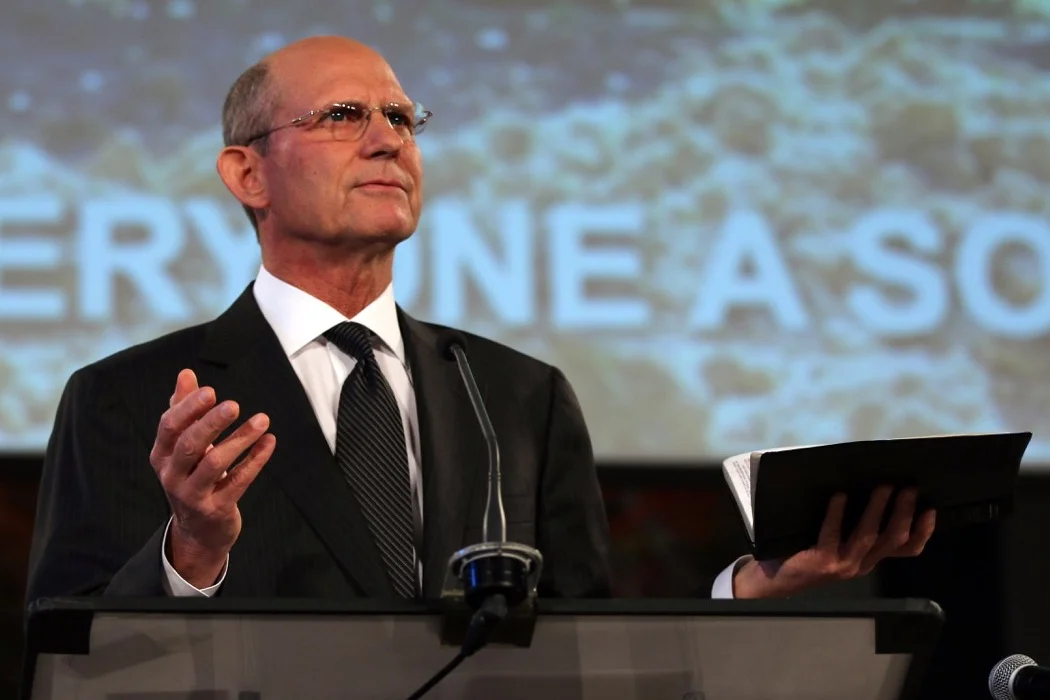
Ted N. C. Wilson is president of the Seventh-day Adventist world church.