
NOTE: This article appeared as the Sunday reading of the Annual Week of Prayer in the September 2025 edition of Adventist World.
When vandals broke the hands off a statue of Jesus outside a church in San Diego, California, a church worker placed a sign where it could be seen by passing motorists. Rather than a message of condemnation for those responsible for the damage, it was a message that appealed to the world. The sign read: “I have no hands but yours.”
Immediately before Jesus left our planet and ascended to heaven, He said to His closest friends, “You shall be witnesses to Me in Jerusalem, and in all Judea and Samaria, and to the end of the earth” (Acts 1:8). These words were an echo of what Jesus said in Matthew 28:19, 20: “Go therefore and make disciples of all the nations, baptizing them in the name of the Father and of the Son and of the Holy Spirit, teaching them to observe all things that I have commanded you.”
The Great Commission communicates an important truth. Jesus has no hands but those of His followers. As He farewelled His disciples, He committed to them the work of reaching a lost world with the saving message of the gospel.
Today, of the more than 8 billion people in the world, it is estimated that less than 2.5 billion are Christian [1]. Many of the roughly 5.5 billion people who are not Christian have never even heard of Jesus or the cross. How, then, is the church, or the church member, to impact such a vast population?
The Lost Ones
In Luke 15 Jesus taught three separate parables for the purpose of encouraging His people to take hold of the privilege of sharing Jesus with others. While similar in nature, the parables emphasize different truths. The prodigal son was cured of his self-centeredness after losing all he thought would bring him happiness. Remembering the love he had experienced, he returned home minus both his money and his pride, willing to accept the role of a servant if it meant he could be reunited with his father. The parable of the lost son teaches something important about the heart of God. Although a person may choose to abandon God, God does not abandon the lost. While in a pigsty, hunger gnawing at his stomach, the young man “came to his senses” (Luke 15:17, NASB) as he heard the Spirit of God speaking to his heart. The Holy Spirit still pursues wandering sinners, appealing to them that they return to the security of God’s loving heart. God does not leave the lost to find their own way home.
Unlike the prodigal son, the coin lost in the home of its owner did not know it was lost. Its owner swept and searched until she found her valuable possession. While the woman who had lost her silver coin lost something of value, and the father had lost one of his sons, another parable tells the story of a man who lost only 1 percent of his flock. While horses can sell for millions of dollars, and bulls and cows may sell for many thousands, a typical sheep is not especially valuable. Yet in the parable of the lost sheep, a shepherd leaves 99 sheep to venture into the potentially dangerous countryside in order to bring back one sheep.
It is a wonder the shepherd even knew one of his sheep was missing. It is impossible, merely by looking, to distinguish between 100 sheep and 99 sheep. Clearly this shepherd watched his flock carefully, indicative of the immense love God has for His wayward children. God notices when one of His children wanders off, and cares enough to be willing to undertake the most costly rescue mission in the history of the universe.
In The Desire of Ages Ellen White writes: “One soul is of such value that, in comparison with it, worlds sink into insignificance” [2].
Jesus’ question to the Pharisees is directed today to His church: “What man of you, having a hundred sheep, if he loses one of them, does not leave the ninety-nine in the wilderness, and go after the one which is lost until he finds it?” (Luke 15:4). It was a rhetorical question. Of course they would search for a lost sheep! As Jesus said on another occasion: “Of how much more value then is a man than a sheep?” (Matt. 12:12).
What God Sees
Walking near my home, I heard a soft thud on the ground beside me. Investigating, I saw a small, strange-looking creature with markings that resembled eyes, and two antennae that moved from side to side. I photographed and filmed the caterpillar-like creature and went home to show my wife.
Her response was direct. “Where is it? We have to save it! Take me to it right away!” Grabbing a container, she walked out into the street, scooped it up, and brought it home. After a quick online search she discovered it was the larva of an eastern tiger swallowtail butterfly.
After preparing it a home, she placed the larva in its new habitat. We waited and watched, but in the days that followed, it seemed to do nothing at all. A couple of weeks later I received an excited text from my wife. “Look at this!” she wrote. While no one was watching, a beautiful yellowand-black butterfly had emerged. It spread its wings in the warm sunlight before soaring high into the air and flying off to places unknown.
While I saw a bug, my wife saw what it might be, and was moved by compassion for a helpless creature. Where you see a lost person, God sees what could be a bold witness for the truth. Where you see someone who has no respect for the Bible, God sees a potential church school teacher, a pastor, or a missionary. Where you see a careless soul, God sees someone He can transform and then use to share the light of the gospel with others.
With billions of people in the world without a saving knowledge of Jesus and heading for a Christless grave, compassion demands we reach someone with the good news of salvation through Christ. While some saw a demon-possessed man, Jesus saw a missionary, who, soon after, “departed and began to proclaim in Decapolis all that Jesus had done for him” (Mark 5:20). After encountering Jesus, the woman at the well hurried to her home a gospel worker. “ ‘Come, see a Man who told me all things that I ever did. Could this be the Christ?’ . . . And many of the Samaritans of that city believed in Him because of the word of the woman who testified, ‘He told me all that I ever did’ ” (John 4:29-39).
“This gospel of the kingdom will be preached in all the world as a witness to all the nations, and then the end will come” (Matt. 24:14). Jesus speaks to His church today and says, “I have no hands but yours.”
REFERENCES
Pam Wasserman, “World Population by Religion: A Global Tapestry of Faith,” Jan. 12, 2024, https://populationeducation. org/world-population-by-religion-a-global-tapestry-of-faith/, accessed Jan. 21, 2025.
Ellen G. White, The Desire of Ages, p. 578.
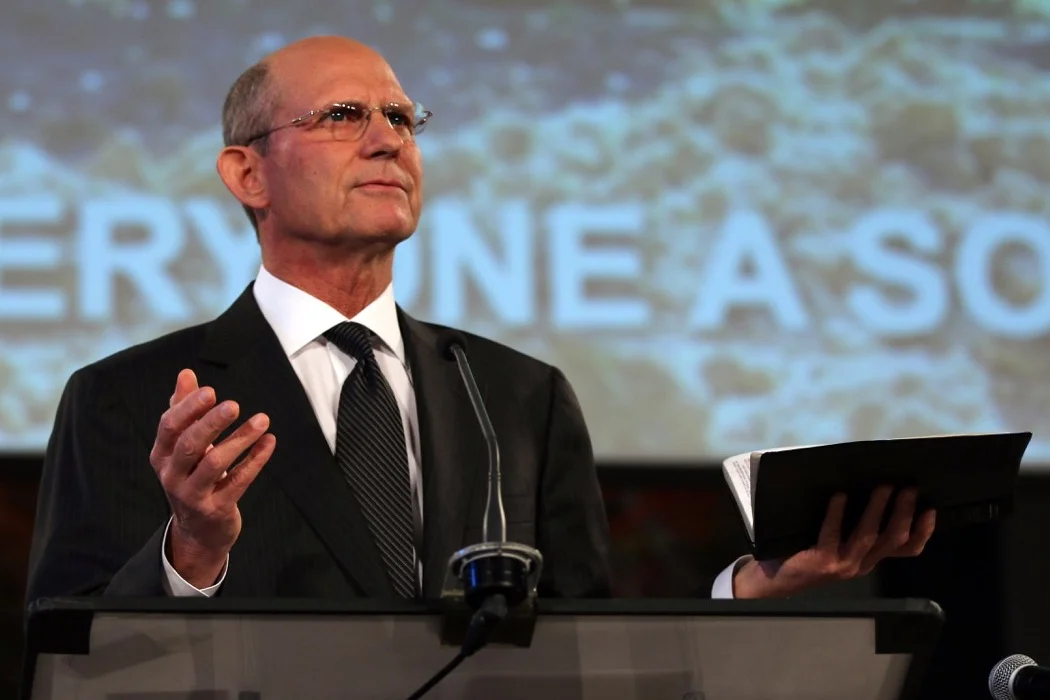
Ted N. C. Wilson served as president of the Seventh-day Adventist world church from 2010-2025.