• About
  • Submit Article
  • Style Guide
  • Writing Agreement
  • Podcast
  • Subscribe
  • Donate
  • Archive
  • Comment Policy
  • Contact
Menu

ADvindicate

11256 Benton Street
Loma Linda, CA, 92354
Phone Number
Reasoning from Scripture

Reasoning from Scripture

ADvindicate

  • About
  • Writers
    • Submit Article
    • Style Guide
    • Writing Agreement
  • Podcast
  • Subscribe
  • Donate
  • Archive
  • Comment Policy
  • Contact

What is an apostle?

January 15, 2013 Brent Shakespeare
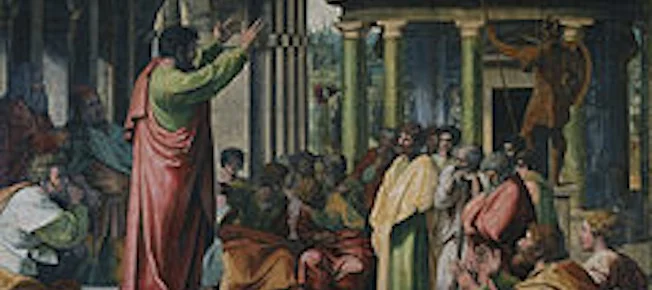
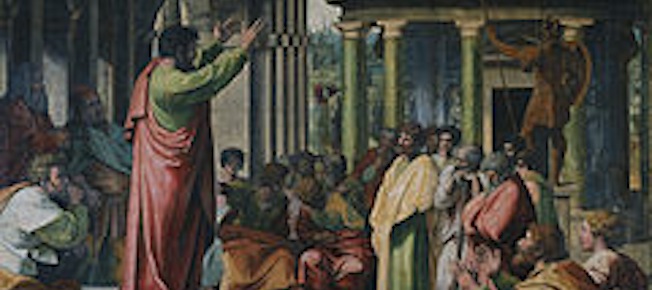
Paul-preaching.jpeg

Paul preachingDuring the current discussions regarding leadership roles within the church, one area often referenced is that of an apostle.[1] What is an apostle? what are the qualifications? Is an apostle ordained to an office, or is it an inner calling manifested in a Spiritual Gift or both? What relevance is the apostle in the church today, and is the office or gift of apostle gender specific, or inclusive? The object of this article is to come to some initial conclusions regarding this type of ministry.

Statistical Findings

The Greek word for apostle is apostolos.[2] Apostolos is used 81 times in the N.T. It is used only once each in Matthew and Mark, six in Luke and 30 in Acts. Except for four references in Jude and Revelation, the remaining 38 references are found in Paul’s writings.

Etymology

Originally, the Greek word for apostle, apostolos, was used as an adjective.[3] Initially it denoted the dispatch of a “fleet (or army) on a military expedition.”[4] Later, it came to be applied to “the fleet itself and acquired the meaning of a naval expedition.”[5] Finally, it referred to a “group of men sent out for a particular purpose, e.g., an army . . . [or a] band of colonists.”[6] In Cynic-Stoic philosophy, it is a “technical term for commissioning and authorizing by a deity.”[7] And in Greek culture, an apostle was known as “the champion of one religion"--missionaries for “religious propaganda.”[8] When looking at Jewish literature, the term apostolos was “not widely used. . . [and] the term appears only twice in Josephus.”[9]

Word Group

The broader word group of which apostolos is associated, includes the verb apostello. “The frequency of apostello reflects the importance of being commissioned.”[10] “The noun apostole derives its meaning from apostello, and it describes the office of an apostle (apostolate), or the act of sending rather than the thing sent. In secular usage it was a noun of action used for the sending of ships, the shooting of a missile, and the sending of a mummy. It also described the sending of an expedition.”[11]

Lexical Meanings

The meanings for apostolos in First Century Greek were:

1) One sent forth (apo, from stello- to send)[12], ambassador[13], delegate[14], agent[15], envoy[16], any messenger[17]-in a general sense- anyone sent[18] (on a mission[19], service[20], business[21], assignment[22] or errand[23]), bearer of a commission[24], represent another person some way.[25]

2 ) Fleet, an expedition,[26] sea-faring and military expeditions[27].

Interestingly, in the N.T. apostolos never means the act of sending. It “always denotes a man who is sent, and sent with full authority.”[28] New Testament theologian Gerhard Kittel has commented that apostolos is a “commissioned representative of a congregation. . . [and] a bearer of the NT message.”[29]

Pre-Eminent Apostle: Jesus Christ

The first mention of an apostle in the New Testament is in the life of Jesus Himself. In His final prayer, Jesus declared that the Father had “sent”[30] Him. Throughout His life He had “manifested” the Father’s name,[31] “glorified” Him on earth[32] and represented Him so perfectly that when seeing Him, you saw “the Father.”[33] Jesus was sent as an Ambassador and Delegate of the Father. He was truly the first apostle, not only in time but in primacy. In fact, Hebrews makes this clear when it describes Him as “the Apostle and High priest of our profession.”[34] New Testament scholar Don Dent has noted that “before He sent out His own apostles, Jesus was Himself God’s apostle to the world. . . Jesus did not ask His apostles to do anything that He Himself had not already done.“[35] Therefore, when we consider the N.T. evidence for apostolos, we start with the Pattern for all others--Jesus Christ.

PHASE ONE: The Twelve

Jesus choose twelve men from those who followed Him, and named them apostles (“whom he also named apostles“[36]). Ellen White comments on the reason why Jesus did this, “that He might send them forth as His witnesses, to declare to the world what they had seen and heard of Him.”[37] Later, Jesus “sent”[38] His apostles on a missionary tour, for the purpose of proclaiming “the kingdom of God,”[39] “healing the sick,”[40] and “preaching the gospel.”[41] The criteria for belonging to this elite group was:

1) They must be with Jesus to witness His ministry[42]- “beginning from the baptism of John,” His ascension and “resurrection.”[43]

2) They would be “sent out to preach.”[44]

3) They were to “have power to heal the sick and cast out devils.”[45]

The Twelve continued to intact after Pentecost[46], but their mission shifted from being Ambassadors of Christ on earth, to the risen Christ in Heaven. The success of their mission was a result of two primary factors: first, they had been empowered by the Holy Spirit at Pentecost, second, they had been direct witnesses of Jesus’ ministry and learners of His teachings. The combination of these two factors enabled them “with great power” to give “witness of the resurrection of the Lord.”[47] The Twelve had been trained and experienced in entering new places to prepare the way for the Jesus to enter, as a result they played a critical role in leading a movement that was spreading out from Jerusalem.[48]

PHASE TWO: Office of Apostle

After the resurrection and ascension of Jesus, the disciples were no longer in training. While Christ was with them personally, they were simply referred to as apostles. In Acts 1:25, the disciples prayed that God would show them who should take Judas’ position, that “he may take part of this ministry and apostleship (apostole). . .” (KJV). This is the first instance that the work and role of the apostles was referred to as an office or an organized function. The word “apostleship” (apostole) has three basic meanings:

1) Sending away, sending off (of troops[49]),[50] dispatching,[51] expedition of ships[52], mission,[53] expedition[54]

2) Discharge, dismissal,[55] release[56]

3) Office of Apostle,[57] apostleship,[58] office of Apostolate,[59] special role of elite Ambassadorship,[60] office of one sent,[61] office of a special emissary.[62]

The first two definitions of “apostole” don’t seem to fit the context of Acts 1:25, since it is referring to a collective group or company of people. In commenting on Judas’ fall, the disciples recognized that he had left their assembly (Acts 1:25- “. . . apostleship, from which Judas by transgression fell“), thus the reference to an office. This office of The Twelve was a singular, non-repeatable ministry in the history of the church. Ellen White comments that “their office was the most important to which human beings had ever been called, and was second only to that of Christ Himself.”[63] They had been commissioned by Jesus as direct witnesses of His life.  Ellen White seems to confirm this understanding when she wrote that “the twelve were called to the apostolate.”[64]

Interestingly, when The Twelve are mentioned in the N.T., the context contains words or phrases which identifies them[65]. When apostolos is referring to The Twelve, the following indicators confirm their identity: 1) the number twelve, 2) the specific names of the twelve (“Peter,” “John,” etc.), 3) Jesus in person, while He walked on earth, 4) the definite article preceding the word apostles ("THE Apostles"- Gr.-tous, tois, ton apostolos), and 5) the context (Acts 1:2- “He had chosen”; Acts 4:33- “witness to the resurrection”; 2 Pet. 3:2- “apostles of the Lord”, etc.). When one or any of these contextual markers are present, Scripture is signaling that the passage is only referring to this special office of the twelve apostles.

PHASE THREE: Paul and companions[66]

The expansion of the ministry of “apostolos” is seen in the work of Paul and his companions, Barnabas and Silas. “Paul was an apostle . . . because Jesus commissioned and sent him to accomplish His purpose. His commission was divine, because Jesus chose and sent him.”[67] “Galatians 1:1 makes it clear that Paul’s apostleship was not based on any human mediator, but was divinely authorized.”[68] Paul uses apostolos fourteen times for himself alone.[69]

There came a point, after Paul had been working for about one year, that both he and Barnabas were ordained as special messengers to the Gentiles. “The Holy Spirit said, ‘Separate Me Barnabas and Saul for the work I have called them.’ When they had fasted and prayed, and laid their hands on them, they sent them away” (Acts 13:2,3). Ellen White comments on this incident, “before being sent forth as missionaries to the heathen world [they] were solemnly dedicated to God by fasting and prayer and the laying on of hands.”[70]

Interestingly, Paul and Barnabas were called “missionaries” in this passage. This seems to be the modern equivalent of the word “apostolos." Paul references this “rite” later when he declares “I am ordained (KJV- set, put- footnote- not making a case for the meaning of ord.) a preacher and an apostle.”[71] It was at this point that Paul considered himself an apostle. Again, Ellen White comments on this incident, “Paul regarded the occasion of his formal ordination as marking the beginning of a new and important epoch in his lifework. It was from the time of this solemn ceremony, when, just before he was to depart on his first missionary Journey . . . that he afterward dated the beginning of his apostleship in the Christian church.”[72]

From this time onward, Paul introduces himself as an apostle,[73] and more specifically “an apostle to the Gentiles.”[74] His apostleship[75] appears to be specialized and singular, just as the office of the twelve was. In an apparent paradox, he calls himself “the least of the apostles, not worthy to be called an apostle,”[76] and yet asserts that he was “not inferior to the most eminent apostles.”[77] He basically declared that although his role as an apostle was different than the twelve, in taking the Gospel Commission to the Gentiles,he was not inferior to them.[78] The office of apostle (apostole) also applies to Paul and his companions. He refers to this three times in his own ministry: “we have received . . . Apostleship,”[79] “the seal of my apostleship,”[80] “Peter to the apostleship.”[81]

Interestingly, Luke calls Paul and Barnabas apostles “only after they go on their first missionary journey.“[82] It was when Paul and Barnabas were fulfilling the Great Commission that they were considered apostolos. They were on an “equal footing with the prominent apostles, but with a different sphere of ministry.”[83]  Paul personally recruited both Silas and Timothy to join his missionary team, and their ministry functioned under his leadership (Acts 15:40-16:3). The fulfillment of the Gospel Commission through the labors of Paul, Barnabas, and his companions[84] completed this “phase” of the role of apostolos.

First Thess. 2:6-7 refers to Paul, Silvanus (Silas) and Timothy as apostolos. The most straightforward reading is that these three men were foundational as a “planting team” bringing the gospel to this city. “Paul considered Silas and Timothy to be apostles in close association with his own apostleship. Paul considered those who worked with him preaching the gospel and establishing new churches to be apostles of Christ.”[85]

PHASE FOUR: The Gift of Apostle

A shift in the biblical meaning of apostles took place after the initial establishment of churches. Up until this time the term apostolos was limited to those God had directly commissioned or ordained to fulfill the initial phase of the Gospel Commission. After the twelve, Paul and others had established churches, the apostolos became a spiritual gift through the agency of the Holy Spirit. It was no longer limited to the early church founders, but rather, those whom God gifted to be missionaries from the established churches. Ellen White explains:

Later in the history of the early Church, when in various parts of the world many groups of believers had been formed into churches, the organization of the church was further perfected. . . Some were endowed by the Holy Spirit with Special Gifts ‘and God has set some in the church, first apostles, secondarily prophets, thirdly teachers . . .’ [1 Cor. 12:28 quoted]. (my emphasis)[86]

Therefore, when the N.T. refers to the “Gift of Apostolos”- it seems to refer to the time after the initial establishment of churches had taken place (by the twelve, Paul, Barnabas, etc.), and the need for missionaries to be sent out from them was needed. Apostles have been needed in all ages and in all times since the apostolate closed in the first century. “Apostles are the first in a sequence of persons who build the church. . . [and] there is every indication that the gift was intended to be on-going.”[87] “Apostles lay the foundation of the church. Their ministry focuses on the initial stage of church planting. This work can be strenuous and ‘dirty’ and often forgotten by those who come in later stages, but the apostle is critical in establishing the strong base and general pattern for the church within a specific geographic or ethno-linguistic boundary.”[88] “Paul makes a careful distinction between their function as apostles and the calling as apostles of Christ to plant churches among the nations, by adding the modifier- ‘apostles OF CHRIST,’ ‘apostles OF THE CHURCHES’ or ‘apostles BEFORE ME.’”[89]

The debate regarding the ongoing role of apostles centers around whether Paul was teaching that missionary apostles are an on-going gift (1 Cor. 12:28 and Eph. 4:11), or whether he meant the unique ministries of eyewitnesses and specifically commissioned apostles. “The context of each passage seems to imply an on-going gift. The gift list in 1 Cor. 12 is in a chapter that emphasizes the diversity of gifts; the Body of Christ is not complete without all of them. If Paul assumed that apostles were not an on-going gift to the church, it seems incongruent with the basic argument of the chapter.”[90] The gifts mentioned in Ephesians 4:11 are given for the purpose of “equipping the saints to build up the church until we all attain to the fullness of Christ.”[91]

New Testament scholar Harold Hoehner has stated, “apostle [in Eph. 4:11, 1 Cor. 12:28] refers to . . . the gift of apostle. There were people in addition to the original twelve who had not been with Jesus in His ministry and did not witness His resurrection but who are listed as apostles. . . It seems the main function of an apostle is to establish churches in areas that have not been reached by others.”[92] Ephesians 4:11 teaches that the gift of Apostle is given until the Second Coming.[93]

Apostles are the first gift, though we should understand this as a priority of sequence rather than of status. In practical terms, the other gifts are on hold until apostle has planted the new church. As a “Gift of the Spirit”--“the church does not ‘raise up’ its apostles, but responds to the apostolic witness.”[94] Scholar David Garland notes: “Apostles appear first as the founders of the church communities.”[95]

Conclusion

This brief survey of apostolos highlights the fact that “New Testament writers, and especially Paul, did not limit the use of apostolos to eyewitnesses. . . He viewed the apostles primarily as those who were commissioned for spreading the faith. . . And Paul’s basic concept when using the word is the missionary role of church planting.”[96]

Apostolos has an evolving meaning in the New Testament. As was suggested, it goes through four general phases: Phase One: The Twelve- chosen by Jesus as His special witnesses of His Ministry from His baptism to His ascension; Phase Two: After Jesus ascension, their “training” had been completed, and they filled the office of the apostle. Their mission was to initiate and spread the Gospel Commission Jesus gave in Matt. 28, especially to the Jews; Phase Three: was seen in the ministry and office of Paul and his companions, in taking the gospel to the Gentiles, and planting churches throughout Asia and Asia Minor; Phase Four: represented a shift from an office to a spiritual gift. As delineated in 1 Cor. 12 and Eph. 4, the gift of apostle is gender inclusive, and based on an inner calling from God to a ministry of His choosing. “Apostles include men and women and children called and sent by God to fulfill the Great Commission through planting churches in pioneer areas.”[97] Therefore, it is not gender or age specific, but Spirit inspired and commissioned.

Reflections

Our understanding of the on-going role of apostles has several implications for our mission work in the modern church. The following application of the New Testament “Gift of Apostles” is worth noting:

1) Present day missionaries who proclaim the gospel and plant churches where Christ is not known, fulfill the same function as missionary apostles in the New Testament. While not all overseas ministry is apostolic in this sense, missions in every generation should prioritize this foundational role of apostles.

2 ) Mission work should develop with apostles as the base because they are God’s gift to lay the foundation of the church. Mission practice that is not built on apostles will likely have an inadequate foundation.

3 ) Apostles come from the churches, but the New Testament emphasizes that churches come from apostles.

4 ) The biblical model for the partnership of established churches with the work of apostles includes commissioning and releasing those who are called by God, hearing and affirming reports of what God is doing in pioneer areas, contributing to the financial support of apostles working in foreign lands.

5 ) When we view the apostle concept in terms of a spiritual gift fulfilled in a function, rather than an ecclesiastical office- we understand that “Apostleship” is not tied to a status, but to a task.[98]

Footnotes [1] Doug Batchelor, (Taken from An open letter from Doug Batchelor regarding the response to his sermon) Women’s Ordination:

A Biblical Prospective” On February 6, 2010, I presented a message to my home church in Sacramento, California. While Jesus engaged women to share the gospel, He called only men to serve in the capacity of apostle. When Judas died, his replacement was chosen from among men (Mark 3:14; Acts 1:21). This is just the beginning of the evidence.” http://www.womenministrytruth.com/portals/7/documents/An-Open-Letter-From-Pastor-Doug-Batchelor.pdf

Stephen Bohr--“Who intentionally chose 12 male apostles when there were women able in ministry that could have been chosen as well? Who chose to place the names of 12 males on the gates of the New Jerusalem and 12 males on the foundations of the city?” http://secretsunsealed.org/Downloads/newsletter2Q12web.pdf

Randy Roberts--“And Junia was identified by Paul as a leading apostle. Women filled every leadership role you can imagine.” http://session.adventistfaith.org/roberts-edited

[2] In the textus receptus

[3] Plat. Ep., VII, 346a; referenced in Kittel, Ibid, p. 407

[4] Kittel, Ibid, p. 407

[5] Kittel, Ibid, p. 407

[6] Kittel, Ibid, p. 407

[7] Kittel, Ibid, p. 409

[8] Kittel, Ibid, 411

[9] Kittel, Ibid, 411

[10] Don Dent, The Ongoing Role of Apostles in Missions: The Forgotten Foundation, p. 31

[11] Karl Rengstorf, “Apostello, exapostello, apostolos, pseudapostolos, apostole.” TDNT, ed. Gerhard Kittle, 1:398-446

The word appears four times in the New Testament (Acts 1:25; Rom. 1:5; 1 Cor. 9:2; Gal. 2:8)

[12] W.E. Vine; Expository Dictionary of N.T. Words

[13] Hermann Cremer, Biblico-Theological Lexicon of the New Testament

[14] Joseph H. Thayer; Thayer’s Greek-English Lexicon of the New Testament

[15] S. Bagster, The Analytical Greek Lexicon

[16] Walter Bauer, Greek-English Lexicon

[17] Edward Robinson, Greek and English Lexicon of the New Testament

E.W. Bullinger; Critical Lexicon and Concordance to the English and Greek N.T. George Berry; Greek-English Lexicon

[18] Hermann Cremer, Biblico-Theological Lexicon of the New Testament

[19] George Abbott-Smith, A Manual Greek Lexicon of the New Testament

[20] Henry George Liddell & Robert Scott; A Greek-English Lexicon

[21] Samuel C. Loveland; A Greek Lexicon: Adapted to the N.T.: with English Definitions

[22] Frederick William Danker, The Concise Greek-English Lexicon of the New Testament

[23] Samuel C. Loveland; A Greek Lexicon: Adapted to the N.T.: with English Definitions

[24] S. Bagster, The Analytical Greek Lexicon

[25] Alexander Souter; A pocket Lexicon to the Greek N.T.

[26] George Abbott-Smith, A Manual Greek Lexicon of the New Testament

Theologian Gerhard Kittel has noted- “Only occasionally in the Gk. Field does apostolos have a meaning related or apparently related ot that which it bears in the NT. . . In the older period apostolos is one of the special terms bound up with sea-faring, and more particularly with military expeditions; it almost a technical political term in this sense.”

(Gerhard Kittel, Theological Dictionary of the New Testament, Vol. 1, p. 407)

[27] In the older period apostolos is one of the special terms bound up with sea-faring, and more particularly with military expeditions; it almost a technical political term in this sense. (Gerhard Kittel, Theological Dictionary of the New Testament, Vol. 1, p. 407)

[28]  Throughout the NT the word is used only of men, although according to the course of things women might also have been called apostles. Yet this would have been a self-contradiction, since it is a legal term and women have very restricted legal competence in Judaism. (Kittel, Ibid, p. 421)

[29] Kittel, Ibid, 422

[30] John 17:21,25

[31] John 17:6

[32] John 17:4

[33] John 14:9

[34] Heb. 2:18

[35] Dent, Ibid, p. 34

[36] Matt. 10:2

[37] EG White, Desire of Ages, 291

[38] Luke 9:2

[39] Luke 9:2

[40] Luke 9:2

[41] Luke 9:6

[42] Mark 3:14

[43] Acts 1:22

[44] Acts 3:14

[45] Acts 3:14

[46] Mathias replaced Judas- Acts 1:25,26

[47] Acts 4:31

[48] Dent, Ibid, p. 37

[49] W. Bauer, Gr./Eng. Lexicon of the N.T.

[50]  Abbott-Smith, Gr. Lexicon of the N.T., Thayers, Gr..Eng. Lex. Of the N.T., E.W. Bullinger, Critical  Lexicon & Concordance to the Greek N.T., Henry Liddell & Robert Scott, Greek English Lexicon

[51] Cremer, Biblico-Theological Dict. Of Gr. N.T.

[52]   Ed. Robinson, Gr. & Eng. Lexicon of the N.T., Frederick Danker, Concise Gk/Eng. Lex. Of the N.T.

[53] Tyro’s Greek/English Lexicon

[54]  S. Bagster, Analytical Gr. N.T., W. Perschbacher, New Analytical Greek Lexicon

[55]  Abbott-Smith, Liddell & Scott, Ibid

[56] Thayers, Ibid

[57] Abbott-Smith, Robinson, Cremer, Perschbacher, Bullinger

[58] Tyro, Abbott-Smith, Robinson, Cremer, Thayer, Perschbacher, Danker

[59] Thayer, Ibid

[60] Danker, Ibid

[61] Bagster, Ibid

[62] Bauer , Ibid

[63] Desire of Ages, 291

[64] Desire of Ages, 290

[65]  The exception is when Paul is mentioned. The Definite article is used for him as well.

[66] 1 Thess 1:1 identifies Paul, Silvanus and Timothy as the authors of 1 Thessalonians.

1.2. The man identified as Silvanus (Greek = Silouanos) in 1 Thess 1:1 as one of the authors of the letter is the same man known as Silas (Silas) in the Book of Acts. This is obvious from the fact that the movements of "Silvanus" in Paul's letters (1 Thess 1:1; 2 Thess 1:1; 2 Cor 1:19; see 1 Pet 5:12) coincide with those of "Silas" in the Book of Acts (Acts 15:22, 27, 32 (34), 40; 16:19, 25, 29; 17:4, 10, 14, 15; 18:5). This man's given name was Silas, which was a Jewish name (see Josephus, War 2.520; 3.11, 20; Ant. 14.40; 18.204; Life 89-90, 272; t. Ber. 2.10); he took a similar sounding Roman name, Silvanus, presumably in order to facilitate his evangelistic work. http://www.abu.nb.ca/courses/ntintro/1thess.htm

[67] Dent, Ibid, p. 39

[68] Dent, Ibid, p. 39

[69] Rom. 1:1; 11:13; 1 Cor. 1:1, 9:1,2; 2 Cor. 1:1; Gal. 1:1; Eph. 1:1; Col. 1:1; 1 Tim. 1:1; 2:7; 2 Tim. 1:1,11; Tit. 1:1

[70] RH 5/11/11

[71] 1 Ti. 2:7; 2 Ti. 1:11

[72] The Review and Herald, May 11, 1911

“Paul regarded his ordination as marking a new epoch in his life. From this time he afterward dated the beginning of his apostleship.” (Trials to Triumph, 87)

[73]1 Cor. 1:1; 2 Cor. 1:1; Gal. 1:1; Eph. 1:1; Col. 1:1; 1 Ti. 1:1; 2 Ti 1:1; Tit. 1:1

[74] Rom. 11:13

[75] 1 Cor. 9:

[76] 1 Cor. 15:9

[77] 2 Cor. 11:5- “most eminent” most likely referring to the Twelve Apostles.

[78] It was not to exalt self, but to magnify the grace of God, that Paul thus presented to those who were denying his apostleship, proof that he was “not a whit behind the very chiefest apostles.” 2 Corinthians 11:5. Those who sought to belittle his calling and his work were fighting against Christ, whose grace and power were manifested through Paul. The apostle was forced, by the opposition of his enemies, to take a decided stand in maintaining his position and authority. (AA 388)

[79] Rom. 1:5

[80] 1 Cor. 9:2

[81] Gal. 2:8

[82] Acts 4:36 and 9:27

[83] F.F. Bruce, Paul: Apostle of the Heart Set Free, 12

[84] Silas and Timothy according to Col. 1:23.

[85] Dent, Ibid, p. 53

[86] Ellen G. White, Acts of the Apostles, p. 91, 92

[87] Dent, Ibid, p. 64

[88] Dent, Ibid, p. 64

[89] Ellis, E. Earle, “Paul and his co-workers,” p. 445

[90] Crag S. Keener, Gift and Giver, p. 105

[91] Dent, Ibid, p. 58

[92] Harold Hoehner, “Ephesians, An Exegetical Commentary,” p. 541

[93] Craig S. Keener, Gift and Giver, p. 128

[94] Anthony Thiselton, The First Epistle to the Corinthians: A Commentary on the Greek Text, p. 1014

[95] David E. Garland, 2 Corinthians, p. 59

[96] Dent, Ibid, p. 5

[97] Dent, Ibid, p. 6

[98] Adapted from Dent, Ibid, p. 64,65

Tags apostle, brent shakespeare, feature, ordination, paul, women

'One wife husband'

July 25, 2012 Brent Shakespeare
Man-Reading-Bible31.jpg

Observations of 1 Timothy 3:1,2 & Titus 1:5,6

Adult man reading the BibleBoth proponents and opponents of women’s ordination have staked their claim to divergent interpretations of 1 Timothy 3:1,2 and Titus 1:5,6. While some see a plain reading of the verses as clear enough, others are challenging these passages with legitimate, yet more complex textual arguments. What did Paul mean when he wrote that a “bishop . . . [should be] the husband of one wife”? Or literally translated- “a bishop . . . [should be] a one wife husband“? Some view this passage through the lens of “culture”- claiming it should be applied to different times and places in “relevant“ ways. In a future article I will review why the “culturally-conditioned” argument is nothing more than subjectivism since it relies on conjectures, guesses and the social sciences (sociology, anthropology, etc.) rather than the biblical text. Furthermore, it constantly changes with time and location. Recently, some have jettisoned the “culturally-conditioned” argument for a “leading of the Spirit” one. Going so far as to claim that the Spirit cannot fall on the church until it ordains women as pastors and elders. Unfortunately, this is biblically untenable. The conditions for the “Latter Rain” are clearly outlined in Acts 2,3 and Revelation 3:18-20- and women‘s ordination is nowhere mentioned. One often hears the assertion “no conference, union or church should stand in the way of God‘s calling to me . . .” In my last article, we saw that the position of “pastor” (poimen) can indeed be filled by a women- since it is a “Spiritual Gift.” However, the functions of the “pastor” are NOT the same as those of the “bishop” (episkopos) and the “elder” (presbuteros) which are NOT spiritual gifts! Certain objective qualifications must be met before one can “apply“ for those positions (including 1 Timothy 3:1-7). Furthermore, the Spirit does NOT lead the church independently from the written Word He inspired. If some feel God is leading them to become “Bishops“ or “Elders,” the only way to confirm this would be with the “Measuring stick” of Scripture.

Still others feel that to continue “debating theology” is not “biblically practical”, that we don’t need theoretical perspectives, but to focus on being “mission-driven.” They see this “theological” argument as getting in the way of the mission of the church, an ecclesiological issue. But instead of carefully examining the text of Scripture and following a “thus saith the Lord”, they are using pragmatic and emotional reasons (women “pastors” in China, etc.) to buttress their position. “Legal” but questionable policy changes are being hastily pursued in order to vote in changes before the world church can study the issue and respond. These efforts, based on faulty hermeneutics, threaten to further disrupt the global unity of the church.

While this “mission-driven-movement” sounds nice and very “Adventist,” if it is not on rooted in Scripture, but on policy or ecclesiology- the efforts will be unsuccessful. For all these reasons (and others), it is helpful to re-visit the texts upon which those who oppose and affirm women “elders” are based: 1 Timothy 3:1,2 and Titus 1:5-7. My purpose is not to present a scholarly exegesis- but an overview of the clear textual evidence.

Grammatical Considerations

“The fact of gender, when considering a word in isolation, is of little importance . . . But in analyzing a sentence as a whole, gender may play a key role, especially when considered along with the adjectives, pronouns, and relative clauses that may be present. Taking note of the gender may alter altogether what a sentence may seem to be saying in English.” Interestingly, in Titus 1:5, the word “elder” (presbuteros) is in the accusative masculine. In the context of verses 5-7, nine of the descriptive nouns and adjectives of presbuteros are in the masculine. In 1 Timothy 3:2, the word for “bishop” (episkopos) is also in the accusative masculine. In the context of 1 Timothy 3:2, there are eight descriptive nouns and adjectives which are also in the masculine. These grammatical parallels seem more than just coincidental. While it doesn’t definitively show that an “elder” or “bishop” should be a “male,” it is grammatically consistent with that conclusion and strongly points that way.

Lexical Considerations

1. “Elder,” “bishop,” “pastor” are different, distinct offices

In the last article we saw that the offices of “elder,” “bishop,” and “pastor” (presbuteros, episkopos, poimen) are distinct, although (as we noted) there is some overlap between them. To summarize the findings: the “elder” (presbuteros) deals primarily with executive, administrative and judicial areas of church policy. The “bishop” (episkopos) has supervisory, investigative and guardianship functions, while the “pastor” (poimen) is nurturing, guarding and teaching. We also saw that the “elder” and “bishop” are recognized and selected based upon external, objective criteria (1 Timothy 3:1-7; Titus 1:6-8). After evaluation of the candidates based on these biblical standards, they are ordained. On the other hand, as we mentioned, the “pastor” is a spiritual gift that is recognized and affirmed without ordination and an explicit list of “external” qualifications. I described what seemed to be modern equivalent of these positions in the church today. (Please see previous article.)

The significance of these findings can’t be overstated, especially where Christians assert the Holy Spirit’s calling to be a “pastor”. Obviously, the word “pastor” doesn’t have the same meaning that it did in the Bible. So the etymology of this English word has undergone some changes since the New Testament. If one takes the position that the Holy Spirit has given them this gift then the position that they should fill is the poimen. However, if they desire to fulfill the role of the episkopos or presbuteros, even if they are called by the Spirit, they must be evaluated by criteria found in 1 Timothy 3:1-7 and Titus 1:5-7. The claim of the Spirit’s leading does not supersede the Spirit’s inspired word, which is used to “test” all “callings”.

2. Lexical (dictionary) meanings for episkopos and presbuteros are delineated for “men”

A word never means what it never meant. The purpose of a lexical (“dictionary”) definition, is to find out what a word meant at the time it was written. An important clue to what episkopos and presbuteros mean today is to understand their meaning when Paul penned Titus and 1 Timothy in the first century A.D. In order to do this, analytical, critical and theological Greek New Testament lexicons, expository Greek dictionaries, Greek-English concordances and New Testament Greek theological wordbooks should be consulted in order to understand. Strong’s Concordance has several weaknesses that I addressed in my previous article and should be probably be avoided when doing serious Bible study (at least it should not be used by itself).

A summary of the definitions are as follows:

Episkopos

  1. “The name given in Athens to the MEN sent into subdued states to conduct their affairs”
  2. “A MAN charged with the duty of seeing that things to be done by others rightly”

Presbuteros

  1. “A body of old MEN” (presbuterion) ; “An old MAN” (presbus, presbutis)
  2. “Rulers of people, judges, etc., selected from elderly MEN”
  3. “Aged MEN” ; “In the Christian church they were MEN appointed”
  4. “Old MEN of the Jewish Sanhedrin” “Officers in the congregation of the Jewish Synagogue”

Interestingly, one area that was intentionally left out of my last study, was the significant use of masculine names (“men,” “man,”) when defining presbuteros and episkopos. Since the purpose of that study was only to show that there is a difference between the three offices, these were omitted. However, from a lexical standpoint, it seems likely that both the “elder” and “bishop” were to be served by men. There is no dictionary definition from the era the New Testament was written that define these Greek words as being filled by “women.” This isn’t a “cultural” issue since the “men” were from both the believing “Jewish community“ (Jewish Sanhedrin, etc.) and the non-believing “Greek community” (Athenian statesmen, politicians). This further strengthens the case against gender neutral inclusion for an episkopos or presbuteros.

3. The lexical (dictionary) definition for “Aner” is limited to three possibilities

As with the preceding section, we must also understand what the meaning of the word translated “husband” (aner) was in the First Century. These meanings are:

  1. An adult human male (of full age and stature- as opposed to a child or female)
  2. A husband
  3. A human being, an individual; someone; a person, generally (in terms of address)

Interestingly, in all the lexicons consulted (around 12), the word aner never means a “female,” “woman,” etc., but can refer to “people in general.” On the other hand, it definitely refers to a “male” or a “husband.” The third definition shouldn’t be considered in Timothy or Titus, since the phrase “human being of one wife” makes no sense. “One wife husband,” or “one woman man” seem to be the clear interpretation of “aner.” Since the context refers to “children” (1 Tim. 3:4) a “wife” (v. 2) and a “house” (v. 4), the most logical and contextually consistent interpretation would be to translate “aner“ as “husband”. Therefore, the Greek phrase “mias gunaikos andra (aner)” should probably be translated “one wife husband.”

Why did Paul use a word that may not always be referring to a “male” (aner) rather than a word that always refers to a “man” (arsen - pronounced “Are-sane”)? Because arsen does not lexically mean “husband.” It seems that Paul was trying to convey both “maleness” and “marriedness” within the same word. Therefore, the best word he could have used is aner. Another word anthropos also means a “male”, but like arsen, doesn’t define the marital status as aner does. Understanding aner as being a “(male) husband” is a significant point buttressing the argument that a “bishop” must be a “ married man.”

Comparative Considerations

There are 215 references for the word aner in the New Testament. Of these, about 40% do not have “contextual markers.” A “marker” is a word(s) the author uses in context to identify which lexical (dictionary) meaning he intends for the word in question. These 40% are translated in the general sense of “humanity,” “people,” etc. Interestingly, however, when aner is to be interpreted as a “man” or “husband”, there are contextual markers that support that understanding. The remaining 60% have at least one of the following contextual markers:

  • NAME OF THE MAN: Mentioned in the immediate context (“Joseph”- Matt. 1:16; “Peter”- Luke 5:8; “Jairus”- Luke 8:41; “Zaccheus”- Luke 19:2; “Adam”- 1 Tim. 2:12; etc.).
  • FEMALE GENDER WORDS: In contradistinction from “males” in the same context (“Aged Women”- Titus 2:5; “Woman”- 1 Cor. 11:7; etc.).
  • MARRIAGE WORDS: Speak of a “male’s spouse” in contrast to himself (“Wife”- Mark 10:2, 12; “Wives”- Eph. 5:24,25; “Widows”- 1 Tim. 5:9; etc.).
  • FAMILY WORDS: Referring to male/female relations and progeny (“Women and children”- Matt. 14:21/Mk 6:44; “Father”- Lk 9:38; etc.).
  • REPRODUCTION WORDS: Contrasting a “male” with “female characteristics” (“Virginity”- Luke 2:36; “Adulteress”- Rom. 7:2; “adulterer”- Rom. 7:2,3; “Childbearing,“ etc.).
  • CONTEXT: There are times when the context makes it explicitly clear that “males“ are being spoken of (“twelve disciples”- Acts 1:21; The “Apostles”- Acts 5:25; “seven deacons”- Acts 6:3; etc.).

In 1 Timothy 3:2 there are several contextual markers that identify that a “male” is being spoken of: “Wife” (3:2; “Childbearing” (2:15), and “Woman” (2:11,12,14). In Titus 1:5,6, there is the marker “Wife” present. This contextual evidence strongly implies that a “bishop” and “elder” should only be a “male.”

Syntactical Considerations

The words “one woman man” or “one wife husband” (mias gunaikos andra) is an interesting and unusual way to communicate this phrase. If Paul wanted to convey a married man, why didn’t he say “a bishop must be a man who is married”? When we look at the syntax (sentence structure) we see that he was describing the quality or character of the man as well as his marital status.

The Greek word for “woman” is gune, and refers to any adult female (including wives). The King James Version translates gune as "woman" 129 times and "wife" 92 times. In 1 Timothy 3:2, gune (gunaikos) is “in the genitive and therefore deals with attribution. It may refer to relationship or quality, for the genitive defines by attributing a quality or relationship to the noun which it modifies."

Tony Capoccia has made the following insightful comment regarding the genitive:

“This should not be considered a possessive genitive, for that would mean that the word in the genitive indicates one who owns or possesses the noun it modifies. In that case the translation would be "a man owned by one woman." Nor can this be considered as a genitive of relationship ("a man who has [possesses] one wife") for there is no indication within the phrase or context that that relationship is implied. It is best to understand this "gunaikos" as being a genitive of quality, that is, giving a characteristic to the noun it modifies.”

The noun andra is the accusative singular of aner. “This accusative functions here as an object of the main verb ‘be’ along with a long list of other accusative nouns and participles. Stated simply, the clause is ‘Therefore . . . an elder must be . . . a man . . .’ The words ‘one woman’ modify "man" to explain what kind, or to qualify the noun by attributing to him this character.” N.T. Greek scholar Robertson adds that genitive of quality (also called attributive genitive). ‘expresses quality like an adjective indeed, but with more sharpness and distinctness.’ “Since the other qualification in 1 Timothy 3 deal with the man's character and since the grammatical structure is more naturally consistent with this emphasis, it seems best to understand the phrase as meaning that he is a one-woman type of man” or “a one-wife type of husband”.

In conclusion, the unique way of expressing the phrase “one wife husband” was Paul’s method of representing the “character” of "the bishop" ("ton episkopon") as well as his marital status. Syntax doesn’t negate the lexical, contextual and comparative evidence that has already shown that aner also refers to a “male husband.” Rather, the syntax shows what KIND of a “husband” Paul is referring to. Scholar Getz makes the following observation: "Paul needed it very clear that an elder in the church was to be a 'one-wife man' — loyal to her and her alone." The emphasis of sentence structure shows that the “bishop” must be completely faithful to his wife, and emphasizes moral purity. The syntax does not change the marital or gender status that we have already affirmed; it only clarifies its quality.

Theological/Contextual Considerations

The context of 1 Timothy 3:1,2 extends back into chapter two. The foundation of what Paul lays for the office of the episkopos, is rooted in the creation and fall account of Genesis two and three. The issue of “teaching” and “women keeping silence” is the subject of my next article, so I won’t address this interesting topic now. We see Paul addressing the “authority” of man over a “woman” for two reasons. First, “Adam was formed first” (v. 13). Second, “Adam was not deceived” (v. 14). Genesis two and three give us some clues of Adam’s role as the leader/head of his “home”:

  1. God gave Adam instructions on how to care for the Garden (2:15)
  2. God instructed Adam in regards to the Tree of Knowledge of Good and Evil
  3. Adam named all the living creatures (2:19,20)
  4. Adam named “the Woman” (2:23)
  5. Only after Adam ate the fruit, were their “eyes opened” (3:7)
  6. God called unto “Adam” first (3:9)
  7. Man shall leave parents, “cleave” unto his wife- a sign of protection, guardian

Interestingly, the roles of the episkopos and presbuteros are similar to those seen in Adam’s functions. The executive and administrative roles of the presbuteros are seen in Adam’s naming the animals, directing the custody of the garden, and naming of “the Woman”. The supervisory and investigative functions are seen in Adam’s role as the informant of God’s will concerning the Tree of Knowledge and man’s “leaving father and mother.” The second reason for man’s “authority” over “woman” was rooted in the statement “Adam was not deceived.” Adam momentarily “investigated” the matter in his mind and knew what was right. He chose to follow his wife, however, and sinned blatantly. His ability to discern the deception (while Eve did not) play a role in why Paul mentions that “Adam was not deceived.” However, most importantly, Paul’s foundation for 1 Timothy 3 is rooted in the Genesis creation and fall account, not culture.

Conclusions

Our overview of 1 Timothy 3:2 and Titus 1:6 shows that a convincing biblical argument can be made for a “male” “elder” or “bishop”. Grammatical considerations showed that contextual nouns and adjectives are in the masculine, thus matching the genders for episkopos and presbuteros. The lexical considerations gave additional evidence that the offices of the episkopos and presbuteros, whether as “rulers of people, judges, statesmen, Sanhedrin, etc.”, were filled by “men.” Furthermore, the definition for aner (“husband”) supports a “male”/“husband” understanding over “humans in general.” A comparative study (using contextual markers) demonstrated that aner, when referring to a “male,” contains at least one each in 1 Timothy 3:2 and Titus 1:6. Further supporting the contention that Paul intended “males” to be the episkopos and presbuteros in the church. The syntactical considerations emphasizes the character of the “husband” while not negating the gender. Finally, the theological/contextual considerations shows that the office of episkopos (and by extension the presbuteros) are rooted in the creation and fall account, not in culture.

References

All references for this article are available in a PDF file. Download PDF here.

Tags bible, brent shakespeare, church, feature, men, ordination, part 2, people, scripture, spotlight, women, womens ordination

PASTOR = BISHOP = ELDER? (Part I)

July 23, 2012 Brent Shakespeare
new-testament-600.jpg

New Testament GreekThere is a growing consensus within the Christian community regarding the role and authority of the “Elder,” “Pastor,” and “Bishop”. Many people see these New Testament positions as simply different names for the same office. Comments such as the following are common:

“There is no distinction between a pastor, a bishop or an elder in the scripture. They all refer to the exact same office. . . To put it simply: A pastor is a bishop is an elder.”

“All three Greek words [presbuteros, poimen, episkopos] refer to the same men, the same work. Pastors, elders, bishops and overseers are the same. The Bible uses all six English words (bishop, overseer, elder, presbyter, shepherd and pastor) interchangeably to refer to the same men, and so should we.”

This study will attempt to show there is a difference between these offices, and that we should not conflate the terms. The proposition is that the Holy Spirit has used different words to describe distinct and separate roles within the church. Certainly there is some overlap between these offices, and we should expect to see some redundancy. However, an examination of the linguistic, lexical and relational usages seems to demonstrate unique differences.

Presbuteros (“Elder”)

Linguistic

The Greek word most often translated “elder” in the New Testament is “presbuteros” (pronounced pres-boo'-ter-os). Presbuteros is formed from the root word presbus. This word has the general meaning of:

  1. Old man, an older person, natural dignity of age, more advance in age, implying dignity and wisdom.
  2. Ambassador
  3. Elder of Jewish/Christian Sanhedrin or Church, assembly of elders.
  4. Senators (Spartan Constitution)
  5. Local Dignitary

The overall meaning for the root word presbus can be summarized as: 1) an older person; 2) an ambassador; 3) administrative member of an assembly of elders; 4) involved with legislative and possibly judicial functions (senatorial position); and 5) a local dignitary.

Grammatical

When used to signify the comparative degree of a presbus (i.e.- “old man,” “an elder”), it is an adjective. When referring to a specific person, role or function (i.e.- a “leader” in the church), it is a noun. We will be looking at the noun for our study.

Definition(s)

(The meaning of the Greek words in this study, is based upon their usage and common understanding from the time period when the New Testament was written. From now on, I will refer to this category by the technical term, “Lexical”).

The Lexical meaning of this word can be summarized as follows:

  1. Administered justice.
  2. Rulers of the people.
  3. Officials in councils - - presiding over assemblies. Management of affairs (members of the Sanhedrin.)
  4. Ranked superior in age- in terms of official responsibility. (“Representatives of the older generation as compared to the younger”)
  5. Representatives of the people
  6. Spiritual care, exercise oversight over, overseers.
  7. Leaders in Congregational settings, “committed the direction and government of individual churches”
  8. Teachers in church.

Several distinct definitions emerge from this list. The presbuteros function in an administrative (officials in assemblies), judicial (administers justice) and executive (congregational assemblies) roles within the church. They also serve as “teachers” and “spiritual care givers”; however, these duties do not uniquely define their position. New Testament scholar Gerhard Kittel makes the following insightful comment: “in the constitution of Sparta presbus occurs as a political title to denote a president of a college . . . Presbuteroi have administrative and judicial functions . . . . And are charged with supervision of the finances and negotiations with the authorities . . . [and] men belonging to the senate.”

Comparative

Presbuteros is used 66 times in the New Testament. Regarding the administrative role, the presbuteros made managerial decisions—“assembled in council,” and “held consultation.” As executive leaders of the “church” they “persuaded the multitude”. Throughout Jesus’ ministry (and the Apostles’), they came with the challenge—“by what authority [power] do you teach in the temple?” Furthermore, they were involved in judicial activities—“they delivered Jesus to Pilate,” Jesus was “rejected of the presbuteros,” and was “accused of the presbuteros”.

In the Post-Resurrection era (i.e. the Christian Church), the functions of the presbuteros remained intact. The administrative capacity was seen when Paul and Barnabas came to Jerusalem and the presbuteros assembled “to consider the matter” of circumcision. Their executive decision was authoritative (in consultation with the Apostles), and their “decrees” were delivered to the churches. Their executive authority is seen at Ephesus, where Paul called the presbuteros together, giving them a mandate to “feed the church.” When relief was sent to the brethren at Antioch, it was sent to the presbuteros.

Their teaching responsibilities were affirmed as they labored in “word and in doctrine.” Their spiritual care can be seen in James’ call for the presbuteros to “pray over the sick. . . anointing them.” Both Paul and Peter addressed the presbuteros as “overseers”, showing that they fulfilled some of the same duties of the episkopos and the poimen (“bishops”, “pastors”).

In Titus 1:5-7 we see that the presbuteros and episkopos have overlapping roles. Paul exhorts the church to “ordain elders (presbuteros) in every city . . . For a bishop (episkopos) must be blameless . . .” Also, when Paul is addressing the “elders” (presbuteros) in Ephesus, he reminds them that “the Holy Ghost has made you overseers (episkopos)”. These passages affirm that a presbuteros CAN (and should) perform the duties of the episkopos but not the other way around. In a sense, the presbuteros must be a “master of all trades”—and the functions of the episkopos are included and incorporated into this office. Titus 1:5-7 confirms that the presbuteros is recognized as such through the ordination process. Furthermore, Paul calls for presbuteros to be ordained in “every city” and in “every church.”

The presbuteros were to be accorded double honor, and be “rewarded monetarily as is appropriate for the laborer is worthy of his wages.” Also, they “should not be accused unfairly or frivolously. An accusation should not even be received unless two or three gather to accuse and the ones who accuse are witnesses of the offense.” Interestingly, both Peter and John refer to themselves as presbuteros while Paul never does.

In conclusion, a linguistic, lexical, comparative overview shows that the primary functions of a presbuteros include administrative, legislative and judicial roles. Within the scope of their duties, are the functions of the episkopos (“overseeing,” etc.) and the “shepherding” roles of the poimen (“feeding,” “caring,” etc.). Dr. Mare summarizes these findings nicely: “Presbuteros is used in Christian contexts for leading officials in local (Acts 11:30; 14:23) and regional (Acts 15:2,4,6) ecclesiae (churches) to lead the church in doctrinal decisions (Acts 15:22f; 16:4), to be responsible for missionary endeavors (Acts 21:18,19), to supervise distribution to the physical needs of the congregations (Acts 11:30), and to guard churches from error (Acts 20:17-31). The position of presbuteros is confirmed through ordination, after a careful review of the qualifications by the church.”

Episcopes (“Bishop”)

Linguistic

The word translated “bishop” in the N.T. is episkopos (pronounced ep-is'-kop-os). Episkopos is made up of the words epi and skopos. The preposition epi has several definitions, but generally means: “towards,” “to,” “against,” “on,” “at,” “upon,” “near,” “for,“ etc. The root word skopos has the following meanings:

  1. Look, Peer into the distance at a goal, end, a mark.
  2. Examine, View attentively; look into one’s affairs- with reference to laws.
  3. Observer, Look out for, watch(er)- a hilltop or lookout-place, watch tower.
  4. Guardian, protector
  5. Spy, Scout, messenger sent to learn tidings.

The root word skopos has the general meaning of: 1) examining, looking attentively at; 2) watching; 3) guarding; and 4) scouting. Therefore, we could say that it refers to “looking towards,” “watching for,” “guarding at/near,” etc.

Grammatical

Episkopos is a masculine noun.

Lexical

The meaning of episkopos is summarized as follows:

  1. Inspecting (an inspector sent to Athens by the states) (In Cynic philosophy- a “Cynic preacher tests men, whether their lives conform to the truth. . . [and] strives for perception of the truth as the basis of moral and rational conduct.”)
  2. Overseeing, a watch- one who watches over- a man charged with seeing that things be done properly. (In the Odyssey, an episkopos is an overseer over goods as the work of a ship’s captain or merchant”)
  3. Scout (In Homer’s writings, an episkopos means a “scout or a spy.”)
  4. Guardian (Office of guardianship within a group), Guarding the apostolic tradition, Protector (Plato asserts that the episkopoi is one who “sees to it that there are no transgressions.“)
  5. Superintendent- supervisor (In Athens, episkopoi were “supervisors sent to the cities. . . . And were in some sense governors.”)
  6. Judicial- There seems to be some judicial element to the function of the Episcopes (it seems a minor role as compared to the presbuteros). State officials seemed “to have discharged, or supervised judicial functions.”

In combination with the root word skopos, we see several unique definitions for the episkopos compared to those for presbuteros. While there are some overlapping qualities (overseeing, teaching), the core responsibilities are primarily supervisory, investigative and guardian. The definitions of episkopos imply the office has a more intimate contact with the laity than with the presbuteros, being less administrative and more personal (“inspecting,” “guarding,” “watching”).

Comparative

Episkopos occurs five times in the New Testament, and confirms the basic Lexical meanings. Regarding the Guarding and Investigative functions—Paul reminds the bishop to be “vigilant.” He exhorts the bishop to “convince gainsayers, vain talkers, deceivers . . . .” He concludes by saying to “rebuke them sharply.” In 1 Peter 2:25, Jesus is referred to as the “guardian” (episkopos) of the soul. When speaking of supervisory function, Paul tells Timothy that the bishop must “rule his own house well. . . having his children in subjection.” He urges Titus that they “hold fast the faithful word . . . exhorting by sound doctrine,” while Peter commands them to “take the oversight . . . [and] feed the flock of God.” By extension, if the presbuteros is to be ordained as an episkopos, then an episkopos is also recognized through the process of ordination.

Other reasons why episkopos should be seen as a distinct role, 1) it is an “office”, “a man desires the office of a bishop”; 2) it is listed as distinct and separate with other offices, “with the bishops (Episkopos) and deacons”; and 3) the Apostles offices are included in being an episkopos, “his (Judas’) bishoprick (episkopee) let another take.”

In conclusion, the episkopos is a church officer whose roles include: “inspecting,” “overseeing,” and “superintending.” This Greek word was used specifically for those sent to conduct affairs of the state as a scout or watch of their jurisdiction. The position of episkopos is established through ordination. It is not a spiritual gift, and therefore there are objective criteria the church must evaluate before instating into position.

Poimen (“Pastor”)

Linguistic/Grammatical

The word translated “pastor” in the New Testament is the root word poimen (pronounced poy-mane'). This masculine noun is akin to poia, which means “to protect.” It is related to the verb poimano, which has the general meaning of to feed or tend a flock, to keep sheep. It is also has a relationship with the noun poimne, which means a flock of sheep.

Lexical

This word also has exclusive and inherent meanings that distinguish it from prebuteros and episkopos:

  1. Shepherd (Shepherd of sheep, oxen, people)
  2. Guardian, protector
  3. Tender care- nourishes, cherishes- not one who merely feeds
  4. Teachers of pupils
  5. Guide, leader of Christian communities

From a lexical standpoint, we can see that the word poimen contains several different meanings from the other two Greek words. This word specifies a position that is more nurturing and guiding. It does not have the administrative, judicial and executive meaning that presbuteros has, or the supervisory, investigative and oversight functions of episkopos. It does, however, include the teaching and protecting roles that are seen in the other two offices.

Comparative

Poimen occurs 18 times in the New Testament, and the comparative survey confirms the preceding definitions. The nurturing function is seen in Matt. 9:36 and Mark 6:34, where Jesus has “compassion on the people.” The guiding role can be seen in passages such as “smite the shepherd and the sheep will be scattered.” Peter elaborates on sheep that have gone astray, whom Jesus, “Shepherd (poimen) of the soul,” rescues. At the birth of Jesus, there were “shepherds in the fields, keeping watch over the flock by night.” John 10 refers to Jesus as the “Chief” poimen, and tells us that the sheep “follow” Him, and “hear His voice.” In Ephesians 4:13, we see that the poimen works with the church to promote the “unity of the faith,” “the work of the ministry,” and prevents “winds of doctrine from tossing” the church “to and fro”.

Interestingly, the role of poimen in the church is a spiritual gift. Unlike the prebuteros and episkopos, it is a position that is not established by a set list of “criteria” or confirmed by ordination. Rather, like other spiritual gifts, it is recognized or discerned by the church as a supernatural gift bestowed by the Holy Spirit. The qualifications for all spiritual gifts are those that involve the heart, and are given to those who are truly consecrated wholly to God.

A common mistake is to conflate the actions (verbs) of the poimen with the positions (nouns) of the presbuteros and episkopos. It is true that the latter two have responsibilities to “feed” the church of God and to “nurture”, but these actions cannot be construed to be the actual position itself.

In conclusion, we have seen lexically and comparatively that the poimen (translated as “shepherd” or “pastor”) fulfills the role of “guarding,” “teacher,” and “nurturer”. This position could include any role that does not involve judicial, administrative, authoritative, investigative, supervisory or managerial roles. The poimen is not a position which is established through ordination, but is a spiritual gift bestowed by the Holy Spirit. It is beyond the scope of this paper to enumerate all the positions or roles this could include.

Summary

The findings of this brief study reveal some interesting conclusions. We have seen that the functions and roles of the presbuteros (“elder”), episkopos (“bishop”), and poimen (“pastor”) are unique to each one. The presbuteros deals with executive, administrative and judicial areas, as well as teaching and supervising. The episkopos deals with supervisory, investigative and protecting areas, as well as teaching. The poimen functions primarily as nurturing, guarding and teaching. The presbuteros and episkopos are both recognized by external, objective criteria that the church evaluates, and then confirms them with ordination. The poimen, on the other hand, is a gift received from the Holy Spirit as a result of internal qualifications that the Spirit recognizes. The following table highlight the major findings:

Functions Presbuteros Episkopos Poimen
Administrative X
Legislative X
Judicial X X
Mature (superior in age) X X
Leaders of Congregations X X
Investigative X
Supervisory X X
Guardian (Overseeing) X X
Teaching X X X
Nurturing X X X
Guiding X X
Ordination X X

So what? Why is this study important—or is it? There are two reasons why these findings are significant:

1) Many people today feel that they are “called to the office of pastor.” A common mantra is “the Holy Spirit has given me the gift of being a pastor—no one has the right to prevent the Spirit‘s calling in my life!” While it IS TRUE that the gift of the Spirit includes the poimen, it DOES NOT include the office of presbuteros and episkopos. As already mentioned, the latter two have specific objective, external check points that the church must evaluate before allowing anyone who feels “called” to fulfill their roles in the church. Scripture simply will not allow for a subjective, internal and gift-oriented rationale for becoming a modern-day presbuteros (“elder”) or episcopes (“bishop“).

2) On the other side of the coin, we shouldn’t be too quick to negate someone’s “calling” for the office of poimen. This spiritual gift is given by God, and it is to be used for His glory.

Read ELDER = PASTOR = BISHOP? (Part II)

Tags brent shakespeare, church, feature, leaders, ordination, part 1, scripture, spotlight

Is sola scriptura 'scriptural'?

July 1, 2012 Brent Shakespeare
solascripturascriptural.jpg

Five centuries ago, Protestants sounded the call, “Sola Scriptura!”ii This epochal motto has echoed down the years, fortifying the church through many battles. Yet, there are cracks beginning to show in this beloved slogan- and some are questioning its validity. What is the meaning of this phrase? The Westminster Confession of Faith defined it as follows: “All things in Scripture are not alike plain in themselves, nor alike clear unto all; yet those things which are necessary to be known, believed, and observed, for salvation, are so clearly propounded and opened in some place of Scripture or other, that not only the learned, but the unlearned, in a due use of the ordinary means, may attain unto a sufficient understanding of them.”iii

Since this Confession was written, many Christians and denominations have jettisoned the “authority of Scripture,” in favor of their own private interpretation—“Solo Scriptura.” The concept of a “Priesthood of all believers” has persuaded some that we are entitled to our personal interpretations, independent of any outside, objective criteria. However, the Bible teaches that God works through the church, and at times it will receive the gift of Prophecy. This charisma is sent for edification, counsel, reproof and correction of the church. Although some prophets’ messages have not been included in Scriptureiv, they were authoritative communications from God to His people at the time they were given. The Bible, therefore, doesn’t stand as the ONLY guide for the Christian—but as the determinate rule for all other sources of revelation. In other words, a clearer way of stating “Sola Scriptura” would be “Sola Prima Tota Scriptura”v- Scripture is the “measuring rod” (i.e.-kanon) for all other communications.vi

As we have moved away from the great Protestant awakening, this bedrock principle is being challenged. Increasingly, one can find references such as:

The reformers’ view of the Holy Scriptures is itself unscriptural.vii

No biblical passage teaches that Scripture is the formal authority or rule of faith in isolation from the Church and Traditionviii. Sola scriptura can't even be deduced from implicit passages.ix

Sola scriptura is an example of the logical fallacy of begging the question, inasmuch as the canonical  scriptures never identify what is and what is not scripture. The only evidence that the 26 books of the New Testament (excluding the self-attesting Revelation) are inspired is the authoritative proclamation of the Catholic Church.x

“The idea of sola Scriptura was an invention of the sixteenth century.”xi

Unfortunately, some “Protestants” are also echoing this viewpoint:

Mark Noll . . . is hardly the only evangelical Protestant raising questions about the viability of sola scriptura. . . What he said resonates with others criticisms of that formal Protestant principle–at least as it has been interpreted and applied especially by Baptists and other free church evangelicals. Tom Oden and D. H. Williams and many others have raised serious questions about it.xii

Five hundred years after the Reformation and about 1900 years since the closing of the Canon, we must ask: Is Sola Scriptura Biblical? If it is not, and we are honest, we really have only two choices: 1) Set the Bible aside as a book of myths, half-truths and contradicting revelations or, 2) Rely on Church counsels and scholars to tell us what is or is not Scripture. If, however, “Sola Scriptura” is Biblical--then there should be self-validating, self-authenticating criteria for determining what is scripture.

Dr. Gerhard Hasel explains this concept:

Because of inspiration the biblical canon is self-authenticating, self-validating, and self-establishing. This means that the origin of the canon of the OT, and we may respectively add the canon of the NT where the same principles are at work, is not the same as its recognition by the respective faith communities . . . The inherent nature of canonicity reveal that a distinction needs to be made between the origin of the canon and its recognition by the religious community . . . The religious community does not bestow canonicity on Scripture; it recognizes canonicity.xiii (emphasis mine)

In the previous study (See Spectrum of Scripture), we saw that the New Testament identified 15 markers which describe the nature of Scripture.xiv If we apply these keys to the writings of the Bible, we should see if Scripture is self-authenticating or not.

Word of God

As we saw, the phrase “word of God” (including synonyms- “word of the Lord,“ “the Lord said,“ etc.) is one of the keys to denote Scripture. After collating the occurrences, this phrase is used in 34 of the 39 Old Testament booksxv and 24 of the 27 New Testament booksxvi. Therefore, of the total 66 books, 56 of them use this expression (Ruth, Esther, Proverbs, Ecclesiastes, Song of Solomon, Lamentations, Philemon, 2, 3 John excluded).

It is Written

The phrase “it is written” (including synonyms- “written,” “are written,” “write,” etc.) is also a marker to identify Scripture. The Old Testament uses this phrase in 12 of the 39 booksxvii, while the New Testament uses it in 20 of the 27 booksxviii. “It is written,” and its variations, are used in 32 of the 66 books of Scripture. More importantly, two of the nine remaining books left over from the “Word of God” use this phrase (2, 3 John). This leaves seven books which in this study we have not yet identified as “Scripture“- Ruth, Esther, Proverbs, Ecclesiastes, Song of Solomon, Lamentations, Philemon.

Writings of the Prophets

Deuteronomy 18:21,22 and Jeremiah 28:9 testify that “Prophecy” is a hallmark of God’s revelations. Many writings claim divine authorship, but a God who can accurately foretell the future possesses absolute knowledge. Scholar Robert Vasholz notes:  “the Old Testament endorses the fulfilled prediction as a hallmark of canonicity, . . .”xix During the time of the Old Testament, short term prophecyxx validated a prophet’s message to his own generation as authoritative communication from Godxx. He goes on to say that Prophetic fulfillment functions:

as proof that the prophet was genuine, and the Old Testament society understood them that way. . . Once a prophet and his contemporaries passed from the scene there would be no way for a prophet to be established. The prophet proved himself by short-term prediction and miracles to his peers. . . Prediction was the crux of the matter for canonicity in terms of its origin as the ’word of the Lord,’ but it also provides the internal criterion of acceptance and recognition by the community. On that basis, the written product of the prophets was recognized as both authoritative and canonical.xxii

Whether Old Testament or New, the communities to which a prophet spoke recognized the inherent quality of their writings as Holy Scripture on the basis of their prophetic nature.xxiii

The word “prophet,” (including synonyms “prophecy,” “prophesied,” etc.) are used in 19 of the 39 Old Testament books, and 5 of the New Testament booksxxiv. The book of Lamentations is a written fulfillment of Jeremiah’s prophecies. Of the 39 Old Testament books, all of them but Ruth, Esther, Job, Ecclesiastes and Song of Solomon contain non-Messianic prophecies fulfilled near or at the time of their proclamation.xxv The New Testament is saturated with fulfilled Messianic prophecies. There are more than 300 Old Testament prophecies confirmed in the life of Jesus.xxvi In fact, only five New Testament books do not contain a prophetic fulfillment that the original hearers could verify (2 Thessalonians, Phile., James, 3 John, Jude)xxvii. This leaves Ruth, Esther, Proverbs, Ecclesiastes, Song of Solomon and Philemon still unaccounted for in our study of the corpus of Scripture.

Quotations of Scripture

A significant “interlocking mechanism” defining “Scripture,” is its reference of other inspired writings. Many commentators see explicit quotations from all the Old Testament books except: Judges, Ruth, 2 Chronicles, Esther, Ezra, Nehemiah, Song of Solomon, Obadiah, Jonah, Nahum, Zephaniahxxviii. The fourth edition of the United Bible Societies' Greek Testament (1993) lists 343 Old Testament quotations in the New Testament, as well as no fewer than 2,309 allusions and verbal parallels. If clear allusions, names or places are taken into consideration, the figures are much higher: “C.H. Toy lists 613 such instances, Wilhelm Dittmar goes as high as 1640, while Eugene Huehn indicates 4105 passages reminiscent of Old Testament Scripture. It can therefore be asserted, without exaggeration, that more than ten per cent of the New Testament text is made up of citations or direct allusions to the Old Testament.”xxix

The books most referenced are Psalms (79 quotations, 333 allusions), and Isaiah (66 quotations, 348 allusions). The book of Revelation has no fewer than 620 allusions, including a direct nine-word quotation (formal quotation) in chapter 14:7 (from Ex. 20:10). Furthermore, the Old Testament is quoted or alluded to in every New Testament book except Philemon and 2 and 3 John. The books of Ruth, Lamentations and Jonah are not directly quoted, but there are names and allusions that are referenced. For example—Ruth is mentioned in Jesus’ genealogy (Matthew 1), Jonah is referred to by Jesus in Matthew 12:39-41, in Lamentations 3:52 and John 15:25. Esther, Song of Solomon and Philemon are the only remaining books to be included in our study as a part of “Scripture”.

Unity and the Canon

The unity that exists between the books of Scripture is profound. The great truths of the Bible, such as sin, redemption, the gospel, God’s law and character, etc., are interwoven into the fabric of the Bible. “This is sometimes called ‘the-unity-of-ideas’ approach to the Scripture. . . There is in both the Old and New Testaments the revelation of one and the same God. The God who created all things at the beginning of time is the God who is seen in the face of Jesus Christ. Both Old and New Testaments are one grand story of redemption, accomplished, to be sure, in stages. The God who delivered Israel out of Egyptian bondage offers salvation to the world through Jesus Christ . . . Israel’s founding father [Abraham], is the prototype of all those believers in the NT who, like him, are justified by faith. Other themes could be mentioned but these three (God, salvation, the people of God) will suffice to show that the two parts of the Bible are tied together by great themes.”xxx

Unity is also seen in typology. Great events, things or people are prefigured by something or someone else at a former time. The Passover, the Jewish feasts, sanctuary, sacrificial system are all symbolic of a real and greater later event. “The typology method is validated by the Bible itself, particularly by the NT, where Christ is seen as the fulfillment of that which was typified in the OT.”xxxi The great themes of sin and redemption, God’s law, and judgment are seen in the books of Proverbs and Ecclesiastes. They testify to God’s character, the futility of man apart from God, and the many ways in which humans can edify or destroy themselves.

The Providence of God

Sometimes called “the hidden face of God”, Providence could be summarized as God’s continual involvement in the created world. It affirms that God cares for, preserves and watches over the affairs of men and women. Several biblical examples are: Moses in the bulrushes, Isaac and Rebecca, Joseph in Egypt, Ruth and Naomi, Jonah, etc. The books of Esther and Ruth fall into this category. Although there is little or no mention of God in these stories, they clearly show God’s hand guiding behind the events.

Writings of Paul

2 Peter 3:16 affirms that the writings of Paul are to be included in Scripture. Although Philemon does not contain several of the markers used to identify scripture, it can be included in the basis of this affirmation. Philemon could also be included in the “Great themes” of Scripture- since it manifests the love of Jesus Christ for each one of us as seen in what He did for us before God in pleading our case. This is one the finest illustrations of the doctrine of Substitution.xxxii

Esther

There may yet be some lingering questions about the book of Esther. It is the only book where God’s name is not explicitly mentioned and has no explicit prophetic message. But Esther should be included in the Canon for several reasons. Firstly, as we have seen, the “Providence” and miraculous power of God is clearly seen in the bookxxxiii. Secondly, we see an example of obedience to God’s law (Mordecai not bowing to Haman)xxxiv. Thirdly, there is implied supplication and humiliation for protection—strongly intimating that God is the object of their fastingxxxv. And finally, the courage of Esther, Mordecai and the Jews resulted in the conversion of many Persiansxxxvi. Behind the play and interplay of human events, we clearly see God’s omnipotent hand at work in this book.

Song of Solomon

What about the Song of Solomon? At first glance, it appears as an evocative love story with little spiritual value. But a more careful look reveals several reasons for its inclusion into the Canon. First, this is a song written by Solomon. At the time of this writing, he was a monogamous king, living a godly life. This song reveals the deep love and intimacy that is shared between a husband and wife. It shows us romance and marital love within the confines of the institution of marriage. Secondly, in a broad sense, the song is a Type and Antitype of God’s relationship with His people. “The love of Solomon and the bride are seen as typical of the love of Christ and His church. The love of marriage is made to illustrate the love between Christ and His Bride. Compare the New Testament picture of Christ and His Bridegroom in Eph. 5:22-23 and Rev. 22:17.”xxxvii Third, there are a number of words, allusions and places from other OT books that are referenced.xxxviii This shows that Solomon relied on the history and geography of the Jewish nation for this song. Fourth, the name of God (not seen in KJV, NKJV, NIV, etc.) is mentioned in 8:6 (mentioned in YLT, ESV, NASB, JPS, ASV, etc.). Fifth, there are New Testament quotes and allusions that most likely find their source in this Song.xxxix For all these reasons, the Song of Solomon should be included in the Canon.

In conclusion, a convincing argument can be made that the Canon recognizes itself! The New Testament was closed around A.D. 100, and from that time on, Christians could perceive which writings belong to it. Scholar Bruce Metzger concluded that the believers “came to recognize, accept, and confirm the self-authenticating quality of certain documents that imposed themselves as such upon the Church.”xl “The ‘self-authenticating quality’ is the divine revelation inscribe in the Word of God by inspiration. The canon was created by God through inspiration and its divine authority and canonicity is inherent in the revelation-inspiration phenomenon.”xli The Bible isn’t a book that can be added to and changed by church counsels, scholars or leaders, because it isn’t “just a record of revelation, but the permanent written form of revelation.”xlii The “Church” didn’t create the Bible—rather, God through Scripture “created” the church!

This article's references are available as a PDF document: view references.

Tags bible, biblical, brent shakespeare, feature, scripture, spotlight

The spectrum of scripture

April 22, 2012 Brent Shakespeare
scripture-scroll.jpeg

Depending on one's faith tradition, different images come to mind when one hears the word scripture. The fact is, we live in a religiously pluralistic world, and can’t assume that our definition of scripture is monolithic. For many, scripture applies to a set of words when and only when these words trace an intimate and ongoing relationship between a community and the transcendent (or one who is transcendent).”(1) For Hindus, scripture is the Bhagavad-Gita. For Jews, it is the Tanach; Buddhists, the Trip taka. Islam believes that the Holy Qur’an is sacred scripture. Christians consider the Holy Bible scripture, while Sikhs and the Baha’i believe that the Adi Granth and Kitab-I-aqdas are scripture. More examples could be listed, but the point is clear, the word scripture has many meanings. Historically, protestants viewed Scripture as the combination of the Old and New Testaments (excluding the Apocrypha). However, some denominations have developed a different locus for their definition. Latter-day Saints (LDS) accept the “general accuracy” of the modern day text of the Bible, but they also believe that it is incomplete and contains errors. In LDS theology, many of these lost truths were restored in the Book of Mormon, which Mormons hold to be “divine scripture and equal in authority to the Bible.”(2) Similarly, Catholics do not believe that God has restricted His authoritative communication and rule of faith to the Bible alone. They hold that “God's Revelation comes to us through the Apostolic Tradition and teaching authority of the Church [i.e. the Magisterium(3)].”(4)

Seventh-day Adventists have been accused of elevating the writings of Ellen G. White to the same authority as Scripture. While there are some within the church who have mistakenly done this, her own testimony and the official position of the church clearly state otherwise. She wrote: “The word of God is sufficient to enlighten the most beclouded mind, and may be understood by those who have any desire to understand it.”(5) “The Word of God [is] the rule of your faith and practice.”(6) “The Lord . . . has not given any additional light to take the place of His word.”(7) “The written testimonies are not given to give new light, but to impress vividly upon the heart the truths of inspiration already revealed.“(8) The Seventh-day Adventist Church officially teaches that “Her writings . . . provide for the church comfort, guidance, instruction, and correction. They also make clear that the Bible is the standard by which all teaching and experience must be tested.”(9)

What is scripture as defined by the Bible? The word scripture (graphe) appears 52 times in the New Testament (in the KJV), and is found either in the singular or in the plural form.(10) The definition of scripture is fairly consistent in most concordances: “express by written characters--to write down,”(11) “that which is written, the writing,”(12) “a writing, book, epistle”(13) “to write.”(14) This meaning can be seen in a number of Bible versions:

  • “Every scripture inspired of God . . .” (KJV; NKJV; NASB; ASV; etc.)
  • “Every holy Writing which comes from God . . .” (Basic English Bible; Darby Bible)
  • “Every Writing [is] God-breathed . . .” (Young’s Literal Bible)
  • “All that is written in the holy writings comes from the Spirit of God. . .” (WE)
  • “All scripture written by the inspiration of the Holy Spirit . . .” (Lamsa)
  • “Everything in the Scriptures is God's Word. . . (CEV)

Interestingly, scripture (graphe) in 2 Timothy 3:16 is a singular noun.(15) And in the singular, it “has reference to a particular passage (Mk 12:10; Lk 4:21; Jn 2:22; Rom. 4:3; Gal. 3:8). Whereas, in the plural, it refers to the ‘whole’ (Matt. 21:42; John 5:39; Acts 17:11; etc.).”(16) Greek scholar J.W. Roberts concurs by saying, “[I]n every N.T. use the singular term means a single passage of scripture.”(17) Therefore, from a lexical standpoint, scripture in 2 Tim. 3:16 is very specific and refers to single, succinct and short written passages. This doesn’t negate that 2 Timothy 3:16 (by implication) also refers to the Scriptures in a broader sense as well. However, the significance of the singular in 2 Timothy 3:16 should not be overlooked. In combination with our first study (which showed that “pasa” means “every”), Paul narrows down the definition of scripture to short phrases, passages, and even individual words.(18) Why is this important? Some theologians have used phrases such as “Scripture as a whole,” or “the whole Scripture.” This has the tendency of diluting or weakening the directive of distinctive passages and doctrines.(19) The implication is, that if 2 Timothy 3:16 refers to “Scripture in general,” don't be too concerned with specifics. However, when Paul refers to scripture, he refutes this understanding, showing that even precise, concise passages and words can be trusted. How else could he go on to say that “Scripture . . . is profitable for doctrine, for reproof, for correction and instruction”?

Here is an overview of the 52 references of graphe in the New Testament, revealing 15 significant points:

“Scripture” is used in a general sense, referring to the entire Old Testament (20):

Matt. 22:9 “You do err, not knowing the scriptures” John 5:39 “you search the scriptures . . .”

In one sense, scripture is used by New Testament writers to include the entire Old Testament. This definition of scripture(s) does little to help us narrow down what that includes. However, it does tell us that the scriptures are a collection of writings that are used to gain knowledge of God, salvation, etc.

“Scripture” is used in a more limited sense, but still covering large sections/themes:

Matt. 26:56 “all this was done that the Scriptures of the prophets might be fulfilled.” Luke 24:2 Jesus expounded “in all the Scriptures the things concerning Himself.”

There are times when N.T. writers used “Scriptures” to refer to general topics or themes. These sections would include the Messianic prophecies or other fulfilled prophecies. For example in John 20:9, the disciples did not understand yet the Scriptures concerning Christ’s death and resurrection. And in Acts 17:2-4, Paul reasoned out of the Scriptures concerning the suffering, death and resurrection of Christ.

“Scripture” is used in a special sense, quoting smaller, concise, individual passages:

Jn. 19:28 “that the scripture might be fulfilled, saith “I thirst . . . Vessel full of vinegar” Ps. 69:21 “in My thirst they gave me vinegar to drink”

Jn. 19:36 “the Scripture might be fulfilled, a bone of Him shall not be broken” Ps. 34:20 “He keepeth all His bones: not one of them is broken”

“In many instances “the Gospels restrict the meaning of 'Scripture' to individual passages within the OT with such terms as 'this' and 'another.' This restricted usage of Scripture is safeguarded by its contexts and special pronouns.”(21) In fact, “Scripture” can even mean one Greek word- “I thirst” (dipsao- Diyw; John 19:28 quoting Ps. 69:21). This reduction in meaning helps us see that scripture includes the very words and phrases that were written.

“Scripture” is referred to as the “word of God”:

Matt. 22:31, 32 “you err, not knowing the scriptures. . . which was spoken unto you by God saying . . .” John 10:35 “The word of God came, and the scriptures cannot be broken.”

Daniel recognized that the book of Jeremiah was the “word of the Lord” (Dan. 9:2) “David expressed the conviction that his words originated from the Holy Spirit (2 Sam. 23:2). . . When Joel the ‘prophet’ (Acts 2:16) spoke, it was ‘God’ speaking (v. 17). Likewise ‘God spoke by the mouth of His holy prophets from ancient time’ (Acts 3:21).”(22) More than 300 times the Old Testament uses phrases that “perceived itself as deriving from God . . . the ‘Word of God.’”(23) “When the New Testament writings were later included with the Old Testament as part of ‘all scripture’ [1 Tim. 5:18 quotes Lk 10:7; Peter refers to Paul’s epistles as “Scripture”- 2 Pet. 3:16], it was natural to conclude that they too were ‘inspired by God’.” (24)

“Scripture” includes the “writings of the prophets":

Rom. 1:2 ". . . by His prophets in the Holy Scriptures, concerning His Son" Rom. 16:26 "The Scriptures of the prophets" (25) 2 Pet. 1:20 "no prophecy of scripture . . ." (26)

The New Testament uses phrases like “it has been written by the prophet” (Matt. 2:5) or “all things which are written through the prophets about the Son of Man” (Lk 18:31). Paul speaks about the promise given “through His prophets in the holy Scriptures” (Rom. 1:2; see also Rom. 16:26). “The term ‘prophecy’ refers to that which was written by the inspired ‘prophets who prophesied’ (1 Pet. 1:10).

Jesus explained to His disciples on the road to Emmaus ‘all the Scriptures,’ namely, ‘Moses and the prophets’ (v. 27).“The phrase ‘all that the prophets have spoken’ seems to be identical with the phrase ‘all the Scriptures,’ expressing the totality of the Bible.”(27)

“Scripture” is referred to by the phrase “It is written”:

Lu. 24:45, 46 “That they might understand the scriptures, and said unto them, ‘It is written . . .” Rom. 15:4 “written for our learning, that we through patience . . . Of the scriptures"

“It is written” (from the Greek grapho) is a verb of the word “Scripture” (graphe).(28) It basically stands for the same thing, and is usually seen referencing the “writings” of the Old Testament. “Jesus appealed to the Bible of His day, the OT, as the word of ultimate authority when He met the Devil’s temptation in the wilderness. Jesus resisted the Devil by stating, ‘It is written,’ quoting Scripture (Matt. 4:4,7,10). . . Jesus and the apostles repeatedly appealed to ‘Scripture’ as the Word of God which is 'written.'”(29) As already mentioned, “It is Written” refers to a number of specific subjects, and among these are:

  • Geography (Matt. 2:5 quoting Micah 5:2- “Bethlehem in the land of Judah”)
  • Marriage laws (Mark 10:4,5 quoting Deut. 9:6- “Moses wrote a bill of divorcement”)
  • Conduct in God’s House (Mark 11:17 quoting Isaiah 56:7- “My house will be . . . A house of prayer”)
  • Life, death and resurrection of Christ (Lk 1:3- “write unto you. . . That you may know of a certainty”)
  • Historical narratives (1 Cor. 10:6-11- quoting Numbers- “they are written for our admonition”; Rom. 11:2 quoting 1 Ki. 19:10- “the scripture says of Elijah. . .”)
  • Specific instruction about livestock (1 Cor. 9:9 quoting- “do not muzzle an ox while it is treading. . .")
  • Condition of humanity (Romans 3:10- “as it is written: ‘there is no one righteous’. . .”)

“Scripture” points to and testifies of Jesus:

John 5:39 “Scriptures . . . testify of Me” John 20:31 “these are written (grapho) that you may believe that Jesus is the Christ”

The focus of the Bible is Jesus. While looking for writings that should be included in Scripture, the underlying theme will be Jesus Christ. There are some books where this is a bit harder to delineate, since there is no DIRECT reference to the Messiah (Esther, Nahum, Obadiah, Song of Solomon, to mention a few). However, we should see implied overtones of Jesus in all these books. The theme of “Scripture” points to a Messiah that will save humanity from sin, and restore the image of God in humanity. It points to His work in the redemption including His birth, death, resurrection and ministry in Heaven.(30)

“Scripture” is referred to as “the law”:

Luke 24:27 “Moses and all the prophets . . In all the Scriptures” Luke 2:23 “It is written (grapho) in the law of the Lord . . .” Luke 10:26 “what is written (grapho) in the law?”

The scripture(s) include the books of Moses- which are referred to as the “law”. There are a number of references that say “in the law and the prophets,” “in the law,” “the law of Moses,” etc. These phrases are called “Scripture”. It is interesting to recognize that Jesus understood the “Law” included even the smallest elements of the written language. Not “one jot or one tittle shall pass from the Law. . .” (Matt. 5:18).

“Scripture” is unified--doctrinally, thematically, historically and typologically:

John 10:35 - “and the Scripture cannot be broken” (31)

As one delves into the study of scripture, he or she is almost forced to confess the amazing unity that exists in the doctrines, themes and history within it’s pages. Theologian David Ewert has noted- “Since God is the Lord of history. . . We can expect His earlier revelations to anticipate the later. . . There are a great many prophecies in the OT that are fulfilled in the NT. . . The great truths of the Bible, such as sin, redemption, hope, and many others, take their rise in the OT and find their fuller development in the New. This is sometimes called ‘the-unity-of-ideas’ approach to the Scriptures. The thematic approach takes us even further and seeks to show the unity of the two Testaments by tracing their underlying themes.”(32) The Scriptures “though written generations apart. . . do not contradict each other.(33) The two testaments are one, as God is one. . . The Old Testament serves as foundation for the New. It provides the key to unlock the New, while the New explains the mysteries of the Old.”(34)

“Scriptures” great themes are the love of God and salvation of man through Jesus:

1 Cor. 15:3 “Christ died for our sins according to the Scriptures”

The under girding theme of Scripture is how God through Christ came to the rescue of fallen humanity, and bought him back through the plan of salvation. “The theme of God’s love, particularly as seen in Christ’s sacrificial death on Calvary--the grandest truth of the universe--is the focus of the Bible. All major bible truths, therefore, should be studied from this perspective.”(35)

“Scripture” provides comfort and hope through its written promises:

Rom. 15:4- “through patience and comfort of the Scriptures”

This is a more subjective element to our understanding of the word graphe. Obviously, there are many religious “holy books," whose adherents claim spiritual benefits through its writings. However, this is not an objective, externally verifiable reason to include a writing as “Scripture.” Nevertheless, it is a confirming reason, which can be known internally, and produces further assurance that the objective claims are valid.

“Scripture” records God’s providence's and supervision over the affairs of man:

Matt. 4:4 “it is written, man shall not live by bread alone, but by every word . . . of God” Acts 17:26 "He hath determined the times before appointed, and the bounds of their habitation” Luke 4:10 “it is written (grapho), He will give His angels charge over you, to keep you.”

God is involved in the affairs of the nations, and in providential control of human affairs. The book of Daniel makes it clear that God sets up kings and removes them. He uses pagan rulers to overrule the sinful behavior of His people. The “scriptures” reveal God’s interaction with humanity as through a “wheel within a wheel”. Above the complex play and interplay of human events, ultimately God is working to further His will and His plans. Therefore, although there may not be a direct references to God in some of the Scriptures- we can clearly see His providence through the events that transpire.(36)

“Scripture” includes “the Psalms”:

Luke 24:44- “written in the law of Moses, and in the prophets, and in the Psalms, concerning Me.”

The book of Psalms is probably quoted more in the New Testament than any other Old Testament book. It is referred to over and over as scripture.

“Scripture” includes a gospel book:

1 Ti. 5:18 “The scripture says" Lk 10:7 quoted- “the laborer is worthy of his reward”

In 1 Tim. 5:18 Paul quotes Jesus in the book of Luke.(37) This is significant, because the scriptures include at least one gospel.

“Scripture” includes the writings of Paul (38):

2 Pet. 3:16 “in his [Paul's] epistles . . . As also in the other scriptures"

“Peter’s use of ‘Scriptures’ places Paul’s writings on a level with other inspired Scripture.”(39) “The manner of referring to Paul’s letters as ‘Scriptures’ alongside the OT indicates that they had been recognized as being on the same level. They were both viewed as being of divine origin and authoritative.”(40)

In conclusion, scripture (as used in the New Testament) is a multi-faceted word that has a broad range of meanings. It can refer to the entire Old Testament, smaller themes of prophetic fulfillment or in a special sense, quoting individual passages and small units of writing. Scripture is called “the Word of God,” the writings “of the prophets,” “the Law” (“law of Moses“) and is also designated by the phrase, “it is written." The Scriptures record God’s providence in the affairs of human history and present the great themes of the love of God through Jesus Christ for lost humanity. The history and doctrines of Scripture are seen as a “golden thread”(41) that unifies the writings into a single book. The focus of Scripture is Jesus Christ, and it includes the gospels and writings of Paul. While we have looked at scripture lexically, we haven’t yet shown how these different words, passages and phrases are connected together to create the whole. In the next article, we will discuss how the Scriptures are joined internally as a unit and thus become sola-prima scriptura (i.e. the canon).

See footnotes.

Tags brent shakespeare, scripture, spectrum, spotlight

Recent
IS BELIEF IN ELLEN WHITE’S PROPHETIC GIFT MERELY OPTIONAL FOR SEVENTH-DAY ADVENTISTS?
Nov 28, 2025
Kevin Paulson
IS BELIEF IN ELLEN WHITE’S PROPHETIC GIFT MERELY OPTIONAL FOR SEVENTH-DAY ADVENTISTS?
Nov 28, 2025
Kevin Paulson
Nov 28, 2025
Kevin Paulson
WHY LAST GENERATION THEOLOGY IS BIBLICAL
Nov 20, 2025
Mark Finley
WHY LAST GENERATION THEOLOGY IS BIBLICAL
Nov 20, 2025
Mark Finley
Nov 20, 2025
Mark Finley
OF CREEDS, CANCEL CULTURE, AND THE U.S. SENATE FILIBUSTER
Nov 14, 2025
Kevin Paulson
OF CREEDS, CANCEL CULTURE, AND THE U.S. SENATE FILIBUSTER
Nov 14, 2025
Kevin Paulson
Nov 14, 2025
Kevin Paulson
THE CONTEXTUALIZATION TRAP
Nov 7, 2025
Kevin Paulson
THE CONTEXTUALIZATION TRAP
Nov 7, 2025
Kevin Paulson
Nov 7, 2025
Kevin Paulson
PROTECTING WHAT IS MOST IMPORTANT
Nov 7, 2025
Ted N.C. Wilson
PROTECTING WHAT IS MOST IMPORTANT
Nov 7, 2025
Ted N.C. Wilson
Nov 7, 2025
Ted N.C. Wilson

ADvindicate Inc. Copyright © 2012-2022. All Rights Reserved. TERMS & CONDITIONS | PRIVACY POLICY