
NOTE: This article appeared as the Tuesday reading of the Annual Week of Prayer in the September 2025 edition of Adventist World.
Waiting can be difficult.
Following the collapse of a section of a tunnel under construction in the northern Himalayas in November 2023, 41 workers were trapped behind a massive pile of rubble. At almost three miles long, the tunnel would improve access to Hindu pilgrimage sites and provide opportunities for economic development. Construction was taking place in an area described by one geologist as “a weak rock mass,” where it was known that collapses were possible. After numerous failed attempts to reach the trapped workers using sophisticated machinery, a team of 24 coal miners dug through a massive debris pile by hand and accessed the stricken laborers. Seventeen anxious days spent trapped behind an enormous pile of debris later, one of the rescued men said, “As it became clear we would be there for a long time, we grew restless” [1]. As difficult as it was to wait for rescuers to arrive, however, the same man said he “never lost hope.”
Our Blessed Hope
Following the catastrophic collapse of humanity’s integrity in the Garden of Eden 6,000 years ago, Planet Earth is waiting to be rescued. “The whole creation groans and labors with birth pangs together until now” (Rom. 8:22). All over the world, people are wrestling with challenges that no human being can solve. While personal, physical, relational, and societal pressures continue to intensify, nothing suggests that the challenges being faced today can be remedied by human intervention.
Yet, as children of God, we look forward to a bright future. For, like the dramatic rescue that resulted in the rescue of 41 men in India, the second coming of Jesus will one day interrupt life as we know it, and usher in eternity. “God will wipe away every tear from their eyes; there shall be no more death, nor sorrow, nor crying. There shall be no more pain, for the former things have passed away” (Rev. 21:4).
Given that the church has long proclaimed and written of and longed for the second coming of Jesus, some may ask whether it is reasonable to believe that Jesus is soon to return. While writers and speakers point to the prevailing wickedness in the world as evidence of the nearness of the Second Advent, we remember that this has long been a sinful world. The first person born became a murderer. It was more than 4,000 years ago that the corruption affecting this planet was so great that God destroyed the world with a flood, preserving only eight individuals. Little wonder that some might say, “Where is the promise of His coming?” (2 Peter 3:4).
But the believer who anticipates the “blessed hope” (Titus 2:13) keeps in mind that the Bible says, “We walk by faith, not by sight” (2 Cor. 5:7). Though we cannot know the day nor the hour of Jesus’ return, we have every reason to trust that God is true to His word.
Waiting for the Promise
It is thought by some scholars that when Cain was born, Eve believed she had given birth to the Messiah. Ellen White wrote that Adam and Eve “joyfully welcomed their first-born son, hoping that he might be the Deliverer. But the fulfillment of the promise tarried” [2]. Several thousands of years would pass before the advent of the Messiah.
After God promised Abraham the land of Canaan, approximately a half millennium went by before the children of Israel entered the Promised Land. An enslaved Hebrew toiling in the hot Egyptian sun might have been tempted to believe that God’s people would remain in captivity forever. When “there arose up a new king over Egypt, which knew not Joseph” (Ex. 1:8, KJV), thoughts of the Promised Land might have appeared a fantasy. Yet in a dramatic series of miracles, the firstborn of every Egyptian family perished, pillars of fire and cloud guided and protected the people of God, and the Red Sea miraculously parted, allowing the people of God to escape their captivity. After a long wait, God’s people were suddenly free.
It is human nature to look at the fulfillment of prophecy and attempt to gauge how close we are to the return of Jesus. Wars, disease outbreaks, financial instability, and technological advancements suggest to us that the second coming of Jesus is imminent. After listing signs of His coming, Jesus informed disciples of future ages that when “these things begin to come to pass” (Luke 21:28, KJV), we can know His return is not only near but “at the doors!” (Matt. 24:33). Yet mothers and fathers in Israel, once convinced they would see Jesus’ return in their lifetimes, continue to pass to their sleep without seeing the heavens part as a scroll (cf. Rev. 6:14).
Where Are We?
The signs of the times as revealed by Jesus act less as signposts telling us how far we have to travel, and more like signposts informing us what road we are on. A person driving from London to Leeds in the United Kingdom would know upon leaving London that they have approximately 200 miles (320 kilometers) to travel to their destination. Yet even without knowing how far they have to travel, a sign telling them they are on the M1 lets them know they are on the right road.
In volume 9 of Testimonies for the Church Ellen White writes the following: “Great changes are soon to take place in our world, and the final movements will be rapid ones” [3]. The events that bring about the return of Jesus will fulfill swiftly, at a time few are expecting. Ours is to wait for Jesus patiently and in faith, believing that He will come again and receive us to Himself; that where He is, there we may be also (John 14:3).
“Therefore do not cast away your confidence, which has great reward. For you have need of endurance, so that after you have done the will of God, you may receive the promise: ‘For yet a little while, and He who is coming will come and will not tarry. Now the just shall live by faith; but if anyone draws back, my soul has no pleasure in him.’ But we are not of those who draw back to perdition, but of those who believe to the saving of the soul” (Heb. 10:35-39).
Regardless of appearances, and irrespective of the time we have waited, we can know Jesus will soon return. He has promised. And on that day we, like the trapped construction workers in India, will be rescued, liberated from a world bound by sin, to enjoy the blessings of eternal life.
May it be said of God’s people that we “never lost hope.”
REFERENCES
1. Shweta Sharma, “ ‘We Were Hungry, but We Never Lost Hope’: Survivors Recount 17-Day Ordeal Trapped in India Tunnel,” Nov. 29, 2023, https://www.independent.co.uk/asia/india/uttarakhand-tunnel-rescue-silkyara-collapse-b2455217.html, accessed Jan. 22, 2025.
2. Ellen G. White, The Desire of Ages, p. 31.
3. ——Testimonies, vol. 9, p. 11.
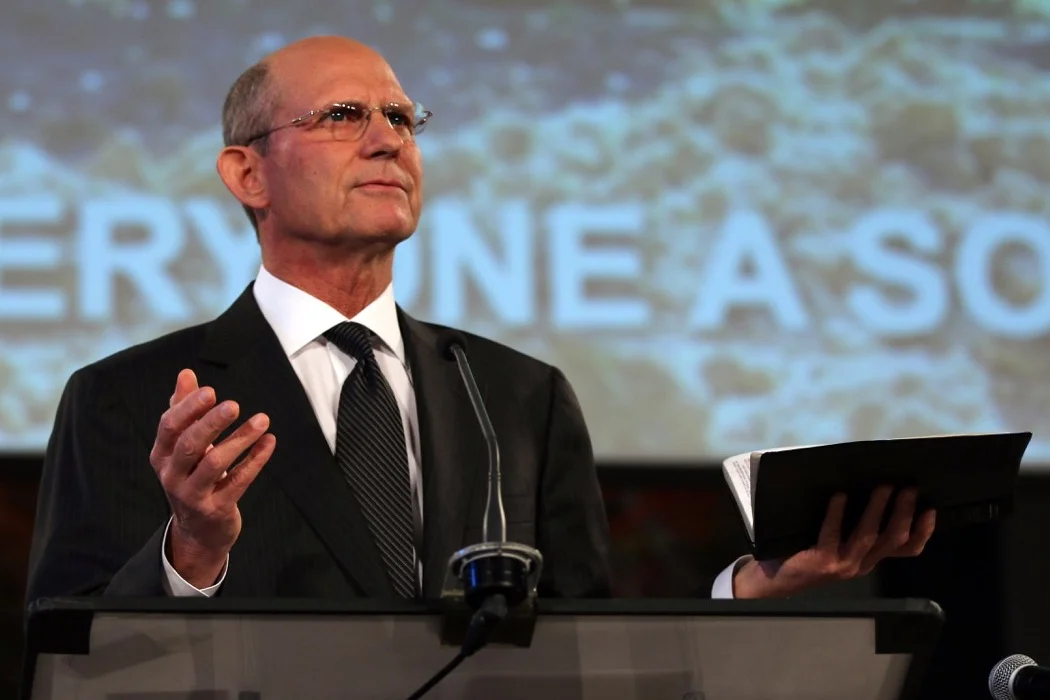
Ted N. C. Wilson served as president of the Seventh-day Adventist world church from 2010 to 2025.