
In the recent chronicle of his journey from secularism to faith, U.S. Vice-President JD Vance introduces his readers to what many would call spiritualism, and what the Bible condemns as necromancy. In the introduction to his book, titled Communion, he writes:
More broadly, I have an open spirit about specific questions of doctrine and faith. For example, some Protestant friends really don’t like the Catholic practice of praying to saints. They’re fine with asking a living person to say a prayer—“Please pray for my mother; she’s sick and needs all the help she can get”—but they draw the line at consulting dead people—“Holy Mary, Mother of God, pray for us sinners, now and at the hour of our death.”
Fair enough, Maybe they’re right. I think they’re wrong. But I’m not here to settle this argument [##1|JD Vance, Communion: Finding My Way Back to Faith (New York: HarperCollins Publishers, 2026), p. 7.##].
Later in the book he returns to his fascination with talking with the dead, in particular his practice of conversing with dead ancestors. Speaking of his decision to purchase his family cemetery in eastern Kentucky, and why, he says:
I walk in that ancient plot of land and speak to people long dead, some of them gone before my grandmother was even born. I’ve visited that cemetery before every major life decision, from proposing to Usha to running for the Senate. I listen to the birds chirp and watch the grasshoppers dance from grave to grave, and I remember that I used to chase the ancestors of those grasshoppers in these very mountains, when the people now buried were alive and breathing and watching over me.
I talk to my grandparents and my great-grandparents, like patron saints of the episodes and emotions we all experience in the course of life. I talk to Mamaw when I need strength or focus and to Papaw when I need wisdom. I talk to Mamaw’s mother, Mamaw Blanton, when I need kindness or empathy and to her father, Papaw Blaine, whom I never met, when I need toughness.
I bought the cemetery for selfless reasons. I wanted to preserve this outdoor temple of the dead for my family and the sake of those buried. But I bought it for selfish reasons, too: for the moments of quiet reflection I find only in this place, unique in all the world. I bought it so that when I am buried, my children will have a place to visit and speak to their ancestors [##2|——Communion, p. 262.##].
A Biblical Response
Vance is quite right that the argument over “consulting dead people” doesn’t need to be settled. The fact is, the Bible settled it long ago.
He would do well to read the following passage from the book of Deuteronomy:
There shall not be found among you any one that maketh his son or his daughter to pass through the fire, or that useth divination, or an observer of times, or an enchanter, or a witch, or a charmer, or a consulter with familiar spirits, or a wizard, or a necromancer.
For all that do these things are an abomination unto the Lord (Deut. 18:10-12).
One wonders if he is familiar with the story of Israel’s King Saul, and the latter’s attempt through the witch of Endor to consult the deceased prophet Samuel (I Sam. 28:7-20). The following day saw the king of Israel dead in battle by his own hand (I Sam. 31:4). Another Bible passage connects Saul’s death directly to his visit to Endor:
So Saul died for his transgression which he committed against the Lord, even against the word of the Lord, which he kept not, and also by asking counsel of one that had a familiar spirit, to enquire of it; and enquired not of the Lord: therefore He slew him, and turned the kingdom unto David the son of Jesse (I Chron. 10:13-14).
In my opinion, Mr. Vance is entirely too generous with those he calls his “Protestant friends,” whom he claims “draw the line at consulting dead people” [##3|——Communion, p. 7.##]. Because the great majority of professed Protestants reject the Biblical teaching of the unconscious state of the dead, many of them believe the apparition summoned by the witch of Endor at Saul’s request was in fact the dead prophet Samuel, who had supposedly died and gone to heaven. The late Walter Martin, in his book The Kingdom of the Cults, speaks as follows regarding the Adventist doctrine of “soul-sleep” (the non-immortality of the soul):
Seventh-day Adventists are welcome to hold this doctrine, but when one is faced with such concrete Old Testament instances as Samuel’s appearance to Saul (I Samuel 28:18-19) and such New Testament accounts as those given by the apostle Paul (2 Corinthians 5:8), “to be absent from the body and to be present with the Lord,” (or (Philippians 1:23) “to depart and to be with Christ, which is far better,” it is difficult to see how our Adventist brethren can sufficiently substantiate their claim for the “sleep of the soul” [##4|Walter Martin, The Kingdom of the Cults (Minneapolis: Bethany House Publishers, 2003), p. 582.##].
It isn’t difficult, of course, for an informed Adventist to refute Martin’s pronouncement here; Paul’s statement about being “absent from the body” and “present with the Lord” (II Cor. 5:8) refers, in context, to the replacement of our earthly bodies with heavenly ones (II Cor. 5:1-4), so “that mortality might be swallowed up of life” (verse 4)—an exchange which, according to the same author, takes place not at death but at the second coming of Christ (I Cor. 15:51-54). And Paul’s declaration, “to depart and to be with Christ” (Phil. 1:23), must be viewed in light of the consensus of both Scripture as a whole and Paul’s own writings, the latter affirming that Christians go to “be with the Lord” not when they die, but when Christ returns, raises the righteous dead, and translates the righteous living (I Thess. 4:16-17).
But most egregiously of all, Martin seems quite unaware of the passage we noted above from First Chronicles, which declares not only that Saul died for consulting the witch of Endor, but that in consulting the witch he “enquired not of the Lord” (I Cor. 10:14). How could this be if, as most conservative Christians believe, the prophet Samuel had died and gone to heaven? Is it possible to consult heavenly beings without God’s permission—and through a means expressly forbidden by God Himself, no less (Deut. 18:12)? That hardly makes sense.
Moreover, Mr. Vance seems unaware of another Biblical problem with the entreaty he cites earlier, “Holy Mary, Mother of God, pray for us sinners, now and at the hour of our death” [##5|Vance, Communion, p. 7.##]. The Bible is absolutely clear that “there is one God, and one mediator between God and man, the man Christ Jesus” (I Tim. 2:5). No reference in Scripture can be found depicting earthly believers approaching God in prayer through any mediator except the Lord Jesus Christ. The objection of classic Protestantism to the Roman Catholic veneration of Mary in this regard is not an arbitrary feature of some antiquated theological dispute, but rather, is based on the unequivocal testimony of God’s eternal Word.
Conclusion
The current Vice-President of the United States needs to study his Bible. First and foremost, the Bible is repeatedly clear that the dead are unconscious (e.g. Job 14:10-12; Psalm 6:5; 115:17; Eccl. 9:5-6; Dan. 12:2; John 5:28-29; 11:11-14), that attempting to communicate with the dead is an abomination to the Lord (Deut. 18:12), and that sorcerers (those who, among other things, try to communicate with the dead) will be lost eternally (Rev. 21:8; 22:15). The righteous dead will be raised to life at the second coming of Jesus (Dan. 12:2; John 5:28-29; I Cor. 15:52; I Thess. 4:16). Until then, they await the call of the heavenly Life-giver.
The Bible warns that in the last days Satan will come “with all power and signs and lying wonders” (II Thess. 2:9), and that Satan’s demons will disguise themselves as ministers of righteousness (II Cor. 11:14-15), much as was done at the behest of the witch of Endor in that cave so long ago. Only God’s Word offers a surety for the faithful, now and in the future. In the ancient prophet’s words:
And when they shall say unto you, Seek unto them that hath familiar spirits, and unto wizards that peep, and that mutter: should not a people seek unto their God? for the living to the dead?
To the law and to the testimony, if they speak not according to this word, it is because there is no light in them (Isa. 8:19-20).
REFERENCES
1. JD Vance, Communion: Finding My Way Back to Faith (New York: HarperCollins Publishers, 2026), p. 7.
2. Ibid, p. 262.
3. Ibid, p. 7.
4. Walter Martin, The Kingdom of the Cults (Minneapolis: Bethany House Publishers, 2003), p. 582.
5. Vance, Communion: Finding My Way Back to Faith (New York: HarperCollins Publishers, 2026), p. 7.
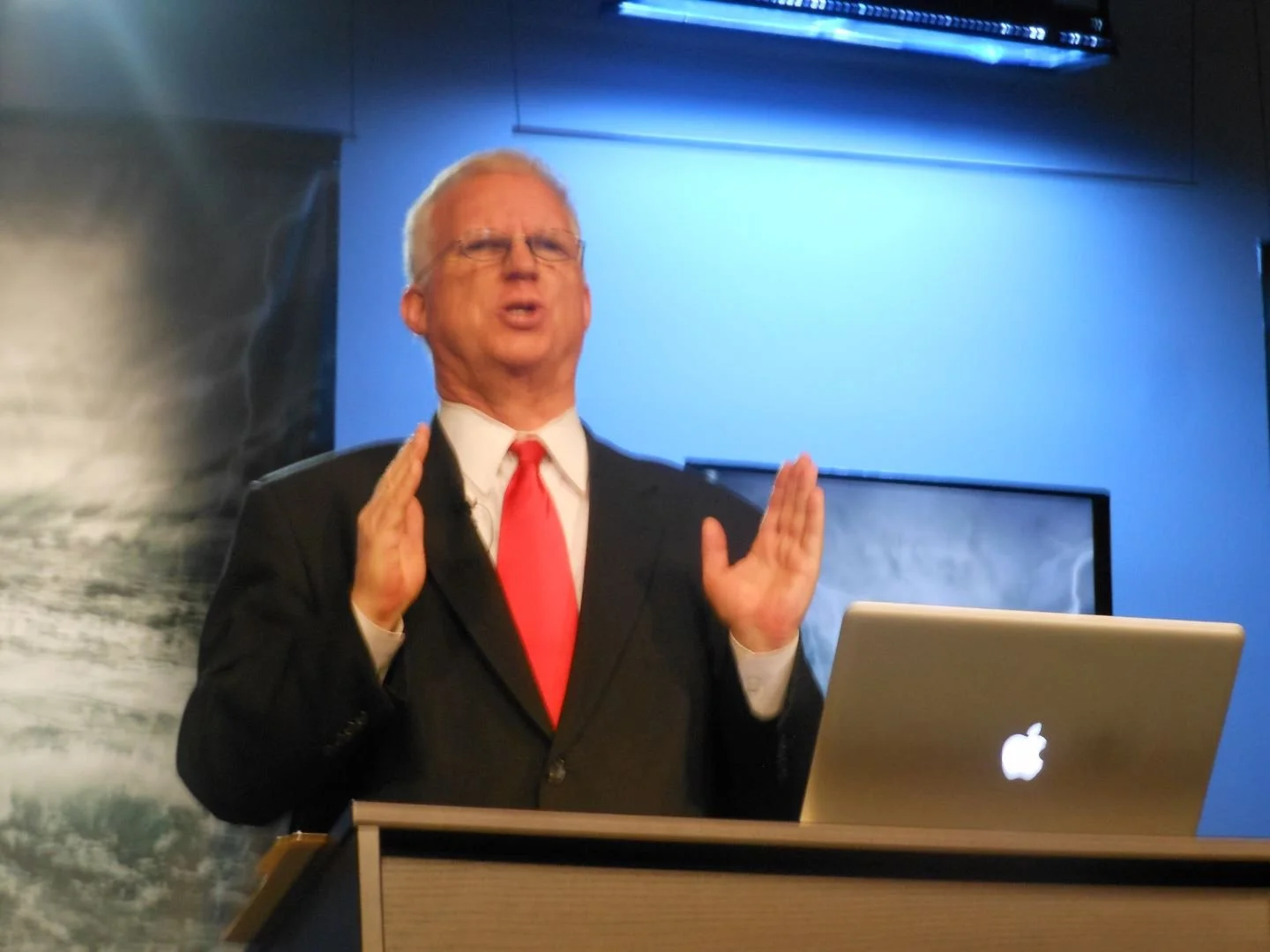
Pastor Kevin Paulson holds a Bachelor’s degree in theology from Pacific Union College, a Master of Arts in systematic theology from Loma Linda University, and a Master of Divinity from the SDA Theological Seminary at Andrews University. He served the Greater New York Conference of Seventh-day Adventists for ten years as a Bible instructor, evangelist, and local pastor. He writes regularly for Liberty magazine and does script writing for various evangelistic ministries within the denomination. He continues to hold evangelistic and revival meetings throughout the North American Division and beyond, and is a sought-after seminar speaker relative to current issues in the Seventh-day Adventist Church. He presently resides in Berrien Springs, Michigan