
NOTE: This article appeared as the Wednesday reading of the Annual Week of Prayer in the September 2025 edition of Adventist World.
William believed he was baptized just in time for the second coming of Jesus. After studying the Bible and becoming familiar with prophecy, he was convinced the final days of earth’s history were imminent. He was relieved that God had reached him when He did. Just a little later, William believed, and he would never have been prepared to meet Jesus at His return.
When William was baptized, Leonid Brezhnev was the leader of the Soviet Union, and Ian Smith was the prime minister of Rhodesia (now Zimbabwe). That same year, the Vietnam War ended, while the Berlin Wall would stand for another 14 years. In 1975 William was convinced he was one of the last who had come to Jesus in time for the Second Coming.
The truth is, there is much we don’t know about the timing of the return of Jesus, other than believing Jesus is coming back “soon.” We have many good reasons for our belief, especially in light of the signs of Jesus’ return as given in Matthew 24 and Luke 21. But apart from “soon,” or “very soon,” we don’t know when Jesus is going to return. As Jesus Himself said: “Of that day and hour no one knows” (Matt. 24:36).
This does not mean that we doubt the imminent return of Jesus. It is the evil servant who says, “My master is delaying his coming” (Matt. 24:48). Although Paul had no need to write to the Thessalonians “concerning the times and the seasons” (1 Thess. 5:1), but did write of God’s people “looking for the blessed hope and glorious appearing of our great God and Savior Jesus Christ” (Titus 2:13).
While We Wait
The apparent delay in Jesus’ return is not all bad news. If Jesus had returned just a few generations ago, no one living today would have everlasting life. And many friends and family members who are not currently walking with Jesus will eventually repent and find their way to the heart of God.
One of Jesus’ parables demonstrates that it is not the timing of His return that is of greatest importance. Addressing people who “thought that the kingdom of God should immediately appear,” Jesus said, “A certain nobleman went into a far country to receive for himself a kingdom, and to return. And he called his ten servants, and delivered them ten pounds, and said unto them, ‘Occupy till I come’ ” (Luke 19:11-13, KJV).
The Greek word used indicates the man was urging his servants to trade or do business with the talents he had given them. And while the parable states that he was leaving and would return, nothing is mentioned about the timing of his return. He simply gives the assurance that he will be back, instructing the servants that they were to occupy until that time. They were to be about his business for as long as it took for him to come back. For those who believe “the kingdom of God should immediately appear,” the message is clear.
If Jesus returns five years from now, God’s people are to occupy for those five years. If He returns in 10, or 20, or 30 years from now, believers in Jesus are to be about their Father’s business for that time. Whether the waiting time is long or short, it is to be employed in service for God, sharing the good news and proclaiming the messages of the three angels.
Let Us Arise
In the book of Nehemiah God’s people return to Jerusalem from Babylon. Although still under Medo-Persian rule, they are granted permission to rebuild Jerusalem and reorder society in what had been a devastated city.
“Then Eliashib the high priest rose up with his brethren the priests and built the Sheep Gate. . . . Next to Eliashib the men of Jericho built. And next to them Zaccur the son of Imri built. Also the sons of Hassenaah built the Fish Gate. . . . And next to them Meremoth the son of Urijah, the son of Koz, made repairs. Next to them Meshullam the son of Berechiah, the son of Meshezabel, made repairs. Next to them Zadok the son of Baana made repairs” (Neh. 3:1-4).
The phrase “next to them” or “after them” appears at least 30 times in Nehemiah 3. During a decisive time for God’s people, they stepped forward and shared the responsibility of doing the work He had given them. This work was so important that the nobles of the Tekoites are mentioned because they “did not put their shoulders to the work of their Lord” (verse 5). It was vital that everyone did his or her part.
Jesus promised that “this gospel of the kingdom will be preached in all the world as a witness to all the nations, and then the end will come” (Matt. 24:14). The everlasting gospel cannot possibly be taken to the world by full-time, paid gospel ministers alone, nor will it go to the world solely by means of electronic media. God grants His people the privilege of sharing their faith in Jesus with others, and when the church rises to the task, the gospel will advance dramatically.
Tom was a keen recreational fisherman. After helping a stranger bring a fish to shore, he and his fellow fisherman became friends. His new friend, Phil, initially showed no interest in religious things, until Tom said to him, “Did you know that Jesus spent a lot of time with fishermen?” Phil, who had no background in the Bible, was intrigued, and surprised Tom by saying, “I’d like to know more about that.”
Bible studies followed, with Phil eagerly receiving the great teachings of Scripture. He began to attend church, accepted Jesus as his personal Savior, grew in his faith, and, before long, was baptized.
But soon after his baptism Phil became ill. Doctors were not able to successfully treat his condition, and he passed away suddenly. At his funeral service the church was filled to overflowing with mourners, many of them fishermen, and many who, like Phil, had no background of faith in God. “It was a blessing to be used by God to reach Phil,” Tom said. Tom even conducted Phil’s funeral service.
It might be a chance meeting at a market, an encounter at work or school, or even the opportunity to help a stranger while fishing, that leads to a life transformed by Jesus. We cannot know exactly when Jesus will return. But it is our privilege to occupy until He does.
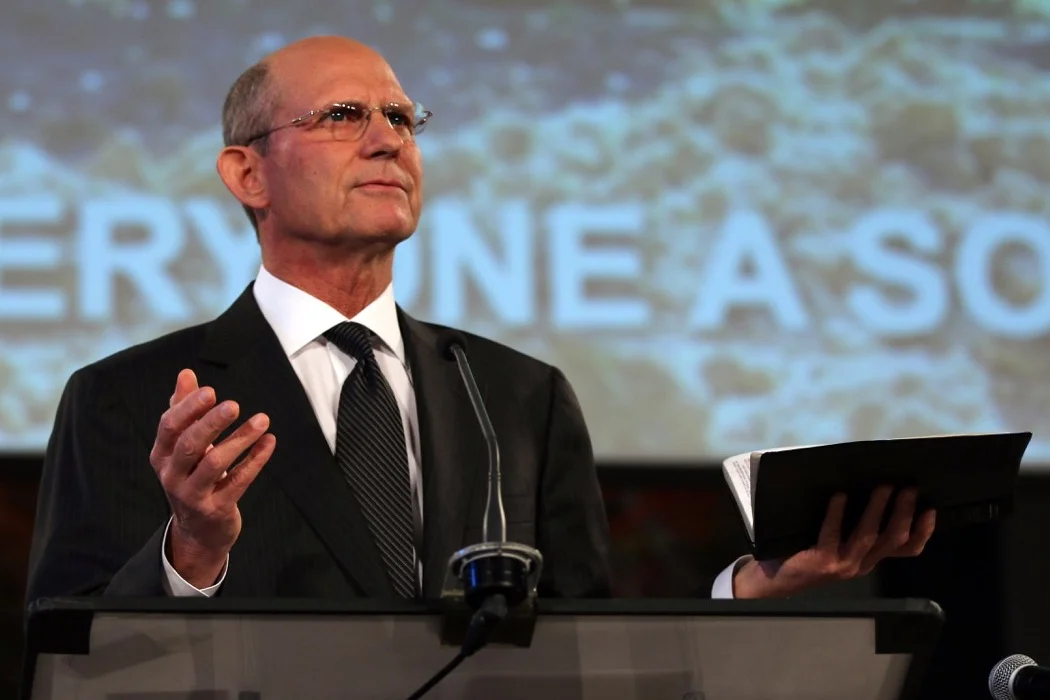
Ted N. C. Wilson served as president of the Seventh-day Adventist world church from 2010 to 2025.