
On January 8, 2026, the Heritage Foundation, a prominent conservative think tank in American politics [1], issued a report titled, “Saving America by Saving the Family” [2]. Framed as a “culture-wide Manhattan Project” [3], the report seeks to avert a demographic collapse before the 250th anniversary of American independence.
Among its most controversial proposals is a call for the restoration of “blue laws” by establishing a “uniform day of rest” on Sundays [4]. The authors argue that a synchronized community pause is necessary to combat “spiritual homelessness” [5]. The proposal explicitly prioritizes “uniformity” over flexibility [6], thus creating a potential legal conflict for Jewish and Seventh-day Adventist communities—among others—who observe their Sabbath on Saturday.
In the report’s own words:
A uniform day of rest that limits commercial activity can provide temporal boundaries that help communities to set aside time for religious observance, family gatherings, outdoor activities, and rest. A stable base of research shows that these practices correlate with better mental health, stronger social bonds, and more stable family structures [7].
Decidedly conservative in its cultural and political leanings, the Heritage Foundation exerts widespread influence within right-of-center political circles in the United States. Such pronouncements as the above cannot, therefore, be written off as inconsequential.
Sunday Laws and the American Religious Right
Readers of this website will recall past articles which have demonstrated that while Sunday law agitation has not been foremost on the agenda of the Religious Right in the United States, it has not been absent from their awareness [8]. The following references, extending over the past four decades and listed in former articles on this site, offer evidence in this regard:
In 1987, the Portland Oregonian reported the following regarding a Republican Party retreat in the state of Oregon while Bob Packwood was still a senator:
He (Packwood) charged that the New Right wants to impose its rigid ideas of theocracy and statism on the party and on this country.
Packwood says this includes a legal ban on abortion, organized prayer in the public schools, and laws attempting to further the belief that the “sabbath is on Sunday” [##9|Jeff Napes, “Packwood Attacks New Right: uproar erupts at retreat,” Portland Oregonian, March 8, 1987.##].
The late televangelist Pat Robertson, in his 1991 book The New World Order, wrote as follows regarding Sunday laws:
Laws in America that mandated a day of rest from incessant commerce have been nullified as a violation of the separation of church and state. In modern America, shopping centers, malls, and stores of every description carry on their frantic pace seven days a week. Before our eyes we watch the increase of chronic burnout, stress breakdown, nervous disorders, and mental and spiritual exhaustion cauterizing the souls of our people [##10|Pat Robertson, The New World Order (Dallas: Word Publishing, 1991), p. 236.##].
Twice in his 1994 book Politically Incorrect: The Emerging Faith Factor in American Politics, Religious Right activist and Christian Coalition director Ralph Reed spoke favorably of Sunday laws [##11|Ralph Reed: Politically Incorrect: The Emerging Faith Factor in American Politics (Dallas: Word Publishing, 1994), pp. 75,132.##].
David Barton, a prominent Religious Right devotee who has served as vice chair of the Texas Republican Party and more recently headed the political action committee Keep the Promise, which supported the 2016 presidential campaign of Texas Senator Ted Cruz [12], wrote the following positive statement in 1992 regarding Sunday laws in nineteenth-century America, describing these as proof of the country’s “Christian” values at the time:
The court, in addressing the seventh-day sabbath of the Jewish religion vs. the first-day sabbath of the Christian religion, . . . emphasized the importance of a uniform national sabbath; in this, a Christian nation, Sunday was to be that day [##13|Bartin, The Myth of Separation: What is the correct relationship between Church and State? (Aledo, TX: Wallbuilder Press, 1992), p. 76.##].
Notice the reference here to a “uniform national sabbath,” language very similar to the new report from the Heritage Foundation. In the same book Barton writes favorably of the following declaration by the 1853 U.S. Senate Judiciary Committee:
Sunday, the Christian Sabbath, is recognized and respected by all the departments of the Government. . . . Here is a recognition by law, and by universal usage, not only of a Sabbath, but of the Christian Sabbath, in exclusion of the Jewish or Mohammedan Sabbath [##14|——Barton, The Myth of Separation, p. 183.##].
And who can forget the apostolic letter of Pope John Paul II on July 30, 1998, titled, Dies Domini (the Day of the Lord), in which he praised the Roman Emperor Constantine’s “legislation of the rhythm of the week” [15]? What is more, many didn’t seem to notice how this same pope declared that one violating the sanctity of Sunday should be “punished as a heretic” [##16|Detroit News, July 7, 1998, p. A1.##]. Anyone familiar with church history can certainly recall the delightful ways in which such punishment was meted out!
More recently, the following statement promoting Sunday laws was written by one Dale Kuehne, who presently serves as director of the New Hampshire Institute of Politics at St. Anselm College in Nashua, New Hampshire, and also serves as senior pastor of the Emanuel Covenant Church in the same town [17]. In his 2009 book Sex and the iWorld, describing how intimate relationships are being trivialized by the immoral onslaught of our day, he offers the following as a solution whereby marital intimacy and family togetherness might be restored in America:
There is a public policy remedy that can be made with no financial cost and that will likely boost profits for businesses and provide all of us with more time for one another: reenact the prohibitions on Sunday shopping and many publicly scheduled activities. The most important reason to do this, apart from any potential financial benefits, is relational. But it will be virtually impossible to achieve this without governmental intervention. As long as Sunday is unregulated, there is an incentive for all stores to stay open so they do not lose their market share. This single change in public policy would do more at less cost to create relational time than anything else we might consider.
There may be those who agree on the importance of a shared day off but would prefer a day other than Sunday. The cultural and political reality, however, is that there will be less resistance to re-regulating Sunday shopping than regulating any other day of the week. If consensus could be built around another day, it would be worth considering, but in the United States, at least, it is hard to imagine any day other than Sunday being protected [##18|Dale S. Kuehne, Sex and the iWorld: Rethinking Relationships beyond an Age of Individualism (Grand Rapids: Baker Publishing Group, 2009(, p. 196.##].
Charlie Kirk, the Sabbath, and Sunday
Considerable attention has recently been drawn to the late Charlie Kirk and his interest in the Sabbath, noted especially in his posthumous book Stop, in the Name of God [##19|Charlie Kirk, Stop, in the Name of God: Why Honoring the Sabbath Will Transform Your Life (Clinton Township, MI: Winning Team Publishing, 2025).##]. An excellent review of this book was published last month in the Adventist Review [20], and has now been republished on our website [21]. What Seventh-day Adventist readers should understand is that while Kirk embraced the seventh-day Sabbath and produced credible arguments in its defense, his book is seriously ambiguous as to which day Christians should observe as the Sabbath. In his words:
As someone who now observes a Saturday Sabbath, I want to be clear. I don’t think the specific day—Saturday or Sunday—is of primary importance” [##22|Kirk, Stop, in the Name of God, p. 194.##].
Kirk’s embrace of the Bible Sabbath did not, however, dampen his zeal for Sunday blue laws. He insisted that such laws do not violate the separation of church and state [##23|——Stop, in the Name of God, p. 74.##], and laments how secularism caused Sunday laws to disappear and that for this reason, “worship became optional” in America [##24|——Stop, in the Name of God, p. 74.##]. Despite his vaunted reverence for religious freedom, Kirk offers the following praise for the colonial Puritans and their legislation of Sunday sacredness:
In no other civilization had a day of rest been so deeply institutionalized. . . . In the American colonies and well into the nineteenth and early twentieth centuries, these values were not merely held by isolated religious communities—they were woven into the cultural and legal fabric of a nation that broadly identified as Christian [##25|——Stop, in the Name of God, pp. 71-72.##].
The assumption was not merely that Sunday was different, but that it must be different—for the sake of the soul, for the sake of the nation [##26|——Stop, in the Name of God, p. 73.##].
It isn’t difficult to see how Kirk’s thinking could easily lend support to a renewed American crusade for Sunday legislation, such as the Heritage Foundation is now promoting.
Sunday Laws and “Moral Reform”
The alleged connection between Sunday legislation and the moral reform of society is noted by Ellen White in the following statement from The Great Controversy:
As the work of Sabbath reform extends, the rejection of the divine law to avoid the claims of the fourth commandment will become well-nigh universal. The teachings of religious leaders have opened the door to infidelity, to spiritualism, and to contempt for God’s holy law; and upon these leaders rests a fearful responsibility for the iniquity that exists in the Christian world.
Yet this very class put forth the claim that the fast-spreading corruption is largely attributable to the desecration of the so-called “Christian sabbath,” and that the enforcement of Sunday observance would greatly improve the morals of society. This claim is especially urged in America, where the doctrine of the true Sabbath has been most widely preached. . . . The leaders of the Sunday movement may advocate reforms which the people need, principles which are in harmony with the Bible; yet while there is with these a requirement which is contrary to God’s law, His servants cannot unite with them [##27|Ellen G. White, The Great Controversy, pp. 587-588.##].
Conclusion
Again we see evidence in the daily news that the predictions of classic Seventh-day Adventist eschatology, as found in Scripture and the writings of the Spirit of Prophecy, are fast fulfilling. May each of us prepare our hearts and lives to meet the pending crisis of the ages, is my prayer.
REFERENCES
1. “The Heritage Foundation” https://en.wikipedia.org/wiki/The_Heritage_Foundation
2. “Saving America by Saving the Family: A Foundation for the Next 250 Years” https://www.heritage.org/sites/default/files/2026-01/SR323.pdf?utm_source=substack&utm_medium=email
3. Ibid, pp. 6-7.
4. Ibid, p. 38.
5. Ibid.
6. Ibid.
7. Ibid.
8. Kevin Paulson, “A New Challenge to Classic Adventist Eschatology,” ADvindicate, May 1, 2020 https://advindicate.com/articles/2019/9/20/paulson-draft-1-s88fl-6mlnf-tyf95-y3hyg-9n5tj-8pwk6-td6yw-3bj83
9. Jeff Napes, “Packwood Attacks New Right: uproar erupts at retreat,” Portland Oregonian, March 8, 1987.
10. Pat Robertson, The New World Order (Dallas: Word Publishing, 1991), p. 236.
11. Ralph Reed, Politically Incorrect: The Emerging Faith Factor in American Politics (Dallas: Word Publishing, 1994), pp. 75,132.
12. “David Barton (author)” https://en.wikipedia.org/wiki/David_Barton_(author)
13. David Barton, The Myth of Separation: What is the correct relationship between Church and State? (Aledo, TX: Wallbuilder Press, 1992), p. 76.
14. Ibid, p. 183.
15. “Apostolic Letter Dies Domini of the Holy Father John Paul II to the Bishops, Clergy, and Faithful of the Catholic Church On Keeping the Lord’s Day Holy,” p. 21. http://www.vatican.va/content/john-paul-ii/en/apost_letters/1998/documents/hf_jp-ii_apl_05071998_dies-domini.html
16. Detroit News, July 7, 1998, p. 1A.
17. https://www.anselm.edu/faculty-directory/dale-kuehne
18. Dale S. Kuehne, Sex and the iWorld: Rethinking Relationships beyond an Age of Individualism (Grand Rapids: Baker Publishing Group, 2009), p. 196.
19. Charlie Kirk, Stop, in the Name of God: Why Honoring the Sabbath Will Transform Your Life (Clinton Township, MI: Winning Team Publishing, 2025).
20. Joe Reeves, “Charlie Kirk’s Stop in the Name of God,” Adventist Review, Dec. 22, 2025 https://adventistreview.org/lifestyle/arts-culture/book-reviews-arts-culture/charlie-kirks-stop-in-the-name-of-god/
21. Joe Reeves, “Charlie Kirk’s Stop, in the Name of God,” Adventist Review, Dec. 22, 2025 https://advindicate.com/articles/2026/1/15/charlie-kirks-stop-in-the-name-of-god
22. Kirk, Stop, in the Name of God, p. 194.
23. Ibid, p. 74.
24. Ibid.
25. Ibid, pp. 71-72.
26. Ibid, p. 73.
27. Ellen G. White, The Great Controversy, pp. 587-588.
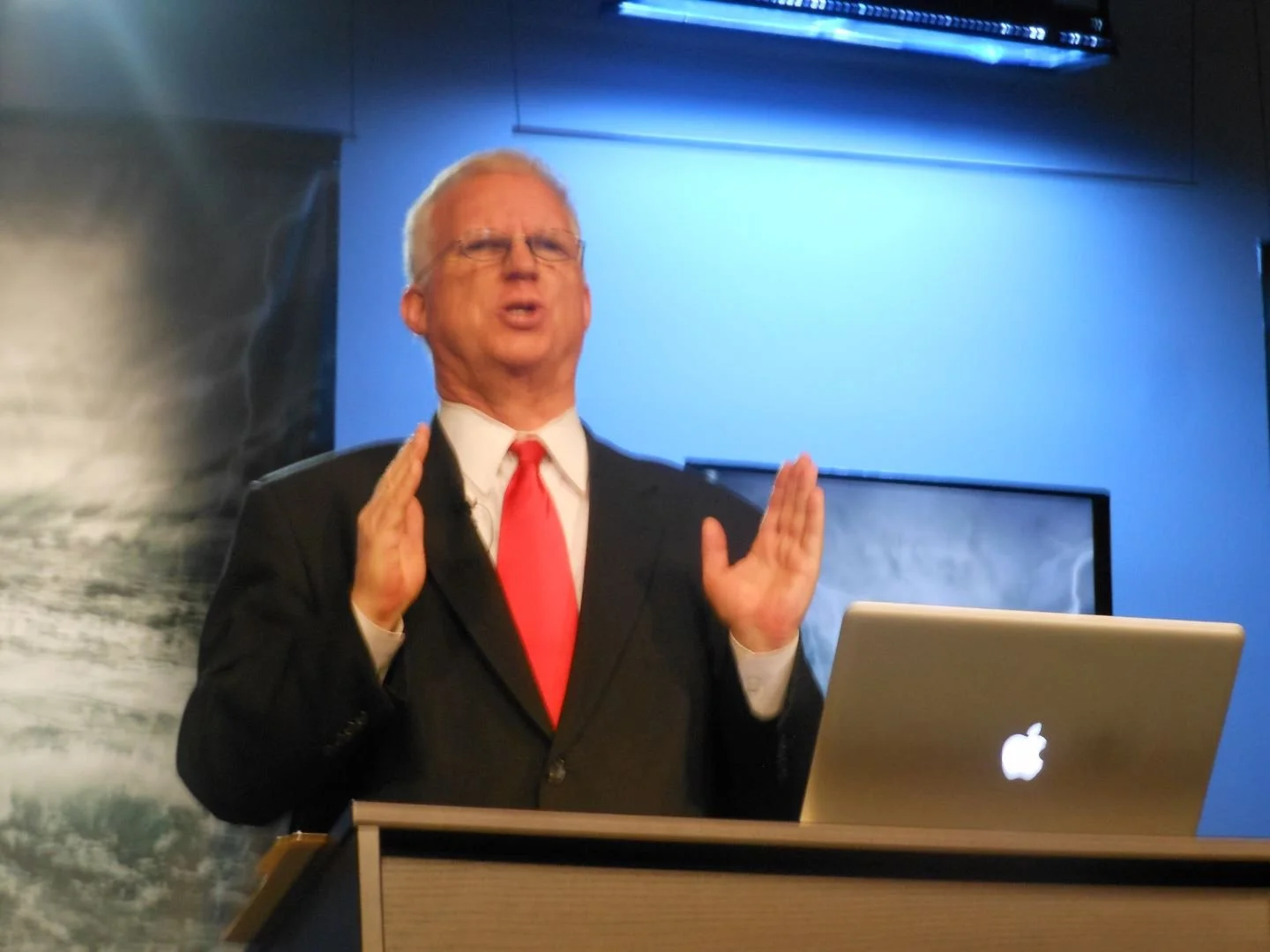
Pastor Kevin Paulson holds a Bachelor’s degree in theology from Pacific Union College, a Master of Arts in systematic theology from Loma Linda University, and a Master of Divinity from the SDA Theological Seminary at Andrews University. He served the Greater New York Conference of Seventh-day Adventists for ten years as a Bible instructor, evangelist, and local pastor. He writes regularly for Liberty magazine and does script writing for various evangelistic ministries within the denomination. He continues to hold evangelistic and revival meetings throughout the North American Division and beyond, and is a sought-after seminar speaker relative to current issues in the Seventh-day Adventist Church. He presently resides in Berrien Springs, Michigan