
Seventh-day Adventist Church President Ted N. C. Wilson today released a State of the Church address in which he updated the denomination on its mission and membership growth and highlighted concerns, including lack of involvement and disunity.
Read MoreGeneral Conference officers respond to SECC
Seventh-day Adventist world church officials today released a statement regarding a local conference that recently elected as president a person who is not recognized by the world church as an ordained minister. Ordination is one of the criteria for being a conference president.
Read MoreSandy Roberts voted SECC president
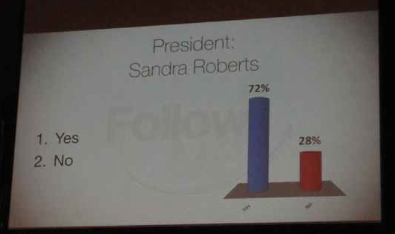
Results of vote on Sandy Roberts' nomination to SECC president: 72% YES and 28% NO
Sandy Roberts' presidential nomination to Southeastern California Conference passed, 72 percent to 28 percent.
Read MoreLive blog: SECC session 2013
Today Southeastern California Conference delegates will vote whether or not to accept Sandra Roberts' nomination to the position of conference president.
The final vote, along with other points of interest, will be published live, right here.
Read MoreFemale nominated for SECC president
Southeastern California Conference (SECC) delegates will vote tomorrow on Sandra E. Roberts' nomination to conference president. The constituency meeting will take place at La Sierra University Church, Calif., at 9 am.
Read MoreWASC visiting team commends La Sierra for revisions to university governance practices
A special visiting team from the Western Association of Schools and Colleges (WASC) has commended La Sierra University for the considerable work the school has completed addressing concerns regarding university governance expressed by the regional accrediting association.
Read MoreLa Sierra University gets 3-year AAA renewal
La Sierra University, a Seventh-day Adventist-owned educational institution in Riverside, California, received a three-year accreditation through 2016, following a vote by the Adventist Accrediting Association (AAA) board, meeting Wednesday, October 9, in Silver Spring, Maryland.
Read MoreGeneral Conference spends nearly one million on great controversy-themed dramatic series
Specialty cocktails greeted attendees at the 21-and-over launch party for the General Conference's trailer for its new web series "The Record Keeper" in San Diego’s Gaijin Noodle and Sake House July 19.
Adventists might wonder how a good-and-bad-angel costume party, serving alcohol Friday night, had anything to do with the church.
Read More
GYC here we come
We're making plans to attend the Generation for Youth Conference (GYC) in Orlando, Fla. Jan. 1-5, 2014. We're excited about attending GYC because of its demographic and size. It's two to three times the size of ASI, and appeals to a younger crowd.
Read MoreIRS approves ADvindicate's 501(c)3 application
We're happy to announce that ADvindicate's application for tax exempt status has been approved as of Sept. 15, 2013.
Read MoreADvindicate Forum
Winner claims his iPad Mini
Just in case you didn't have a chance to visit us at ASI in Orlando, Fla., we've posted some pictures for you.
Read MoreCome visit ADvindicate in Florida

Rosen Shingle Creek Convention Center, Orlando, Fla., where the ASI International Convention will take place.
Pacific Press and Review and Herald will not merge
Citing “differing perspectives as to the interpretation” of Spirit of Prophecy writings about the independences of the two units, a statement issued by church leaders said: “It is felt in the best interest of the publishing work of the church at this time for there to be no change to the governance of the two institutions.”
Read MoreKeene church considering female senior pastor
Senior Pastor Jennifer Scott of the Seventh-day Adventist Church in Shelton, Wash., will interview July 11 for the senior pastor position at the Keene Seventh-day Adventist Church, Tex. Scott's name is at the top of a list of 50 candidates selected by a 25-member search committee. She will also present the sermon at the 9:30 and 11:30 a.m. services July 13 at the Keene church.
Read MoreInfamous 'La Sierra four' recording transcribed
North American Division and General Conference ignore inspired counsel
On Wednesday, June 19, the General Conference and North American Division administrations forwarded to the boards of the Pacific Press Publishing Association and the Review and Herald Publishing Association a request for the two organizations to consider a merger in the near future.
Read MoreLa Sierra constituency approves bylaw revisions 69-10
 Constituency delegates approved a series of changes to La Sierra University’s bylaws during a special meeting held on the campus on May 23. The revised bylaws document passed by a vote of 69-10, or 87 percent, well beyond the two-thirds vote required for passage. The bylaws revisions provide refinement to La Sierra University’s governance, while addressing some concerns about the university’s bylaws expressed since 1996 by the Western Association of Schools and Colleges, La Sierra’s regional accrediting agency.
This follows an information session held on February 21 in which constituents offered feedback and suggestions on the proposed bylaws revisions.
Constituency delegates approved a series of changes to La Sierra University’s bylaws during a special meeting held on the campus on May 23. The revised bylaws document passed by a vote of 69-10, or 87 percent, well beyond the two-thirds vote required for passage. The bylaws revisions provide refinement to La Sierra University’s governance, while addressing some concerns about the university’s bylaws expressed since 1996 by the Western Association of Schools and Colleges, La Sierra’s regional accrediting agency.
This follows an information session held on February 21 in which constituents offered feedback and suggestions on the proposed bylaws revisions.
“We all need to appreciate the difficult task that our Articles and Bylaws Committee members have had to complete,” said Ricardo Graham, Pacific Union president and current La Sierra University board chair. “During their nearly two years of study and review, committee members have listened to constituency delegate feedback, and have used care to ensure the revised bylaws meet current governance needs while reinforcing La Sierra University’s clear and unequivocal connection to the Seventh-day Adventist Church and its mission and philosophy.”
The significant bylaws changes fall into two main areas:
- Changing the way in which the board chair is selected.
- Making clear the specific roles of the Board of Trustees and the university President.
Delegates approved bylaws changes that require, in consultation with Pacific Union Conference officers, La Sierra University’s Board chair to be elected by the board itself from one of the four ex officio member Union officers, rather than automatically being the Union president. This change allows the trustees to select their own chair, while simultaneously ensuring that the chair will always be an officer of the Pacific Union. An additional key limitation would be that neither the chair or vice chair of La Sierra’s board can serve concurrently as chair or vice chair of another university or college board. This resolves Pacific Union Conference’s unique issue in its operation of two institutions. La Sierra University and Pacific Union College both faced questions from the accrediting agency on this issue that are not faced by institutions in the rest of the North American Division.
Since 1990, La Sierra’s board membership has included nine ex officio members (the Pacific Union Conference president, secretary, treasurer, vice president; the Pacific Union Conference education director; the presidents of the Arizona, Southeastern California, and Southern California Conferences; and the university president); and 14 members elected by the constituency. No change in that composition was considered during this process. Additionally, the revised bylaws require all 14 elected trustees be members of the Seventh-day Adventist Church. Previously one elected trustee could be from outside the Church.
The approved bylaws charge the Board of Trustees with ensuring that the mission and major policies of the university reflect the goals and objectives of the Adventist Church. Other changes recognize the limitations of expecting a board to manage day-to-day details of a complex institution.
The board will continue to appoint the president, provost, and vice president for financial administration, and grant tenure to members of the faculty. This allows the board to have direct interaction with the administrative, academic, and financial leaders of the university. It allows trustees to maintain financial oversight of the university, and to establish the policies necessary to university governance. The president is identified as the university officer accountable for implementing the board’s broad policies into daily operations.
Trustees will also focus on providing strategic vision for the university, establishing governing policies, and protecting the university’s assets. The full bylaws document identifies 18 specific governance functions retained by the trustees under the revised bylaws. The full document will be posted on the university website after the bylaws committee completes editorial changes voted by the delegates
“God’s spirit was evident throughout the session,” Graham said. “I appreciated how delegates cared so much about these issues, as demonstrated through the robust discussion and their insightful questions.
“I am optimistic about La Sierra University’s future,” Graham concluded. “The board, administration, and faculty are committed to building this outstanding institution of higher education and developing the Christian commitment of every student.”
For Immediate Release May 23, 2013 Larry Becker lbecker@lasierra.edu
Tax-free bonds limit religious schools' freedom to uphold standards

 Last year, ADvindicate broke the story that La Sierra University had issued $24 million dollars in tax exempt bonds.
Pursuant to the California Supreme Court ruling that allows “pervasively sectarian” schools such as La Sierra University and Cal Baptist University to issue tax-free bonds, the issuing institution is required to sign a solemn covenant stating:
Last year, ADvindicate broke the story that La Sierra University had issued $24 million dollars in tax exempt bonds.
Pursuant to the California Supreme Court ruling that allows “pervasively sectarian” schools such as La Sierra University and Cal Baptist University to issue tax-free bonds, the issuing institution is required to sign a solemn covenant stating:
The Corporation covenants and agrees that no portion of the proceeds of the Bonds will be used to finance or refinance any facility, place or building used or to be used for sectarian instruction or study or as a place for devotional activities or religious worship or in connection with any part of the programs of any school or department of divinity,
This restriction applies for the useful life of any structure financed or refinanced with bond proceeds. Given the language of the covenant—which was repeated several times in the bond documents, and signed by La Sierra President Randal Wisbey and Vice President for Finance, David Geriguis—the public discussion naturally revolved around the secularization of specific buildings and structures financed by tax-free bond money, most notably the Thaine B. Price Science Complex.
But now a California court has ruled that participation in the tax-free bond program effectively secularizes even a private, sectarian university, converting it into a secular business establishment and severely limiting its right to uphold its own religious standards.
The story begins when Domainlor Javier Cabading, an immigrant from the Philippines, enrolled in the nursing program at Cal Baptist University, a private institution in Riverside, California, that is affiliated with the Southern Baptist Convention. The 25 year old Cabading, who goes by the name “Dominique Javier,” is biologically male, but has always identified as female, and hence clicked the “female” box on Cal Baptist's online application form.
In April, 2011, Cabading appeared on the MTV show “True Life” and revealed that “she” was actually a he. “I’m a girl trapped in a guy’s body,” Cabading said on the show. On August 30, 2011, Cabading was expelled from Cal Baptist for “committing or attempting to engage in fraud, or concealing identity,” and for presenting false or misleading information in university judicial processes.
California state law, specifically the Unruh Civil Rights Act (Cal. Civ. Code § 51), prohibits “business establishments” from discriminating based upon several categories—sex, race, color, religion, ancestry, national origin, disability, medical condition, genetic information, marital status, or sexual orientation. The act defines “sex” as including “a person's gender identity and gender expression” and hence outlaws discrimination based upon gender identity. On February 25 of this year, Cabading sued Cal Baptist claiming “she” was expelled because “she” identified and dressed as female, but was biologically male. Cabading is claiming $500,000 in damages.
Cal Baptist demurred, arguing that the Unruh Act did not apply to Cal Baptist University because it is not a “business establishment,” but a private educational institution with a religious mission that integrally includes inculcating religious beliefs and values. Citing a recent case in which a Lutheran high school expelled two female students for sexual impropriety--Doe v. California Lutheran High School Ass'n (2009) 170 Cal.App.4th 828—Cal Baptist asked Judge Matthew Perantoni to dismiss the Unruh Act claims.
Cabading's attorney, Paul Southwick of Davis Wright Tremaine, LLP, argued that Cal Baptist University (“CBU”) had effectively admitted that it was in the secular education business in statements made in connection with issuing the tax-free bonds:
Moreover, as a participant in California Statewide Comm. Dev. Auth. v. All Persons Interested's tax free bond financing program, CBU has obligated itself to demonstrate that, despite its inclusion of a religious viewpoint in otherwise secular classes, “it provides an education that is secular in substance.” California Statewide Comm. Dev. Auth. v. All Persons Interested (2007) 40 Cal.4th 788, 805 fn 9 (“CSCDA”). When an educational institution provides a broad curriculum in secular subjects, “the bond program assists the religious school in providing educational opportunities to California residents, enhancing their employment prospects[.]” Id at 803.
Moreover, CBU joined an amicus brief [in the CSCDA case], promising the court that monies raised through the bonds would be spent exclusively on projects that advanced CSCDA's secular goals and would “not be used for activities that the outside world would typically view as religious or sectarian.” . . . In so doing, CBU holds itself out as an institution whose primary service is to the state and the community, and not to its religious denomination.
Arguing that schools are public if their potential constituency is more public than private, Southwick stated:
The same is true of CBU. However, it is even more public in that it is . . . a beneficiary of a public bond program through which it has raised over $100 million, and is seeking an additional $115 million, to construct educational facilities to be used exclusively in support of secular education.
On May 7th Judge Perantoni sided with Cabading and Southwick, ruling that the lawsuit against Cal Baptist, including the Unruh Act claims, could go forward.
La Sierra University has participated in the same tax free bond program as Cal Baptist. La Sierra admits many non-Adventist students; by some reports, 40% of the student population is non-Adventist. In its bond documents, La Sierra made the same admissions as Cal Baptist regarding the secular nature of its curriculum: “Thus, La Sierra does the things most other universities do: all information and coursework used to teach secular subjects are neutral with respect to religion.” If Cal Baptist loses this case, it will create a precedent that will certainly apply to La Sierra.
Some commentators have already noted that issuing the tax exempt bonds might interfere with La Sierra's ability to uphold its own standards of conduct and deportment. Michael Peabody, who operates the Religiousliberty.TV website, was way ahead of the curve on the issue. In an article on the bond issue published in February (just before the Cabading lawsuit was filed), Peabody wrote:
Finally, when it comes to allowing student clubs on campus, La Sierra may . . . no longer legally prohibit recognition for a gay and lesbian club. This issue made news in November 2012 when a gay and lesbian club was denied recognition because, in the words of the campus spokesperson, the club “does not align with Seventh-day Adventist beliefs on sexuality. La Sierra is a Seventh-day Adventist university, so we support the values of the SDA Church. That is why they were turned down.”
It does not appear that the bond has been used by any parties to expand their rights on campus, but the bond would seem to give many groups a right of legal action in the event that they feel discriminated against by the university because of their religious beliefs. From a religious liberty angle, religious institutions have long held the “right to discriminate” in order to protect their interests and religious missions, but what the California Supreme Court seems to be saying is that they also have the right to contract away some of these protections in return for tax-exempt bond funding.
From the other side of the ideological spectrum, T. Joe Willey, has also suggested that, because of the bond financing, La Sierra may not be able to prevent a homosexual student group from meeting on campus. It is becoming ever clearer that La Sierra was likely wrong when it asserted, through counsel Kent Hansen, that:
The issuance of the bonds does not alter La Sierra's rights of religious preference in employment and student admissions or Adventist standards reflected in the policies of the campus.
The truth is that none of us knew with certainty what legal effect issuing the bonds would have. My own legal analysis turns out to have been less perspicacious than Michael Peabody's, but even a year ago when ADvindicate first broke the tax-free bond story, I noted that the monetary savings were not worth the legal risks of issuing the bonds:
But rather than try to guess how much legal jeopardy La Sierra has placed itself in, the question you should be asking is why? Why would any Seventh-day Adventist institution voluntarily place itself in a position where it may not be able to teach exactly what it wants in exactly the way it wants? Why should we ever, in order to save 2% of interest, promise anyone that we won't teach in a sectarian way, and promote our specific doctrine and worldview? Why would we ever promise that our classes will be “neutral with respect to religion”?
We now have a clearer picture of the problems La Sierra has blundered into by issuing the tax-exempt bonds. The problems are worse than I would have guessed.
Denmark suspends ordinations until 2015 General Conference

According to a statement voted yesterday by the Seventh-day Adventist Danish Union, all future ordinations for new pastors will be suspended until the General Conference session in 2015. Also, it will no longer distinguish between genders when appointing pastors because the special priesthood reserved for men, because of sin, was fulfilled in Christ. Read the unions statement:
 According to the Seventh Day Adventist Church´s belief in creation, as witnessed in the Bible, God has created mankind – man and woman – in His image and therefore equal.
Because of sin, God instituted a special priesthood reserved for men. This special priesthood with its sacrifices and functions found its fulfillment in Jesus Christ. There is no longer any special priesthood. Jesus Christ is our only true priest, the exalted high priest in the true temple in heaven. Now all have free access to God (Hebrews 4-5).
All of Christ's followers – both men and women – were lifted up to be a "chosen generation, a royal priesthood, a holy nation, a peculiar people, to declare His praises" (1 Peter 2:9).
This royal priesthood has a common purpose, namely to proclaim the gospel.
This ministry is based on the spiritual gifts which the Holy Spirit gives equally to men and women (1 Chor 12). Paul mentions some specific grace based ministries in the Church, including apostles, prophets, evangelists, shepherds (i.e. pastors), and teachers (Eph 4:7-16).
With background in this biblical understanding, the Seventh Day Adventist Church in Denmark will not distinguish between genders when appointing pastors, and wishes to see equality between genders in all areas of responsibility. As a result, the Seventh Day Adventist Church in Denmark will suspend the ordaining of any new pastors until the General Conference session in 2015.
Voted at the Danish Union session, May 12, 2013